




Blood pressure is written as two numbers, such as 128/82. Knowing what those numbers mean, and which readings count as high, helps you understand your results and know when to act. In the UK, the thresholds for home readings are lower than for readings taken in a clinic, which often causes confusion.
This guide explains what counts as a high blood pressure reading in the UK, how home and clinic readings differ, which number matters and when a reading needs urgent attention.
Quick answer
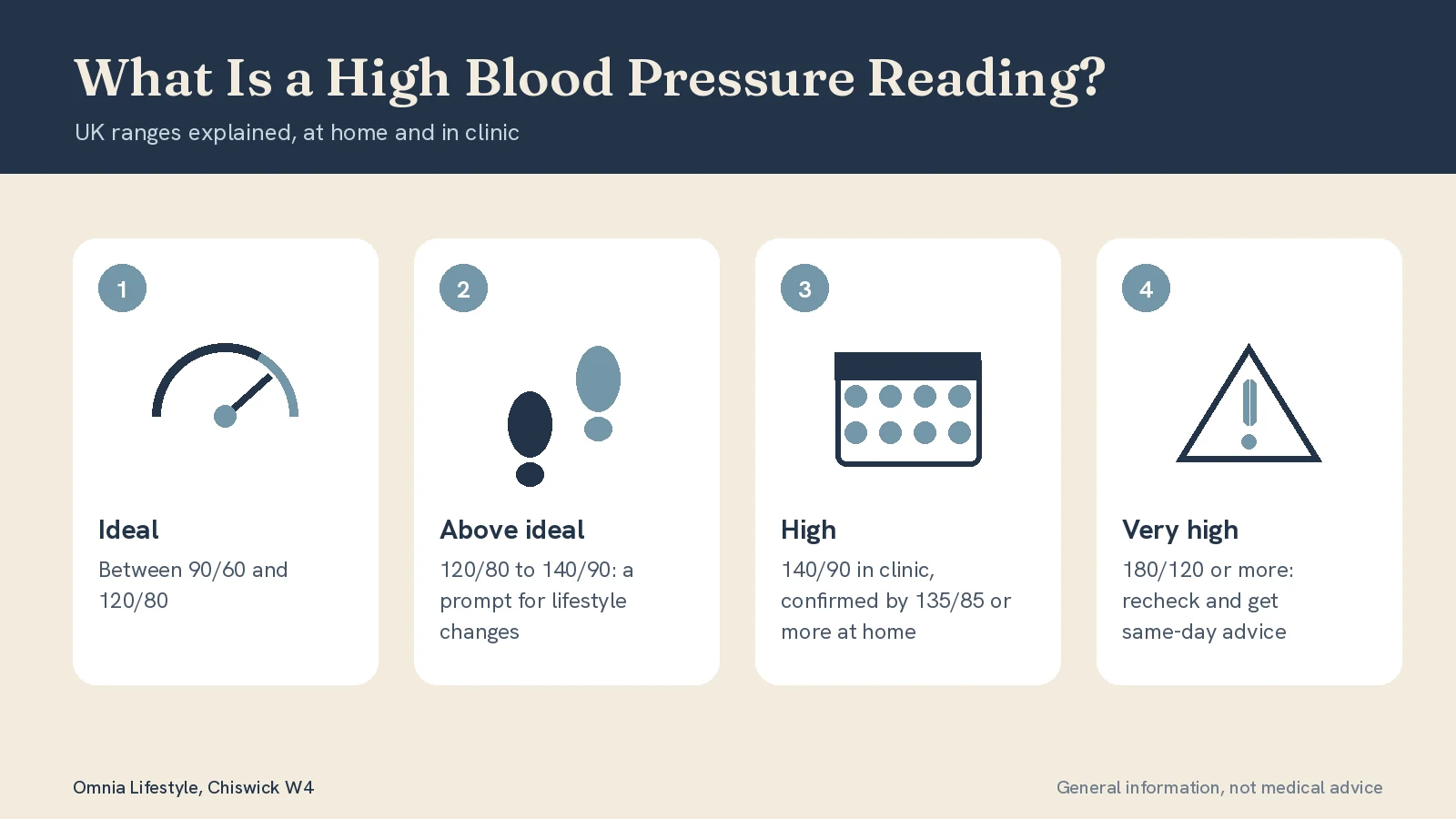
Ideal blood pressure is between 90/60 and 120/80. A clinic reading of 140/90 or higher may mean high blood pressure, but it needs confirming with home or 24-hour readings that average 135/85 or higher. Readings between 120/80 and 140/90 are above ideal and a good prompt for lifestyle changes. A reading of 180/120 or higher is very high and needs same-day medical advice, or a 999 call if it comes with symptoms.
What the two numbers mean
The top number, called systolic pressure, is the pressure in your arteries when your heart beats. The bottom number, called diastolic pressure, is the pressure when your heart rests between beats. Both are measured in millimetres of mercury (mmHg). Either number being above the threshold counts.
UK blood pressure ranges
- Low: below 90/60. Often harmless, but worth discussing with your GP if you feel dizzy or faint.
- Ideal: between 90/60 and 120/80.
- Above ideal: between 120/80 and 140/90 in a clinic. This is not high blood pressure, but your risk is starting to rise.
- Stage 1 high blood pressure: 140/90 to 159/99 in a clinic, with a home or 24-hour average of 135/85 to 149/94.
- Stage 2 high blood pressure: 160/100 or higher in a clinic, with a home or 24-hour average of 150/95 or higher.
- Severe high blood pressure: a clinic reading with a top number of 180 or higher, or a bottom number of 120 or higher.
Why home readings have a lower threshold
Readings taken in a clinic tend to be higher than readings taken at home, partly because many people feel more anxious in a medical setting, known as the white coat effect. For this reason, a home average of 135/85 is treated as equivalent to a clinic reading of 140/90. Some people have the opposite pattern, called masked hypertension, where readings are normal in clinic but high at home, which is one reason home monitoring is so useful.
Which number matters more?
Both matter. The top number tends to rise with age as the arteries stiffen, and in people over 50 it is the stronger predictor of heart attack and stroke. In younger adults, a raised bottom number is more common. If either number is above the threshold, it counts as high.
Does one high reading mean you have high blood pressure?
No. Blood pressure changes throughout the day with activity, stress, caffeine, talking and even the size of the cuff. A diagnosis is made from repeated readings, usually with a 24-hour monitor or a week of home readings, not from a single measurement.
How to take accurate readings at home
- Use a validated upper-arm monitor with the right cuff size
- Sit quietly for five minutes with your back supported and your arm resting at heart level
- Take two readings a minute apart, morning and evening, for seven days
- Ignore the first day's readings and average the rest
- Avoid caffeine, exercise and smoking for 30 minutes beforehand
Targets once you are being treated
For adults under 80, the usual target is below 140/90 in a clinic, or below 135/85 at home. For adults aged 80 and over, it is below 150/90 in a clinic, or below 145/85 at home. Your doctor may set a different target if you have diabetes, kidney disease or another condition.
What to do if your reading is high
If your readings are above ideal, this is a good time to make changes: less salt, more activity, a healthy weight, less alcohol and better sleep. If your home average is 135/85 or higher, see your GP, who can confirm the diagnosis and assess your overall heart risk. For the causes, see what causes high blood pressure, and for practical steps, how to lower blood pressure naturally.
When to seek medical help
Call 999 if a very high reading comes with chest pain, a severe headache, breathlessness, confusion, changes in your vision, difficulty speaking, or weakness, numbness or drooping on one side of the face or body.
If a reading is 180/120 or higher and you feel well, sit quietly for five minutes and measure again. If it is still that high, contact your GP the same day or call NHS 111.
If you are pregnant and your reading is 140/90 or higher, or you have a severe headache, vision problems or sudden swelling of the face, hands or feet, contact your maternity unit the same day.
See your GP if:
- Your home average is 135/85 or higher
- Your readings are low and you feel dizzy or faint
- Your blood pressure stays above target despite treatment
Frequently asked questions
Is 140/90 high blood pressure?
In a clinic, 140/90 is the UK threshold for high blood pressure, but the diagnosis needs confirming with home or 24-hour readings averaging 135/85 or more.
Is 130/80 a good blood pressure?
It is above ideal but below the UK threshold for high blood pressure. It is a useful prompt to make lifestyle changes before it rises further.
What blood pressure is dangerous?
A reading of 180/120 or higher is considered severe. With symptoms such as chest pain, a severe headache or confusion, call 999.
Does blood pressure go up with age?
The top number tends to rise with age as the arteries stiffen. It is common, but it still increases risk and is worth treating.
Blood pressure support in Chiswick
Lifestyle support for healthy blood pressure is available at Omnia Lifestyle in Chiswick, W4, close to Turnham Green station, on bus routes 94, E3 and 272. Limited parking is available on request when booking. We work alongside your GP's care and never change or advise stopping prescribed medicine.
Read more about high blood pressure, see whether high blood pressure makes you tired, explore fitness and nutrition coaching, an InBody scan and blood tests, or book an appointment.
This article is general information, not medical advice. If you have any of the warning signs listed above, seek medical attention.


.jpg)
.jpg)