




Your blood test report has arrived, and it is a page of abbreviations, numbers and flags. Some results are marked high or low, some are in red, and it is not always clear which ones matter. This guide explains how to read a blood test report: what the reference range means, why a flagged result is not automatically a problem, what the common abbreviations stand for, and when a result needs prompt attention.
Looking for a test rather than help reading one? See every blood test and price at our Chiswick clinic.
Quick answer
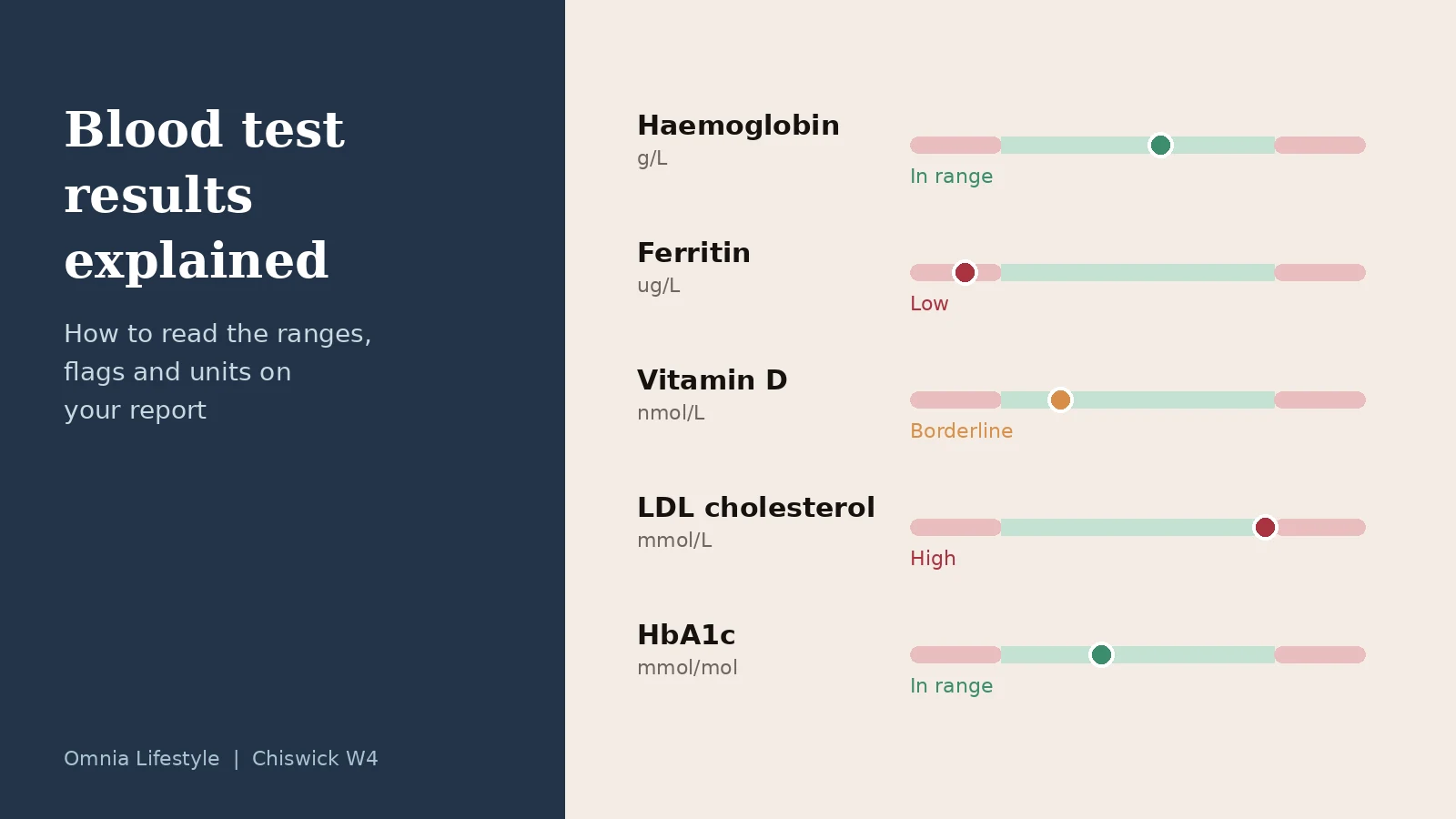
Each result on your report sits beside a reference range, which shows where about 95 percent of healthy people fall. A result outside that range is flagged high or low, but because 1 in 20 healthy people sit outside any given range by chance, a single flag is a prompt to look closer, not a diagnosis. What matters is how far outside the range a result is, whether related markers agree, how you feel, and whether the result is changing over time. Anything marked as urgent or critical, or any result that comes with new symptoms, should be discussed with a doctor the same day.
What the reference range means
A reference range is worked out by testing a large group of healthy people and taking the middle 95 percent of their results. It is a description of what is common, not a line between healthy and unwell. Two things follow from that.
First, about 1 in 20 healthy people will fall just outside the range for any one marker. On a panel of 50 markers, a couple of mild flags in a perfectly healthy person is normal.
Second, sitting inside the range does not guarantee everything is fine. A ferritin at the very bottom of the range in someone with tiredness and hair shedding may still be worth acting on.
Ranges also differ slightly between laboratories, and some change with age, sex and pregnancy, so always read a result against the range printed on your own report.
High, low and colour flags
Most reports mark results with H for high and L for low, or colour them green, amber and red. A flag tells you a result is outside the range. It does not tell you how much that matters. A potassium slightly above range in a sample that sat too long before testing is very different from a potassium far above range in someone who feels unwell.
A useful way to think about any flag is to ask three questions: how far outside the range is it, do related markers point the same way, and does it fit with how I feel?
Units on UK reports
- mmol/L for glucose, cholesterol, triglycerides, sodium, potassium and urea
- mmol/mol for HbA1c. Some countries use a percentage instead, so online calculators can be confusing
- nmol/L for vitamin D. US sources use ng/mL, where the numbers are about 2.5 times smaller
- micrograms per litre (µg/L) for ferritin
- g/L for haemoglobin, and x109/L for white cells and platelets
Common abbreviations
Full blood count (FBC)
Hb is haemoglobin, the oxygen carrier; low means anaemia. MCV is the average size of red cells; small cells usually point to low iron, large cells to low B12 or folate. WBC is the white cell count, and PLT is platelets. See what a full blood count shows.
Kidney function (U&E)
Urea and electrolytes: sodium, potassium, urea and creatinine. eGFR is an estimate of how well the kidneys filter, worked out from creatinine, age and sex. An eGFR above 90 is normal; 60 to 89 can be normal for age if there are no other signs of kidney damage.
Liver function (LFT)
ALT and AST are enzymes released when liver cells are irritated, for example by alcohol, fatty liver or some medicines. ALP and GGT relate to the bile ducts, and ALP also comes from bone. Bilirubin is a breakdown product of red cells; a mild rise on its own is often Gilbert's syndrome, a common harmless variant. Albumin is a protein made by the liver.
Cholesterol (lipid profile)
LDL is the cholesterol linked to heart disease, HDL is protective, and non-HDL is total cholesterol minus HDL, which many UK clinicians now use to judge risk. Triglycerides rise after meals and with alcohol, so they are best measured fasting.
Blood sugar
HbA1c shows average blood sugar over about three months. In the UK, 42 to 47 mmol/mol is the pre-diabetes range and 48 or above suggests diabetes, which a doctor confirms.
Thyroid (TFT)
TSH is the signal from the brain to the thyroid. A high TSH usually means an underactive thyroid; a low TSH usually means an overactive one. FT4 and FT3 are the thyroid hormones themselves.
Iron, vitamins and inflammation
Ferritin reflects iron stores; see what low ferritin means. 25-OH vitamin D is the standard vitamin D measure; see the vitamin D blood test. CRP rises with infection and inflammation.
Why results can be misleading
- Not fasting raises glucose and triglycerides
- Hard exercise in the previous 24 to 48 hours raises creatine kinase and can nudge liver enzymes
- Dehydration concentrates the sample
- A recent cold or infection raises CRP, white cells and ferritin
- Time of day matters for testosterone and cortisol, which are highest in the morning
- Biotin supplements can interfere with thyroid and some hormone tests
- A delayed sample can falsely raise potassium
Look at the trend, not one result
One test is a snapshot. Two or three tests over months or years, under the same conditions and ideally at the same laboratory, show whether something is stable, improving or drifting. A cholesterol that has risen steadily over three years tells you more than a single reading. See how often to have a blood test.
When a result needs prompt attention
Get same-day medical advice, from your GP or NHS 111, if:
- Your report or the laboratory marks a result as critical or urgent
- A result is far outside the range and you feel unwell
- You have new symptoms such as chest pain, breathlessness, fainting, confusion or bleeding, whatever your results say
Book a routine GP appointment if:
- A result is outside the range on a repeat test
- Several related markers are abnormal together
- You have low iron without a clear reason, especially if you are a man or after the menopause
Frequently asked questions
What does a red flag on my blood test mean?
It means the result is outside the laboratory's reference range. It does not mean something is wrong. Look at how far outside the range it is, whether related markers agree and how you feel.
Can I read my own blood test results?
You can understand a lot with the right context, but results are best interpreted alongside your symptoms, medicines and history by someone trained to read them.
Should I share private results with my GP?
Yes, especially anything abnormal, so it is on your record and can be acted on.
Why is my result normal but I still feel unwell?
Normal results mean those particular markers are unremarkable, which is useful information. It is a reason to keep looking at other causes with your GP, not to stop.
Blood testing in Chiswick
At Omnia Lifestyle in Chiswick, W4, every blood test is analysed by Randox, an ISO/IEC 15189 accredited laboratory, and every result is explained to you by a practitioner rather than sent as a PDF. We are two minutes from Turnham Green station, on bus routes 94, E3 and 272, and limited parking is available on request when booking.
Start with Omnia Essential (£90), the Standard Screen (£127), or a comprehensive Randox Everyman or Randox Everywoman (£313), or see every blood test and price.
This article is general information, not medical advice. Blood test results should be interpreted by a qualified clinician alongside your symptoms and history. If you feel unwell, see your GP.



.jpg)
.jpg)