


Book at our Chiswick clinic
Blood Test
A cholesterol test gives you several numbers, not one, and each tells you something different about your heart and circulation. Knowing what a healthy level looks like for each, and how your result fits with the rest of your health, turns a confusing printout into something you can act on.
This guide explains every number on a typical UK cholesterol result, the healthy ranges the NHS uses, why your overall risk matters more than any single figure, and the practical steps that bring cholesterol down.
Quick answer
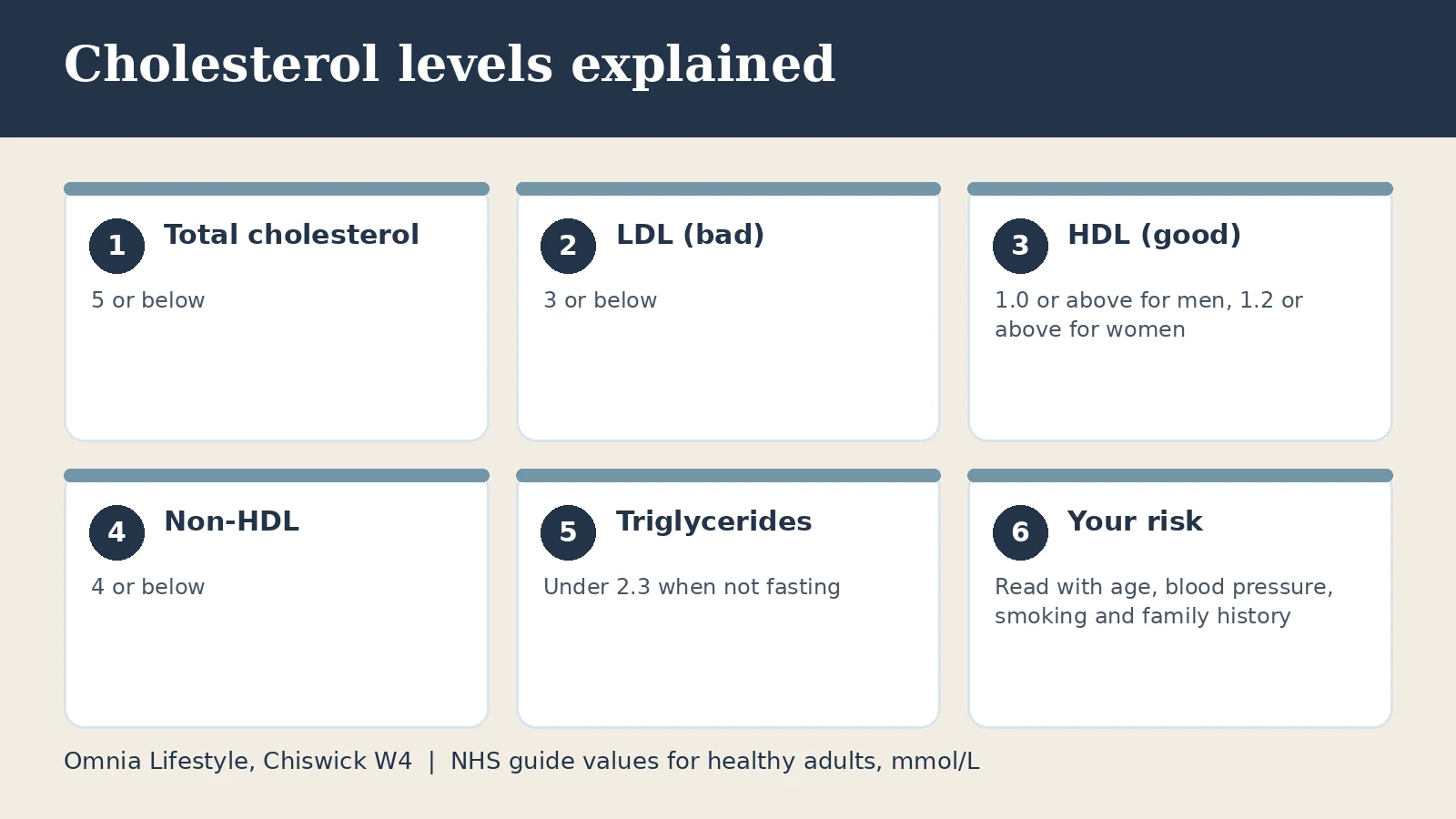
For healthy adults in the UK, the NHS suggests total cholesterol of 5 mmol/L or below, LDL (bad) cholesterol of 3 or below, HDL (good) cholesterol of 1.0 or above for men and 1.2 or above for women, non-HDL cholesterol of 4 or below and non-fasting triglycerides under 2.3. These are guides, not pass marks: your doctor reads them alongside your age, blood pressure, smoking, diabetes and family history to work out your overall risk of heart disease and stroke.
What cholesterol is
Cholesterol is a fatty substance your body needs to build cells and make hormones and vitamin D. It travels in the blood inside particles called lipoproteins. Some carry cholesterol into the artery walls, where over many years it can build up into the fatty plaques that narrow arteries and cause heart attacks and strokes. Others carry cholesterol away to the liver to be cleared. That is why the type of cholesterol matters as much as the total.
Every number on your result, explained
Total cholesterol
The sum of all the cholesterol in your blood. A healthy level is generally 5 mmol/L or below. On its own it is a blunt measure, because it includes the protective HDL as well as the harmful types.
LDL cholesterol
Low-density lipoprotein, often called bad cholesterol, is the main type that builds up in artery walls. A level of 3 mmol/L or below is the usual target for healthy adults, and lower targets apply for people who already have heart disease or diabetes.
HDL cholesterol
High-density lipoprotein, often called good cholesterol, carries cholesterol away from the arteries to the liver. Higher is generally better: 1.0 mmol/L or above for men and 1.2 or above for women.
Non-HDL cholesterol
Your total cholesterol minus your HDL. It captures all the potentially harmful particles in one figure and is increasingly used by doctors in the UK. A healthy level is 4 mmol/L or below.
Triglycerides
A different type of blood fat, raised by excess weight, alcohol, sugary foods and poorly controlled diabetes. Non-fasting triglycerides are usually considered healthy under 2.3 mmol/L, and fasting levels at 1.7 or below. Very high triglycerides, above 10 mmol/L, need prompt review with your GP because of the risk of pancreatitis.
Total cholesterol to HDL ratio
Your total cholesterol divided by your HDL. A lower ratio is better: a ratio of 4 or below is ideal, and above 6 is generally considered high risk. It is one of the figures used in heart risk calculators.
ApoB and Lp(a)
More detailed panels include apolipoprotein B (ApoB), which counts the number of harmful particles, and lipoprotein(a), a largely inherited particle that raises heart risk independently of your other numbers. Lp(a) barely changes with diet or exercise, so most adults only need it measured once. A raised Lp(a) is a reason to manage every other risk factor more carefully.
Why your overall risk matters more than one number
Two people with the same cholesterol can have very different risks. Doctors in the UK usually calculate your chance of a heart attack or stroke over the next ten years using a tool called QRISK, which combines cholesterol with age, sex, ethnicity, blood pressure, smoking, diabetes, kidney disease and family history. National guidance recommends offering a statin to people whose ten-year risk is 10 per cent or more, after discussing the benefits and side effects, alongside lifestyle changes.
Blood pressure is the other big modifiable risk. See what counts as a high blood pressure reading.
When cholesterol is very high
A total cholesterol above 7.5 mmol/L, especially with a family history of heart disease at a young age, can point to familial hypercholesterolaemia, an inherited condition that affects around 1 in 250 people. It needs assessment by your GP, because it is very treatable and close relatives may need testing too.
Do I need to fast for a cholesterol test?
Usually not. Cholesterol levels change very little after eating, so most tests are done without fasting. Fasting may be advised if your triglycerides were high on a previous test or if your panel includes fasting glucose. See whether you need to fast before a blood test.
How to lower your cholesterol
- Swap saturated fat for unsaturated fat. Cut back on fatty meat, butter, cream, cheese, pastries and coconut oil, and use olive or rapeseed oil, nuts, seeds and oily fish instead.
- Eat more soluble fibre. Oats, barley, beans, lentils, fruit and vegetables help lower LDL.
- Move more. Aim for at least 150 minutes of moderate activity a week, such as brisk walking or cycling. Exercise raises HDL and lowers triglycerides.
- Stop smoking. Smoking lowers HDL and damages artery walls.
- Cut down on alcohol and sugar, which raise triglycerides.
- Lose excess weight, particularly around the waist.
Lifestyle changes typically lower LDL by a modest amount, often around 5 to 15 per cent, and lower overall risk further by improving blood pressure, weight and blood sugar. For people at higher risk, or with inherited high cholesterol, medication is usually needed as well. Always discuss treatment with your GP.
How often should cholesterol be checked?
The NHS Health Check offers adults aged 40 to 74 a cholesterol test every five years. People with raised cholesterol, a strong family history or other risk factors often check more frequently, and anyone making changes to diet or starting treatment usually retests after about three months. See how often to have a blood test.
Frequently asked questions
Is a cholesterol level of 6 high?
A total cholesterol of 6 mmol/L is above the healthy guide of 5, but what it means depends on how much of it is HDL and on your overall risk. Look at your LDL, non-HDL and ratio, and discuss your ten-year risk with your GP.
Can you have high cholesterol and be slim?
Yes. Genes play a large part, and slim, active people can still have high LDL or a raised Lp(a). That is why testing matters even if you feel healthy.
Can high HDL be too high?
Very high HDL, above about 2.3 mmol/L, does not seem to add extra protection and occasionally reflects other conditions or heavy alcohol use. It is worth mentioning to your doctor.
Do eggs raise cholesterol?
For most people, eggs eaten as part of a balanced diet have a small effect on blood cholesterol. Saturated fat has a much larger effect.
Does stress raise cholesterol?
Stress can affect cholesterol indirectly through diet, sleep, alcohol and activity. Managing it supports heart health in many ways.
Cholesterol testing in Chiswick
Omnia Lifestyle offers private cholesterol testing at 8 to 9 Bedford Corner, The Avenue, Chiswick W4 1LZ, close to Turnham Green station, on bus routes 94, E3 and 272. Limited parking is available on request when booking. Samples are analysed by the Randox accredited laboratory, no GP referral is needed, and a practitioner goes through your results with you.
Choose a cholesterol test on its own or the 13-marker heart health panel with LDL, HDL, ApoB and Lp(a), add it to a wider check such as the Standard Screen, compare every blood test and price, or read how to read your blood test results.
This article is general information, not medical advice. Discuss your results and any treatment with your GP or practitioner.
Ready to book?
Blood Test



.jpg)
.jpg)