


Book at our Chiswick clinic
Blood Test
Vitamin D is one of the most commonly tested nutrients in the UK, and with good reason. From October to March the sun in Britain is too weak for the skin to make enough, and many people start the spring low without knowing it. A simple blood test shows where you stand, but the result is only useful if you know how to read it.
This guide explains what your vitamin D level means, the ranges used in the UK, the symptoms of low vitamin D, who is most at risk, how much to take, and how to avoid taking too much.
Quick answer
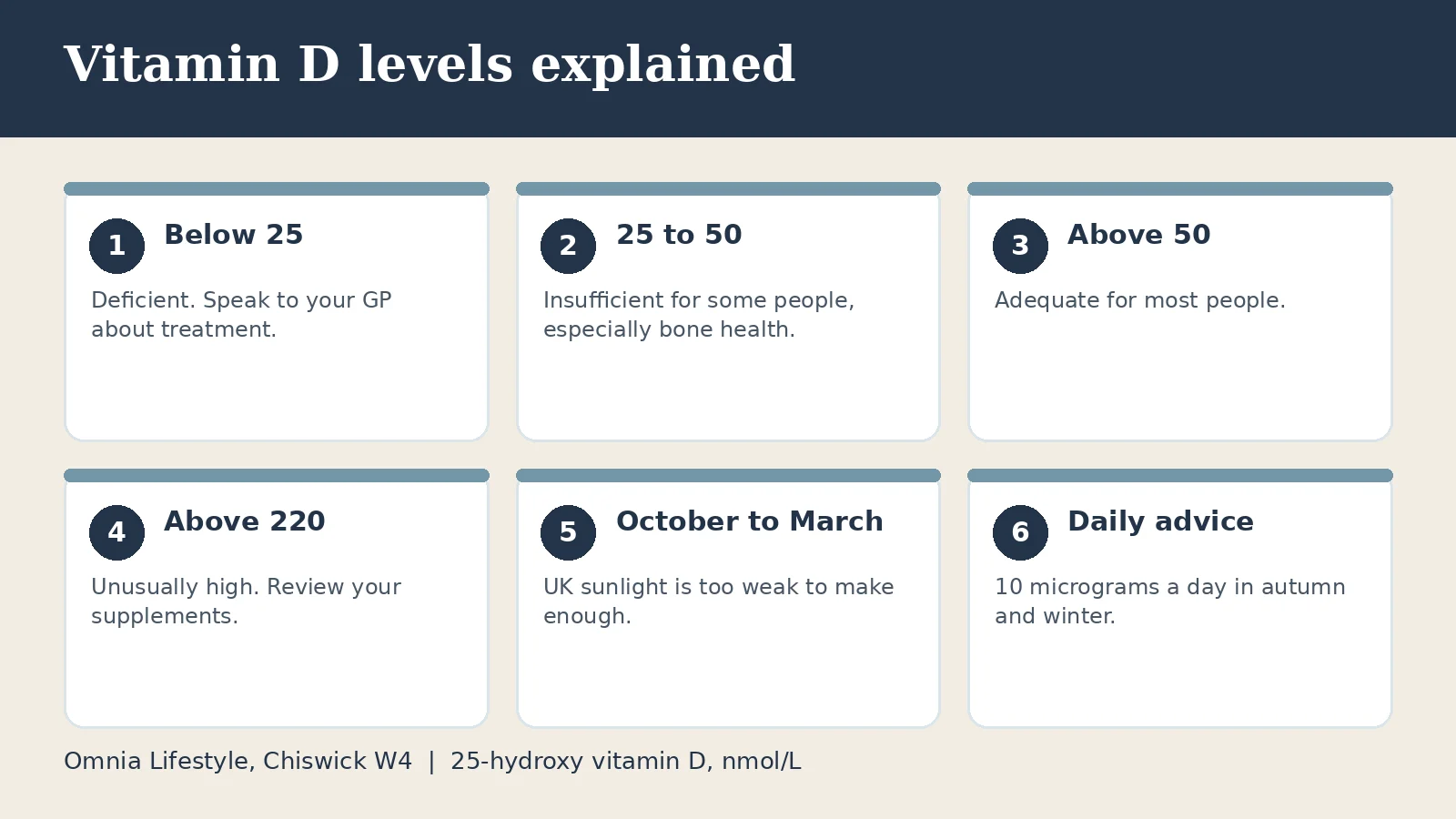
Vitamin D is measured as 25-hydroxy vitamin D in nmol/L. In the UK, below 25 is generally considered deficient, 25 to 50 may be insufficient for some people, and above 50 is adequate for most. The NHS advises everyone to consider 10 micrograms (400 IU) a day from October to March, and all year round if you are rarely outdoors or cover most of your skin. A low result is usually treated by your GP with a higher dose for a few weeks, then a maintenance dose.
What vitamin D does
Vitamin D helps the body absorb calcium and phosphate from food, which keeps bones, teeth and muscles healthy. Long-term deficiency can cause bone pain and weakness, and in severe cases softening of the bones, called osteomalacia in adults and rickets in children. It also plays a part in muscle function and the immune system, although many of the wider claims made for vitamin D are not yet backed by strong evidence.
What your result means
- Below 25 nmol/L: deficient. Treatment is usually recommended, typically a higher loading dose prescribed or advised by your GP, then a daily maintenance dose.
- 25 to 50 nmol/L: insufficient for some people. A daily supplement is usually advised, especially through autumn and winter, and particularly for people with bone problems or risk factors for osteoporosis.
- 50 to 75 nmol/L: adequate. Most people do not need treatment. Following the NHS advice on winter supplements keeps you in this range.
- Above 75 nmol/L: generally fine. Some laboratories use 75 as their target for people with osteoporosis or on bone treatment.
- Above about 220 nmol/L: unusually high. This is almost always from high-dose supplements and is a reason to review what you are taking with your GP or pharmacist.
Reference ranges vary slightly between laboratories, so always read your result against the range printed on your report.
Symptoms of low vitamin D
Many people with low vitamin D have no symptoms at all. When symptoms do occur they are often vague:
- Tiredness and low energy
- Aching bones, particularly in the lower back, hips and legs
- Muscle weakness or cramps, sometimes making stairs or getting up from a chair harder
- Frequent infections in some people
Because these symptoms overlap with many other conditions, including low iron, thyroid problems and poor sleep, testing is more useful than guessing. Our Tired All The Time blood test checks vitamin D alongside the other common causes of fatigue.
Who is most at risk
- Everyone in the UK from October to March
- People who are rarely outdoors, including those who are housebound or work long indoor hours
- People who usually cover most of their skin when outdoors
- People with darker skin, such as those of African, African-Caribbean or South Asian heritage, who need more sun to make the same amount of vitamin D
- People living with obesity
- Older adults, because the skin makes less vitamin D with age
- People with conditions that affect absorption, such as coeliac disease or Crohn's disease, or who take certain medicines, such as some anti-epilepsy drugs
How much vitamin D should I take?
The NHS advises that adults and children over four consider 10 micrograms (400 IU) a day during autumn and winter, and all year if they are in a higher-risk group. If a blood test shows deficiency, your GP may recommend a short course of a higher dose to bring levels up, followed by a maintenance dose.
Do not take more than 100 micrograms (4,000 IU) a day unless a doctor has advised it. Taking too much for a long time can raise calcium levels in the blood, which can affect the kidneys and heart. Check the total from all your supplements, because vitamin D is often included in multivitamins and calcium tablets too.
Getting vitamin D from sun and food
From late March to the end of September, most people in the UK can make enough vitamin D from short periods of sunlight on the skin, typically around midday, without burning. Food provides only small amounts: oily fish such as salmon, sardines and mackerel, egg yolks, red meat and fortified foods such as some breakfast cereals and plant milks.
When to test, and when to retest
Testing is most useful if you have symptoms, risk factors or bone problems, or if you want to know whether your supplement is working. Levels are naturally lowest in late winter and early spring. If you start or change a supplement, wait around three months before retesting, because levels take time to settle. Vitamin D does not need fasting before the test.
Frequently asked questions
Is 40 nmol/L vitamin D low?
It is in the insufficient range for many people. A daily supplement of at least 10 micrograms is usually advised, and your GP may suggest more if you have symptoms or bone problems.
Is 30 nmol/L too low?
It is just above the deficiency threshold of 25 and is considered insufficient. Most people at this level are advised to take a daily supplement and retest after about three months.
Which vitamin D supplement is best?
Vitamin D3 (cholecalciferol) is the form most commonly recommended. Taking it with a meal containing some fat may help absorption.
Can low vitamin D cause hair loss?
Low vitamin D has been linked with some types of hair loss, but low iron and thyroid problems are more common causes. Testing all three gives a clearer picture.
Should I take vitamin K2 with vitamin D?
There is not yet enough evidence to recommend vitamin K2 routinely for everyone taking standard doses of vitamin D. Ask your GP or pharmacist if you take blood thinners.
Vitamin D testing in Chiswick
Omnia Lifestyle offers private vitamin D testing at 8 to 9 Bedford Corner, The Avenue, Chiswick W4 1LZ, close to Turnham Green station, on bus routes 94, E3 and 272. Limited parking is available on request when booking. Samples are analysed by the Randox accredited laboratory, no fasting or GP referral is needed, and a practitioner explains your result and what to do next.
Book a vitamin D blood test, read our vitamin D blood test FAQ, compare every blood test and price, or read how to read your blood test results.
This article is general information, not medical advice. Speak to your GP or pharmacist before taking high-dose supplements.
Ready to book?
Blood Test



.jpg)
.jpg)