






Book at our Chiswick clinic
Blood Test
Your thyroid is a small gland in the front of your neck that sets the pace of your metabolism. It affects your energy, weight, mood, temperature, heart rate and periods. A thyroid blood test shows whether the gland is making too little hormone, too much, or about the right amount.
The key results are TSH, free T4 and free T3, often with thyroid antibodies. This guide explains what each one means, the common result patterns, how UK guidance from NICE and the British Thyroid Association (BTA) approaches borderline results, and when to get help.
Test it in Chiswick: our Thyroid blood test costs £59, with your result explained in person by a practitioner. No GP referral needed. Book this test or call 020 4515 0000. Prefer to test at home? A home finger-prick kit is also available, ask us when you enquire.
Quick answer
TSH is the most sensitive thyroid marker. A typical adult range is about 0.4 to 4.0 mU/L, with free T4 about 9 to 25 pmol/L and free T3 about 3.5 to 7.8 pmol/L, although ranges vary between laboratories. A high TSH with a low free T4 suggests an underactive thyroid. A low TSH with a high free T4 or free T3 suggests an overactive thyroid. A slightly high TSH with a normal free T4 is called subclinical hypothyroidism and is usually rechecked before any treatment.
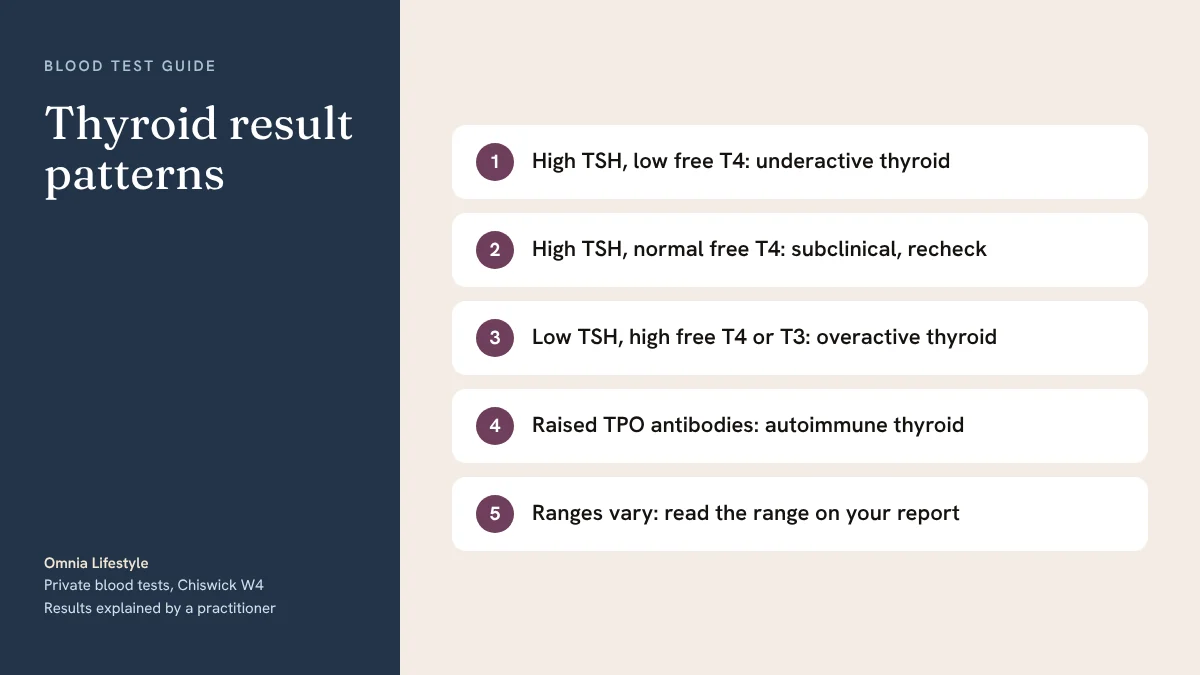
What each thyroid marker means
TSH (thyroid stimulating hormone)
TSH is made by the pituitary gland in the brain and tells the thyroid how hard to work. It moves in the opposite direction to thyroid hormone: when the thyroid is slow, TSH rises to push it harder, and when the thyroid is overactive, TSH falls. NICE advises TSH as the first test for most adults.
Free T4 (free thyroxine)
T4 is the main hormone the thyroid makes. It is a storage form that the body converts into the active hormone, T3. NICE advises measuring free T4 when TSH is outside the range.
Free T3 (free tri-iodothyronine)
T3 is the active hormone that acts on your cells. It is mainly useful for diagnosing an overactive thyroid and judging how severe it is, so NICE advises measuring it when TSH is low.
TPO and thyroglobulin antibodies
Thyroid peroxidase (TPO) antibodies are raised in Hashimoto's thyroiditis, the main cause of an underactive thyroid in the UK, and sometimes in Graves' disease. Thyroglobulin antibodies are sometimes raised in Hashimoto's. Antibodies can be positive in people whose thyroid is working normally, where they suggest a higher chance of thyroid problems in future. NICE suggests checking TPO antibodies when TSH is raised, and says the test does not need repeating.
Thyroid result patterns
- High TSH, low free T4: suggests an underactive thyroid (hypothyroidism), which usually needs treatment with levothyroxine.
- High TSH, normal free T4: subclinical hypothyroidism. Often rechecked, especially if you have raised antibodies or symptoms.
- Low TSH, high free T4 or free T3: suggests an overactive thyroid (hyperthyroidism), which needs specialist assessment and treatment.
- Low TSH, normal free T4 and free T3: subclinical hyperthyroidism, usually monitored with repeat tests.
- Low TSH, low free T4: may point to a pituitary problem, or to a temporary effect of serious illness rather than the thyroid itself.
Subclinical results: what NICE NG145 says
A borderline TSH is common and often settles. NICE suggests considering levothyroxine for adults whose TSH is 10 mU/L or higher on 2 separate occasions 3 months apart. For adults under 65 with symptoms and a TSH above the range but below 10 on 2 occasions 3 months apart, NICE suggests considering a 6-month trial of levothyroxine. If subclinical hypothyroidism is not treated, NICE suggests checking TSH and free T4 once a year if there are features such as raised antibodies or previous thyroid surgery, or every 2 to 3 years if not.
Symptoms
An underactive thyroid can cause tiredness, feeling cold, weight gain, constipation, low mood, poor concentration, dry skin and hair, hair loss, a croaky voice and irregular or heavy periods. An overactive thyroid can cause anxiety, irritability, poor sleep, feeling hot, weight loss, a fast or irregular heartbeat, trembling and a swelling in the neck (goitre). Many of these symptoms have other causes, which is why a blood test helps.
When to see your GP or get urgent help
- See your GP if you have symptoms of an under or overactive thyroid, a new lump or swelling in your neck, or a result outside the range.
- Ask for an urgent GP appointment or contact NHS 111 if you have a fast or irregular heartbeat, or symptoms are getting worse quickly.
- Call 999 or go to A&E for a sudden, severe flare of overactive thyroid symptoms (a thyroid storm), extreme drowsiness or confusion in someone with an untreated underactive thyroid, or neck swelling that makes it hard to breathe or swallow.
Who should test
The British Thyroid Foundation suggests asking about a thyroid test if you have thyroid symptoms, neck swelling, a fast or irregular heartbeat, high cholesterol, osteoporosis, fertility problems, or a family history of autoimmune disease. It is also worth checking if you feel unwell after having a baby, or are planning a pregnancy with a past thyroid problem.
Preparing for the test and retesting
Fasting is not usually needed for thyroid tests on their own. Biotin, found in many hair, skin and nail supplements, can interfere with some thyroid tests: NHS laboratory advice is ideally to skip it on the day of your test, and to leave at least 8 hours after a high dose. Tell us about all medicines and supplements, including levothyroxine, and if you are pregnant, as ranges are different in pregnancy. Once a thyroid condition is treated and stable, a check about once a year is typical, with more frequent tests after a dose change.
Frequently asked questions
Is a TSH of 5 high?
It is slightly above many laboratory ranges. If your free T4 is normal, this is subclinical hypothyroidism, and NICE guidance is to repeat the test about 3 months later before deciding on treatment.
What do positive TPO antibodies mean?
They show your immune system is reacting to your thyroid, most often in Hashimoto's. With normal TSH and free T4, they mean a higher chance of developing an underactive thyroid later, so periodic checks make sense.
Can my TSH be normal and my thyroid still be a problem?
Rarely. Pituitary problems can give a normal or low TSH with low free T4, which is why NICE advises testing free T4 as well if a pituitary problem is suspected.
Should I stop biotin before a thyroid test?
Yes. Ideally skip it on the day of the test, and allow at least 8 hours after a high-dose supplement.
Do I need free T3?
Free T3 is most helpful when an overactive thyroid is suspected. Our Thyroid test includes it, so you have the full picture.
Thyroid testing in Chiswick
We take your sample at our clinic at 8 to 9 Bedford Corner, The Avenue, Chiswick, London W4 1LZ. We are a short walk from Turnham Green station (District line, with Piccadilly line trains stopping there early morning and late evening only) and close to the 94, E3 and 272 bus routes. Limited parking is available on request when you book. Your sample is analysed at the Randox accredited laboratory, no GP referral is needed, and most results are ready within a few working days. A practitioner explains your result with you in person, and a GP feedback report is available on request.
Book the Thyroid blood test (TSH, free T4, free T3 and both antibodies), or choose the Hormone and Thyroid Panel to check thyroid and sex hormones together. You can also explore our women's health blood tests, compare every blood test and price, or read about blood tests for hair loss and blood tests for brain fog.
This article is general information, not medical advice. Discuss your results with your GP or practitioner.
Ready to book?
Blood Test




.jpg)
.jpg)
