





Gout is a type of inflammatory arthritis caused by crystals of uric acid forming in a joint. An attack is often described as one of the most painful things a person can experience: it comes on quickly, usually in a single joint, and makes it hot, red, swollen and extremely tender.
This guide explains what a gout attack feels like, where it happens, the early signs, how long it lasts, what else can feel similar and when you need same-day help.
Quick answer
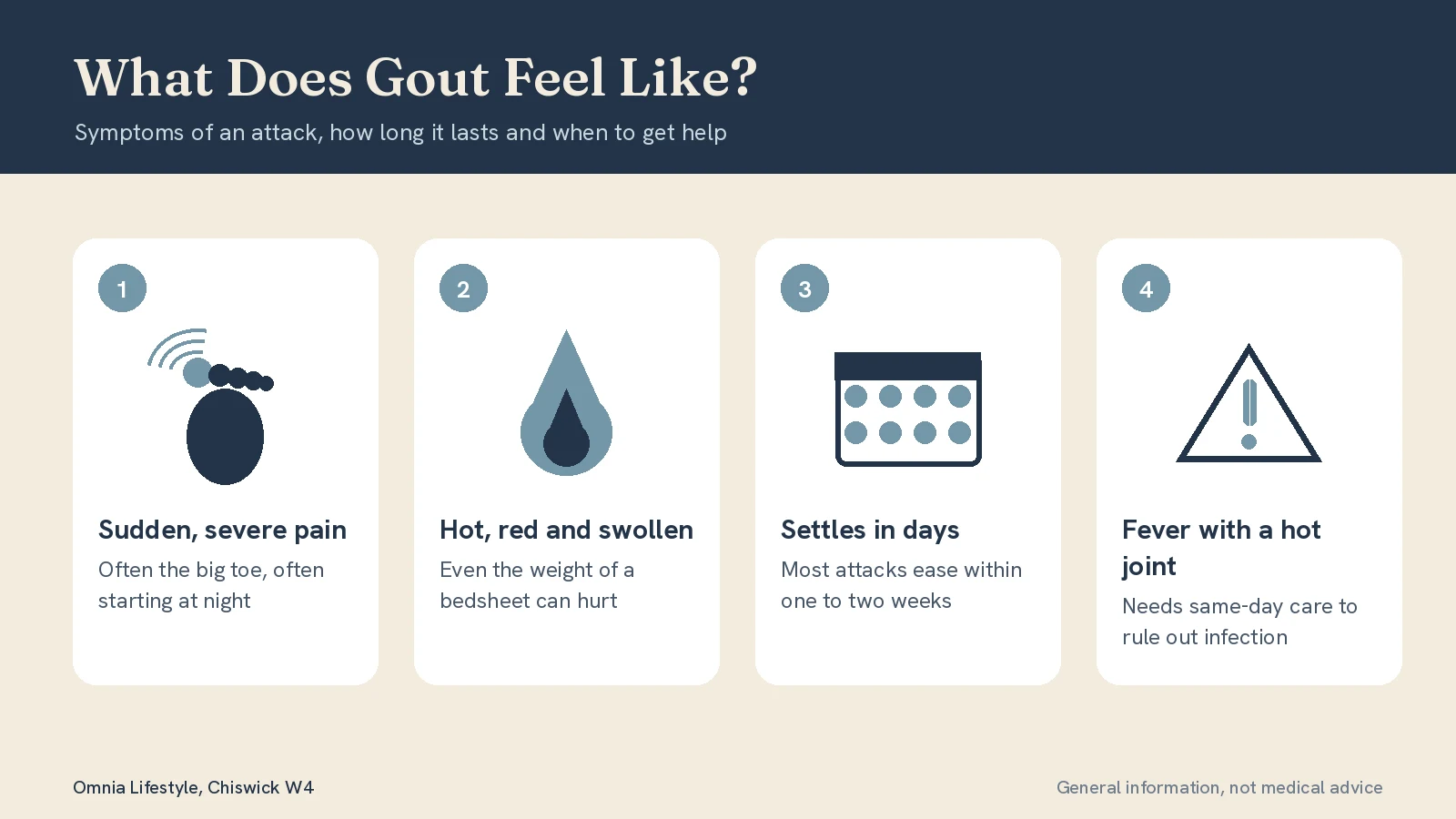
Gout usually feels like a sudden, severe, throbbing or crushing pain in one joint, most often the base of the big toe. It often starts at night or in the early morning and builds over a few hours. The joint becomes hot, swollen and red or purple, and so tender that even the weight of a bedsheet can be unbearable. Most attacks settle within a week or two.
What a gout attack feels like
- Sudden onset. Pain often wakes people in the night or is there on waking, and gets rapidly worse over a few hours, usually peaking within a day.
- Intense pain. People describe it as throbbing, crushing, burning or like a broken bone.
- Extreme tenderness. Light touch, a sock or a bedsheet can be very painful.
- Heat and swelling. The joint feels hot and looks swollen.
- Red or purple, shiny skin over the joint, which may peel as the attack settles
- Difficulty walking or putting a shoe on when the foot is affected
- Feeling unwell. Some people have a mild temperature during an attack.
Where gout happens
The joint at the base of the big toe is the most common site, especially for a first attack. Gout can also affect the top of the foot, the ankle, the knee, the wrist, the fingers and the elbow. Attacks usually affect one joint at a time, although several joints can be involved, especially after years of repeated attacks.
Early signs
Some people notice a warning a few hours before an attack, such as tingling, burning, mild aching or stiffness in the joint. Between attacks, most people have no symptoms at all, which is why gout is easy to ignore until the next flare.
How long a gout attack lasts
Most attacks peak within 12 to 24 hours and settle within three to ten days, and treatment started early can shorten them. Without long-term treatment, attacks tend to return more often, last longer and affect more joints. Over years, uric acid crystals can collect under the skin as firm, painless lumps called tophi, often around the toes, fingers, elbows or ears, and can damage joints.
What else can feel like gout
- A joint infection (septic arthritis), which also causes a hot, swollen, painful joint and is a medical emergency
- Pseudogout, caused by a different type of crystal, which most often affects the knee or wrist
- Cellulitis, a skin infection that causes spreading redness and heat
- An injury, such as a fracture or sprain
- Other types of arthritis, such as osteoarthritis or rheumatoid arthritis, which usually build up more gradually
Because a joint infection can look identical to gout, a first attack, or any attack with fever, needs to be assessed the same day. For how other types compare, see what arthritis feels like.
How gout is diagnosed
Your GP can often diagnose gout from your symptoms and an examination. A blood test measures uric acid, but levels can be normal during an attack, so the test is often repeated at least two weeks after it settles. Sometimes fluid is taken from the joint to look for crystals and rule out infection, and an ultrasound or a specialised scan may be used.
What helps during an attack
- Rest the joint and raise it
- Apply an ice pack wrapped in a towel for up to 20 minutes at a time
- Keep bedclothes off the joint, for example with a pillow or frame under the covers
- Drink plenty of water
- Speak to your GP or pharmacist promptly about treatment, as anti-inflammatory medicines or colchicine work best when started early
- If you already take a urate-lowering medicine such as allopurinol, keep taking it during an attack unless your doctor advises otherwise
To understand triggers and prevention, see what causes gout.
When to seek medical help
Call 999 or go to A&E if a hot, swollen joint comes with feeling very unwell, confusion, fast breathing, shivering or mottled skin, as these can be signs of a serious infection.
Get same-day medical advice, from your GP or NHS 111, if:
- This is your first attack of a hot, red, swollen joint
- You have a high temperature or feel generally unwell with a painful joint
- The pain is severe and not improving within two days
See your GP if:
- You have had more than one attack
- You notice lumps under the skin near a joint
- You have had kidney stones
Frequently asked questions
Why is gout worse at night?
Attacks often start at night, possibly because of lower body temperature in the feet, mild dehydration overnight and changes in hormone levels during sleep, all of which can encourage crystals to form.
Can gout affect both feet at once?
It usually affects one joint at a time, but several joints can be involved, especially in people who have had gout for many years.
Can you walk with gout?
During an attack in the foot, walking is often very difficult. Rest the joint until the pain eases, then return to normal movement gradually.
Does gout feel like a sprain?
It can, but gout usually starts without any injury, comes on over hours, and causes more heat, redness and tenderness than a typical sprain.
Gout support in Chiswick
Support between gout attacks, including uric acid blood tests and nutrition coaching, is available at Omnia Lifestyle in Chiswick, W4, close to Turnham Green station, on bus routes 94, E3 and 272. Limited parking is available on request when booking. An acute attack needs your GP, and we work alongside their care.
Read more about gout and joint pain, see whether arthritis is hereditary, explore blood tests, fitness and nutrition coaching and physiotherapy, or book an appointment.
This article is general information, not medical advice. If you have any of the warning signs listed above, seek medical attention.



.jpg)
.jpg)