




Soft tissue injuries, such as muscle strains, ligament sprains, tendon problems and bruises, are the most common injuries in sport and everyday life. One of the first questions people ask is how long it will take to heal. The honest answer depends on which tissue is injured, how badly, and how well the recovery is managed.
This guide explains typical healing times for common soft tissue injuries, the stages of healing, what speeds recovery and what slows it down.
Quick answer
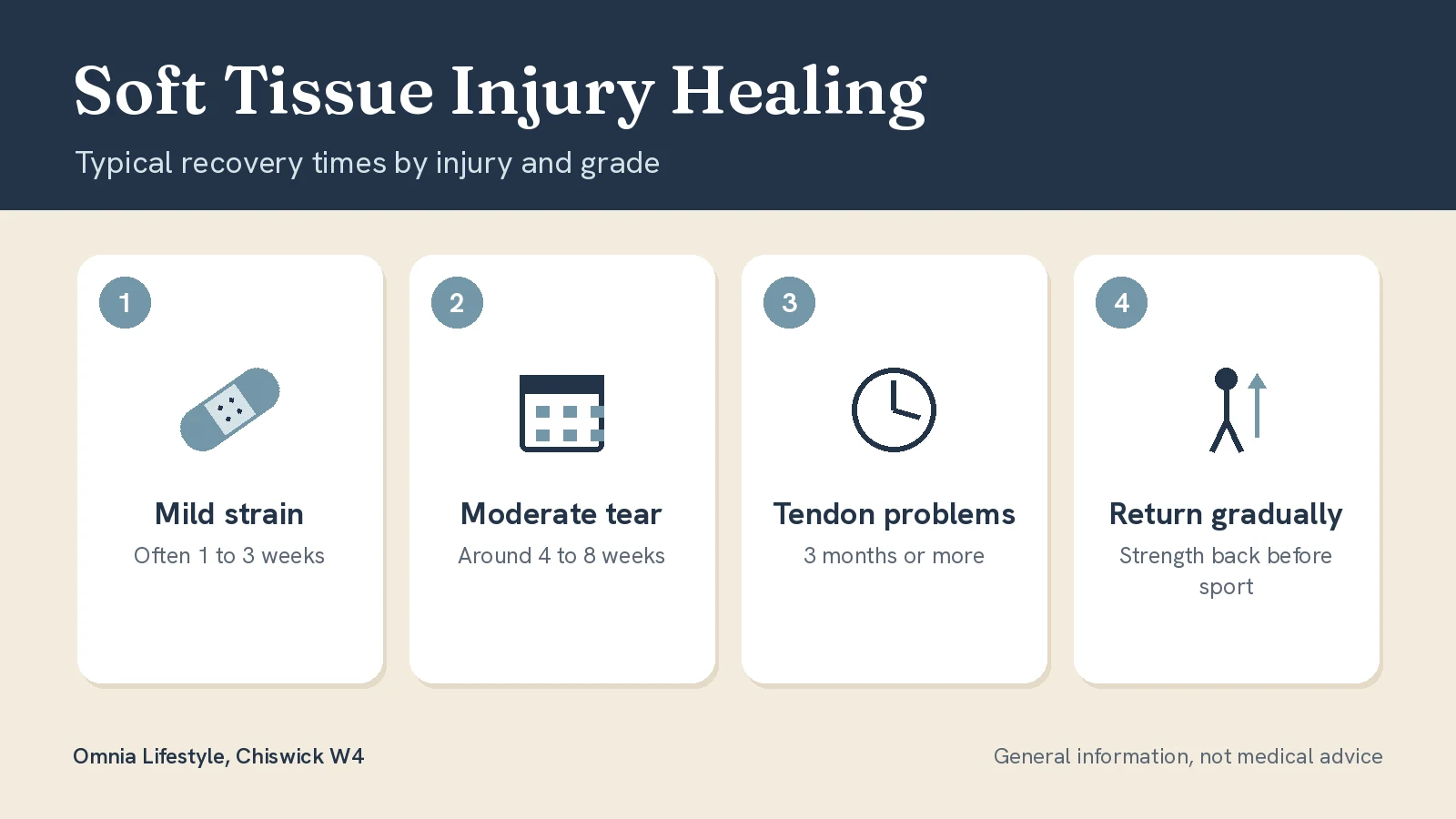
Most mild soft tissue injuries heal in one to three weeks. Moderate muscle strains and ankle sprains usually take four to eight weeks, and severe tears can take three months or longer. Tendon problems often take three months or more, and ligament reconstructions nine months or more. Pain usually eases before the tissue is fully strong, so returning to sport should be based on restored strength and movement, not on pain alone. Gentle, gradually increasing movement heals tissue better than long periods of rest.
What is a soft tissue injury?
- Strain: an injury to a muscle or the tendon that attaches it to bone, such as a hamstring or calf strain
- Sprain: an injury to a ligament, which connects bone to bone, such as an ankle or knee sprain
- Contusion: a bruise to muscle from a direct blow
- Tendinopathy: an overuse problem in a tendon, such as Achilles or tennis elbow pain
Injury grades
- Grade 1 (mild). A few fibres are damaged. There is some pain and tenderness but little loss of strength or movement.
- Grade 2 (moderate). A partial tear, with more pain, swelling, bruising and weakness.
- Grade 3 (severe). A complete or near-complete tear, often with significant swelling, loss of function or instability. Some need a surgical opinion.
Typical healing times
- Muscle bruise: one to three weeks
- Mild muscle strain: one to three weeks
- Moderate muscle strain: four to eight weeks
- Severe muscle or tendon tear: three months or more, sometimes with surgery
- Mild to moderate ankle sprain: two to six weeks. See when to worry about a sprained ankle
- Severe ankle or knee ligament sprain: three months or more
- Tendon problems such as Achilles tendinopathy or tennis elbow: often three months or more
- Whiplash: most people improve within a few weeks to three months. See how long whiplash lasts
- Ligament reconstruction: usually nine months or more. See torn ACL recovery
These are typical ranges. Age, general health, the exact location of the injury and how well rehabilitation goes all make a difference.
The three stages of healing
- Inflammation (first few days). Swelling, warmth and pain as the body cleans up damaged tissue and starts repair. This stage is normal and necessary.
- Repair (from a few days to about six weeks). New tissue is laid down. It is weak and disorganised at first, which is why re-injury is common if you do too much too soon.
- Remodelling (from about six weeks to a year or more). The new tissue strengthens and lines up with the forces placed on it. Gradual, progressive loading is what guides this process.
What helps a soft tissue injury heal
- Protect it in the first few days, avoiding activities that clearly make it worse
- Elevate it to help reduce swelling
- Ice for pain, for up to 20 minutes every few hours, wrapped in a towel
- Keep gently moving within comfort, rather than resting completely
- For the first two to three days, avoid heat, alcohol, running and vigorous massage, which can increase swelling
- Load it gradually once the early pain settles, with exercises that rebuild strength
- Sleep well and eat enough protein to support repair
- Return to sport in stages, completing full training before competing
Paracetamol can ease pain. Ibuprofen can help pain and swelling, although some experts suggest avoiding anti-inflammatory medicines in the first couple of days, so ask a pharmacist what is right for you.
What slows healing
- Returning to full activity too soon
- Long periods of complete rest, which weaken the tissue
- Smoking
- Poorly controlled diabetes
- Poor sleep and high stress
- Not eating enough, particularly protein
- Repeated injury to the same area
When to seek medical help
Go to A&E or call 999 if:
- The limb looks deformed, or a bone is visible
- The limb below the injury is numb, cold or pale
- You heard a crack and have severe pain, suggesting a fracture
Get same-day care, at an urgent treatment centre or from NHS 111, if:
- You cannot put any weight on the leg or use the arm
- Swelling is severe and getting worse
- You have sudden calf pain with swelling, warmth or redness, which can be a sign of a blood clot
- A wound over the injury is red, hot or oozing, or you have a high temperature
See your GP or a physiotherapist if:
- The injury is not improving after one to two weeks
- The area still feels weak or unstable after six weeks
- The same injury keeps happening
Frequently asked questions
Should I rest a soft tissue injury?
Rest for the first few days, then begin gentle, pain-guided movement. Long periods of complete rest slow recovery and weaken the tissue.
Does ice help an injury heal?
Ice helps with pain and swelling in the first few days. It does not speed up healing on its own, and gentle movement matters more.
How do I know if it is a sprain or a tear?
A sprain is an injury to a ligament and a strain to a muscle or tendon. Severe swelling, a large loss of strength or instability suggest a more serious tear that should be assessed.
Can massage help a soft tissue injury?
After the first few days, massage can ease muscle tension and support recovery alongside exercise. See whether sports massage helps a sports injury.
Injury rehabilitation in Chiswick
Sports and soft tissue injuries are assessed and treated at Omnia Lifestyle in Chiswick, W4, close to Turnham Green station, on bus routes 94, E3 and 272. Limited parking is available on request when booking. Our physiotherapists grade the injury, set a staged rehabilitation plan with clear milestones, and may combine sports massage, manual therapy, red light therapy and Pixformance guided strength training. We refer to your GP where imaging or a medical opinion is needed.
Read more about sports injuries, see torn ACL, what a sports massage involves and whether manual therapy helps sports injuries, explore physiotherapy, sports massage, red light therapy and Pixformance, or book an assessment.
This article is general information, not medical advice. If you have any of the warning signs listed above, seek medical attention.

.jpg)
.jpg)