





Hip bursitis is the common name for pain over the bony point on the outside of the hip. It is typically sore to lie on, sore on stairs, and sore after standing or walking for long periods. Clinicians now more often call it greater trochanteric pain syndrome, because research has shown that the gluteal tendons which attach at that point are usually involved, with or without inflammation of the bursa, the small fluid-filled cushion that sits over them.
That distinction matters, because it changes the treatment. This guide covers the exercises that help, the popular stretches that often make it worse, how to sleep and sit more comfortably, and the warning signs that mean your hip should be assessed rather than exercised.
What hip bursitis actually is
The gluteal tendons wrap around the outside of the hip bone, and the iliotibial band, a thick strap of tissue, runs over the top of them. When the thigh moves across the midline of the body, the band presses the tendons and bursa against the bone. Repeated or sustained compression of this kind, combined with more load than the tendons are conditioned for, is thought to be the main driver of the pain.
It is most common in women between 40 and 60, in runners and walkers who have increased their distance, and after a period of reduced activity. It can also follow a fall onto the side of the hip.
The two principles that matter most
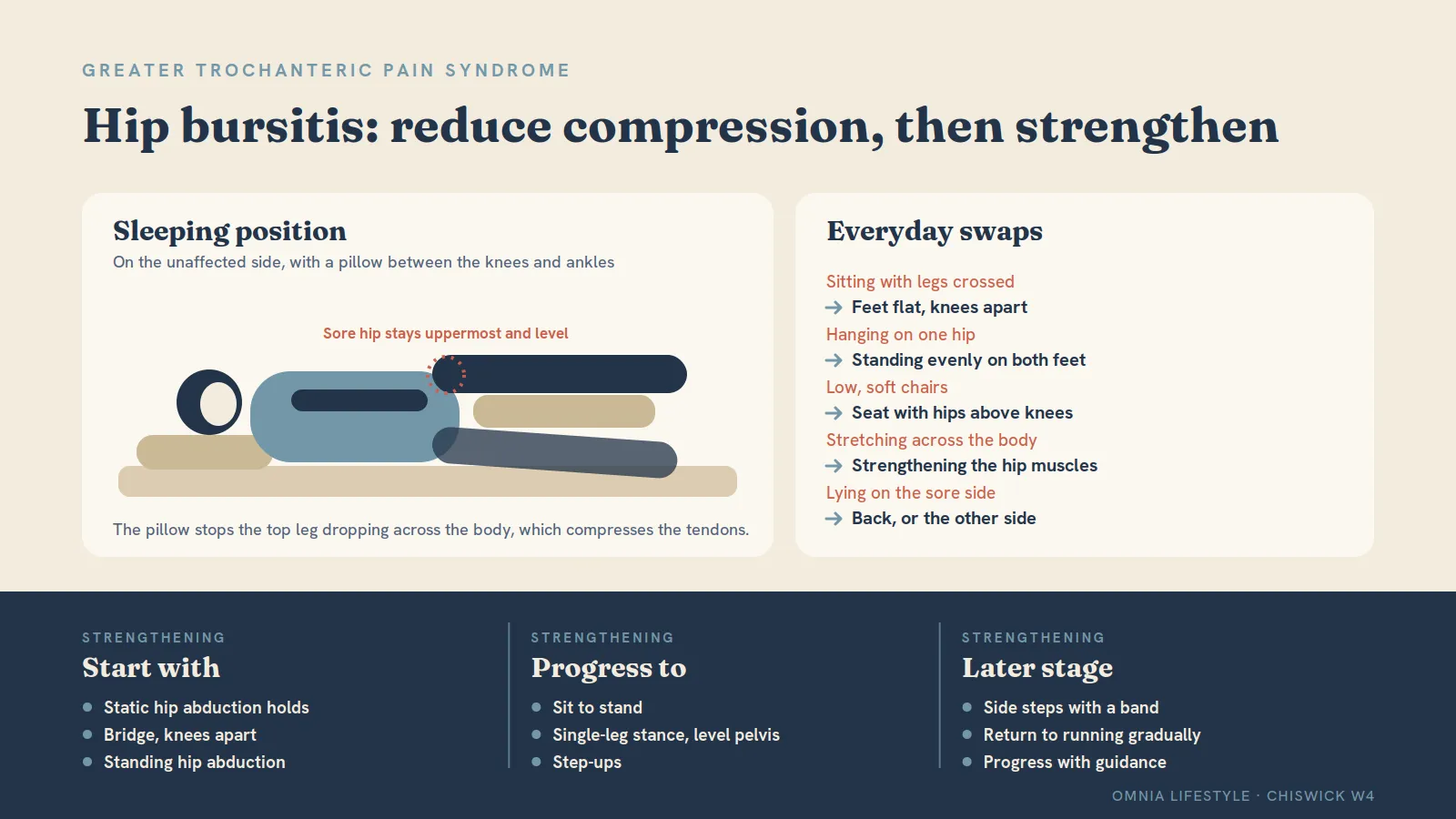
Reduce compression. Positions in which the affected leg crosses the body, or in which you hang on one hip, squeeze the sore tendons against the bone. Changing these everyday positions is often the single most effective step, and it is the part most exercise sheets leave out.
Strengthen gradually. Tendons recover by being loaded, progressively, over weeks. Rest eases the pain in the short term but leaves the tendons less able to cope when you return to activity.
The evidence supports this approach. A trial published in the BMJ in 2018 compared education plus exercise against a corticosteroid injection, and the exercise group had better results at both eight weeks and one year.
A useful guide to intensity: mild discomfort during exercise, up to about 3 or 4 out of 10, is acceptable if it settles within 24 hours. Pain that is worse that night or the next morning means you did too much.
Everyday changes that reduce the pain
- Do not sit with your legs crossed, and avoid low, soft chairs where your knees sit higher than your hips.
- Stand evenly on both feet rather than hanging on one hip.
- Sleep on your back, or on the unaffected side with a pillow between your knees so that the top leg does not drop across your body. A mattress topper can help if you cannot avoid the sore side.
- Take stairs and hills steadily, and reduce them for a few weeks if they flare the pain.
Exercises to start with
Static hip abduction
Lie on your back with your legs straight and a belt or band looped around your thighs just above the knees, feet hip-width apart. Gently press both legs outward against the belt without any movement taking place. Hold for 10 to 15 seconds at a low to moderate effort, relax, and repeat five times. Sustained holds of this kind often ease tendon pain as well as beginning to strengthen.
Bridge
Lie on your back with knees bent and feet flat, hip-width apart. Squeeze your buttocks and lift your hips until your body forms a straight line from shoulders to knees. Hold for five seconds and lower slowly. Build up to three sets of 10. Keep your knees apart throughout and do not let them drift together.
Standing hip abduction
Stand tall holding a worktop. Keeping your body upright and your toes pointing forward, slide the affected leg out to the side a short distance, then return under control. Repeat 10 times on each leg. The standing leg is working just as hard to keep the pelvis level, so both sides benefit.
Exercises to progress to
Sit to stand
From a dining chair, stand up and sit down slowly with your feet hip-width apart and your knees in line with your toes. Do not let your knees fall inward. Build up to three sets of 10.
Single-leg stance with a level pelvis
Standing in front of a mirror with a worktop within reach, lift the unaffected foot slightly off the floor. Keep your pelvis level and do not let the hip push out to the side. Hold for up to 30 seconds. This trains exactly the control that walking and stairs demand.
Step-ups
Step up onto a low step with the affected leg, keeping your pelvis level and your knee in line with your toes, then lower slowly. Start with a step of 10 to 15 centimetres.
Side steps with a band
With a resistance band around your thighs just above the knees, bend your knees slightly and take 10 slow steps to one side, then 10 back. Keep tension on the band throughout. This is a later-stage exercise, to be introduced when the earlier ones are comfortable.
What to avoid, at least initially
- Stretching the outside of the hip. Iliotibial band stretches, and buttock stretches that pull the knee across the body, compress the sore tendons. They can feel satisfying in the moment and still prolong the problem.
- Foam rolling or massaging directly over the bony point.
- Lying on the affected side without cushioning.
- Sudden increases in walking or running distance, and running on cambered roads.
- Complete rest. Keep walking on level ground within comfort.
Why a generic exercise sheet sometimes fails
Many hip bursitis sheets found online are built around stretching, which is the opposite of what compressed tendons need. Others begin with exercises that are too demanding for an irritable hip, such as lying on the sore side or repeated side-lying leg lifts, and cause a flare within days.
Pain at the outside of the hip can also come from elsewhere. Hip joint arthritis, which more often causes groin pain and stiffness, and referred pain from the lower back can both be mistaken for bursitis, and each needs a different programme.
When to seek medical attention
Seek urgent medical attention if:
- You have had a fall and cannot put weight through the leg. A fracture needs to be ruled out, particularly if you are over 60 or have osteoporosis
- The hip area is hot, red and swollen, or you feel feverish and unwell
- You have severe pain that came on suddenly without an obvious cause
See your GP or a physiotherapist if:
- Pain has lasted more than a few weeks without improvement
- Pain regularly wakes you at night
- Pain is felt mainly in the groin, or the hip is stiff when you put on shoes and socks
- You have numbness, tingling or pain travelling below the knee
- You have unexplained weight loss, or a history of cancer, alongside the pain
What a physiotherapy assessment adds
An assessment confirms whether the gluteal tendons and bursa are the source of the pain or whether the hip joint or lower back is responsible. It measures hip strength against the other side, looks at how you stand, walk and climb a step, and identifies the positions and activities that are compressing the tendons in your daily routine. The programme is then set at a level the hip can tolerate and progressed as it strengthens.
Frequently asked questions
How long does hip bursitis take to get better?
With the right changes, many people notice improvement within four to eight weeks. Tendons adapt slowly, so full recovery commonly takes three to six months, and longer if the pain has been present for a long time.
Is walking good for hip bursitis?
Yes, within tolerance. Walk on level ground at a comfortable pace and shorten the distance if it flares the pain. Avoid long hills and cambered surfaces for a few weeks.
Should I stretch hip bursitis?
Generally not in the early stages. Stretches that take the leg across the body compress the sore area. Strengthening and changing aggravating positions are more effective.
What is the best sleeping position?
On your back, or on the unaffected side with a pillow between your knees and ankles so that the top leg stays level with the hip.
Do steroid injections work?
An injection can give short-term pain relief, and is sometimes offered when pain is severe. The benefit tends to fade over a few months, and research shows better long-term results from education and exercise. This is a decision to discuss with your GP.
Can I keep running?
Often yes, at a reduced volume, provided pain stays low during the run and settles within 24 hours. Flat, even surfaces, shorter runs and avoiding speed work are the usual adjustments.
Is heat or ice better?
Either can help with comfort. Ice after activity suits a sore, irritable hip. Neither addresses the underlying cause.
Hip pain assessment and treatment in Chiswick
Outer hip pain is assessed and treated at Omnia Lifestyle in Chiswick, W4, close to Turnham Green station, on bus routes 94, E3 and 272. Limited parking is available on request when booking. Assessment confirms whether hip bursitis is the cause and sets a strengthening programme at a level your hip can tolerate, so that it settles rather than flares.
Read more about joint pain and sports injuries, see our guides to sciatica exercises and gait analysis, explore physiotherapy, or book an assessment.
This article is general information, not medical advice. If you have any of the warning signs listed above, seek medical attention.


.jpg)
.jpg)