



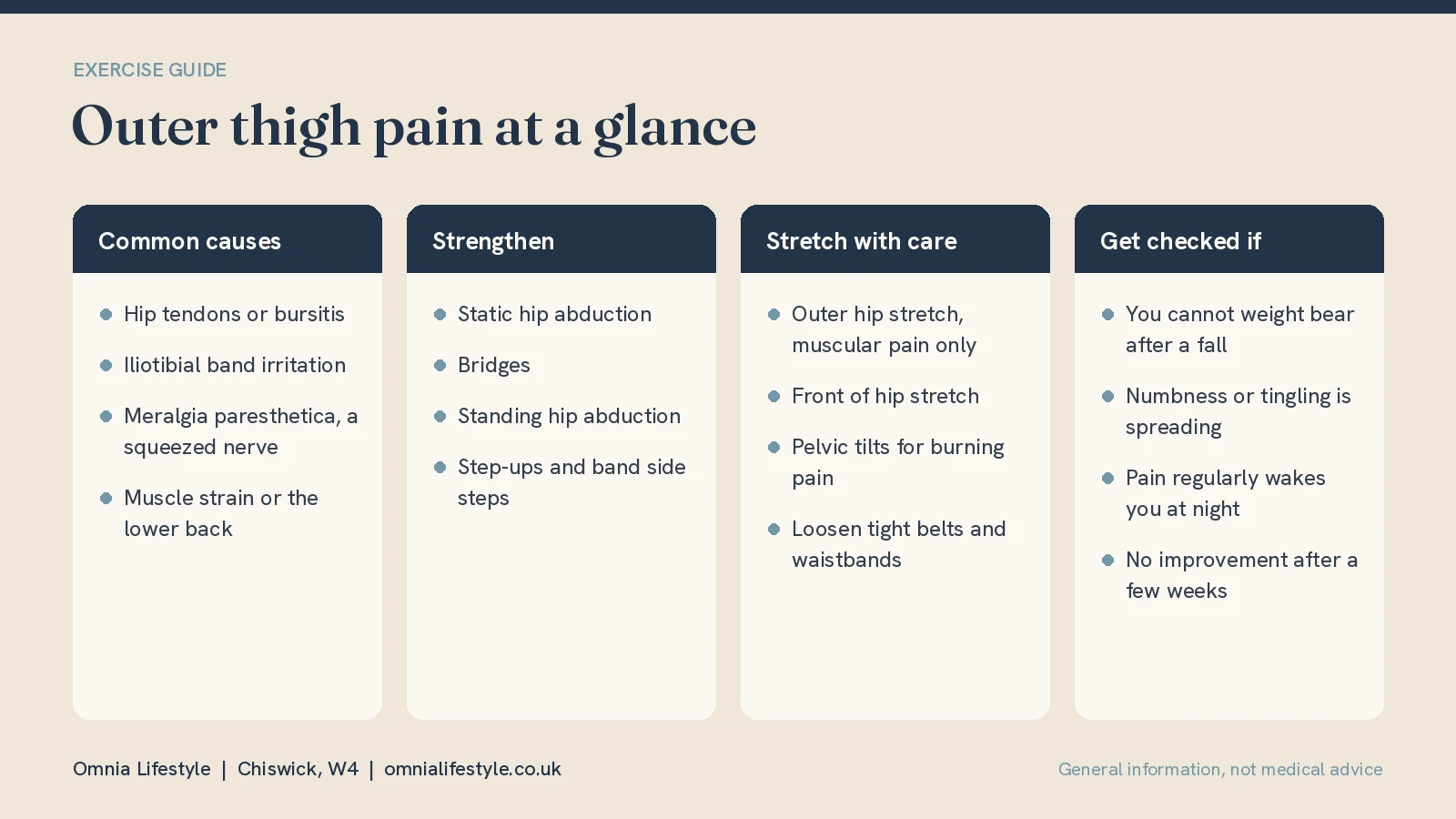


Pain on the outside of the thigh is common, and it has several quite different causes. Some come from the tendons at the side of the hip, some from the band of tissue running down the outer thigh, and one comes from a nerve, which is why the pain can feel like burning or tingling rather than an ache. The right exercises depend on which it is, and some popular stretches help one cause while aggravating another.
This guide explains the main causes of outer thigh pain, how to tell them apart, which stretches and exercises suit each, and the warning signs that mean you should be assessed.
The main causes of outer thigh pain
Gluteal tendinopathy and hip bursitis
Pain centred on the bony point at the side of the hip, which may spread down the outer thigh towards the knee. It is typically sore to lie on, on stairs and after standing or walking for a long time. It is most common in women between 40 and 60 and in walkers and runners who have increased their distance. This is also called greater trochanteric pain syndrome.
Iliotibial band irritation
The iliotibial band is a thick strap of tissue running from the hip to just below the knee. Irritation usually causes pain lower down, on the outside of the knee or lower thigh, and is common in runners and cyclists, particularly after a sudden increase in training or a lot of downhill running.
Meralgia paraesthetica (meralgia paresthetica)
Burning, tingling, numbness or a strange sensitivity to touch on the front and outside of the thigh, with no weakness, points to meralgia paraesthetica, often spelled meralgia paresthetica. It happens when a sensory nerve, the lateral femoral cutaneous nerve, is squeezed where it passes near the front of the hip bone. Tight belts and waistbands, weight gain, pregnancy, diabetes and long periods of standing are common triggers. It usually improves once the pressure on the nerve is reduced.
Muscle strain
An ache or sharp pain in the muscle itself after unusual activity, such as a new exercise class, a long walk or lifting, often with tenderness when you press the muscle. It usually settles within a few weeks.
Pain referred from the back or hip joint
A nerve irritated in the lower back can cause pain in the thigh, often with back pain, pins and needles or pain that changes with bending and sitting. Hip joint arthritis more often causes groin pain and stiffness, but can spread to the thigh.
How to tell them apart
- Sore to lie on, pain at the bony point of the hip: most likely gluteal tendinopathy or bursitis.
- Pain near the outside of the knee during running or cycling: most likely iliotibial band irritation.
- Burning, tingling or numb skin on the outer front thigh: most likely meralgia paresthetica.
- Pain with back pain, or tingling below the knee: the lower back may be the source.
- Groin pain and stiffness putting on shoes and socks: the hip joint may be involved.
These are patterns, not a diagnosis. An assessment confirms the cause, which matters because the treatments differ.
Outer thigh stretches: when they help and when they do not
Stretching the outer thigh and hip is often the first thing people try. It can ease a tight or strained muscle, but for pain at the bony point of the hip, stretches that pull the leg across the body press the sore tendons against the bone and can prolong the problem.
Standing outer hip stretch
Stand side on to a wall with the sore side nearest it, one hand on the wall. Cross the leg furthest from the wall in front of the other and gently lean your hips towards the wall until you feel a stretch along the outer hip and thigh. Hold for 20 to 30 seconds and repeat three times.
Use this only if your pain is muscular. If the pain sits at the bony point of the hip or you are sore lying on that side, skip it and start with the strengthening exercises below.
Front of hip stretch
Kneel on a cushion with one knee down and the other foot in front. Keeping your body upright, gently tuck your tailbone under and shift your weight forward until you feel a stretch at the front of the hip of the kneeling leg. Hold for 20 to 30 seconds and repeat three times each side.
Strengthening exercises
For tendon-related outer thigh pain, strength matters more than stretching. Tendons recover by being loaded gradually over weeks. Mild discomfort up to 3 or 4 out of 10 during exercise is acceptable if it settles within 24 hours.
Static hip abduction
Lie on your back with your legs straight and a belt looped around your thighs just above the knees. Gently press both legs outward against the belt without any movement. Hold for 10 to 15 seconds and repeat five times. This is a gentle starting point for irritable hip tendons.
Bridge
Lie on your back with knees bent and feet flat, hip-width apart. Squeeze your buttocks and lift your hips until your body forms a straight line from shoulders to knees. Hold for five seconds and lower slowly. Build up to three sets of 10.
Standing hip abduction
Stand tall holding a worktop. Keeping your body upright and toes pointing forward, slide one leg out to the side a short distance and return under control. Repeat 10 times on each leg.
Step-ups
Step up onto a low step with the affected leg, keeping your pelvis level and your knee in line with your toes, then lower slowly. Start with a step of 10 to 15 centimetres and build to three sets of 10.
Side steps with a band
With a resistance band around your thighs just above the knees, bend your knees slightly and take 10 slow steps to one side and 10 back. Introduce this once the earlier exercises are comfortable.
Meralgia paresthetica: stretches and self-help
For meralgia paresthetica, the priority is taking pressure off the nerve rather than exercising through it. Gentle stretches that ease tension at the front of the hip can help some people, but the research on them is limited, and any stretch that brings on more burning or tingling should be stopped.
Front of hip stretch
The kneeling front of hip stretch described above is the most useful. Keep it gentle and hold for 20 to 30 seconds, three times each side.
Standing hip flexor stretch
If kneeling is uncomfortable, stand in a short lunge holding the back of a chair, with the affected leg behind. Tuck your tailbone under and shift your weight forward until you feel a gentle stretch at the front of the back hip. Hold for 20 to 30 seconds and repeat three times.
Pelvic tilts
Lie on your back with your knees bent. Gently flatten your lower back into the floor by tilting the pelvis, hold for five seconds and relax. Repeat 10 times. This eases stiffness around the front of the hip without stretching the nerve.
Self-help that makes the biggest difference
- Loosen tight belts, waistbands and work belts, and avoid heavy items such as tool belts resting at the front of the hip.
- Break up long periods of standing, and change position often.
- Gradual weight loss helps where weight gain was a trigger.
Most cases settle over weeks to months. Numbness that spreads, weakness in the leg or symptoms that do not improve should be assessed.
What to avoid, at least initially
- Sitting with your legs crossed or standing hanging on one hip if the pain is at the side of the hip.
- Foam rolling hard over the bony point of the hip or a painful band.
- Sudden increases in running, walking or hills.
- Complete rest. Keep active within comfort.
When to seek medical attention
Seek urgent medical attention if:
- You have had a fall and cannot put weight through the leg
- The leg is hot, red and swollen, or you feel feverish and unwell
- You have numbness around the genitals or buttocks, or new problems controlling your bladder or bowels
- You have sudden weakness in the leg
See your GP or a physiotherapist if:
- Pain has lasted more than a few weeks without improving
- Pain regularly wakes you at night
- Numbness or tingling is spreading
- You have back pain, or pain travelling below the knee
- You have unexplained weight loss, or a history of cancer, alongside the pain
What a physiotherapy assessment adds
Outer thigh pain is a good example of why assessment matters, because the common causes need different approaches. An assessment identifies whether the tendons, the iliotibial band, a nerve, the hip joint or the lower back is responsible, checks strength against the other side, and looks at how you walk, climb a step and stand. The programme is then matched to the cause and progressed as you improve.
Frequently asked questions
Why does the outside of my thigh hurt when I lie on it?
Pain lying on your side usually comes from the gluteal tendons or bursa at the bony point of the hip. Sleeping on your back, or on the other side with a pillow between your knees, eases it.
What causes a burning sensation on the outer thigh?
Burning, tingling or numbness on the outer front thigh with no weakness is typical of meralgia paresthetica, a squeezed sensory nerve near the front of the hip bone. Tight clothing, weight gain and long periods of standing are common triggers.
Do stretches help meralgia paresthetica?
Gentle front of hip stretches and pelvic tilts help some people, but loosening tight clothing and reducing long periods of standing usually make the bigger difference. Stop any stretch that increases the burning or tingling.
Should I stretch my IT band?
The iliotibial band itself stretches very little. Stretches that pull the leg across the body can aggravate pain at the side of the hip. Strengthening the hip muscles and adjusting training load are usually more effective.
How long does outer thigh pain take to go away?
A muscle strain often settles within a few weeks. Tendon-related pain commonly takes three to six months to fully recover with the right exercise. Meralgia paresthetica usually improves over weeks to months once pressure on the nerve is reduced.
Is walking good for outer thigh pain?
Usually yes, on level ground and within comfort. Shorten the distance if the pain flares, and avoid hills for a few weeks.
Outer thigh and hip pain assessment in Chiswick
Outer thigh and hip pain is assessed and treated at Omnia Lifestyle in Chiswick, W4, close to Turnham Green station, on bus routes 94, E3 and 272. Limited parking is available on request when booking. Assessment identifies which of the causes above is responsible so that treatment is matched to it from the start.
See our guides to hip bursitis exercises, sciatica exercises and knee pain exercises, read more about joint pain and sports injuries, explore physiotherapy, or book an assessment.
This article is general information, not medical advice. If you have any of the warning signs listed above, seek medical attention.



.jpg)
.jpg)