


Book at our Chiswick clinic
Physiotherapy
Pain on the outside of the knee is common in runners, cyclists and walkers, but it can affect anyone. It might be a sharp pain on the outer side of the knee that starts partway through a run, soreness along the outside of the knee after a long walk, or a dull ache at the bottom outside of the knee that will not settle.
The most common cause is iliotibial band syndrome (ITBS), but ligament, cartilage, tendon and arthritis problems can all cause outer knee pain. This guide explains how to tell them apart, what helps and when to get your knee checked.
Quick answer
Outer knee pain is most often iliotibial band syndrome, an overuse problem that causes sharp pain on the outside of the knee during running or cycling. Other causes include a lateral ligament sprain, a lateral meniscus tear, hamstring tendon pain and arthritis. Most cases improve with reduced load and hip and knee strengthening. Get urgent help if you cannot bear weight, the knee is very swollen or it locks.
Why does the outside of my knee hurt?
The outside of the knee has several structures packed into a small area: the iliotibial band, the lateral collateral ligament, the outer half of the meniscus, the biceps femoris hamstring tendon and the top of the fibula bone. Where the pain is and what brings it on are the best clues.
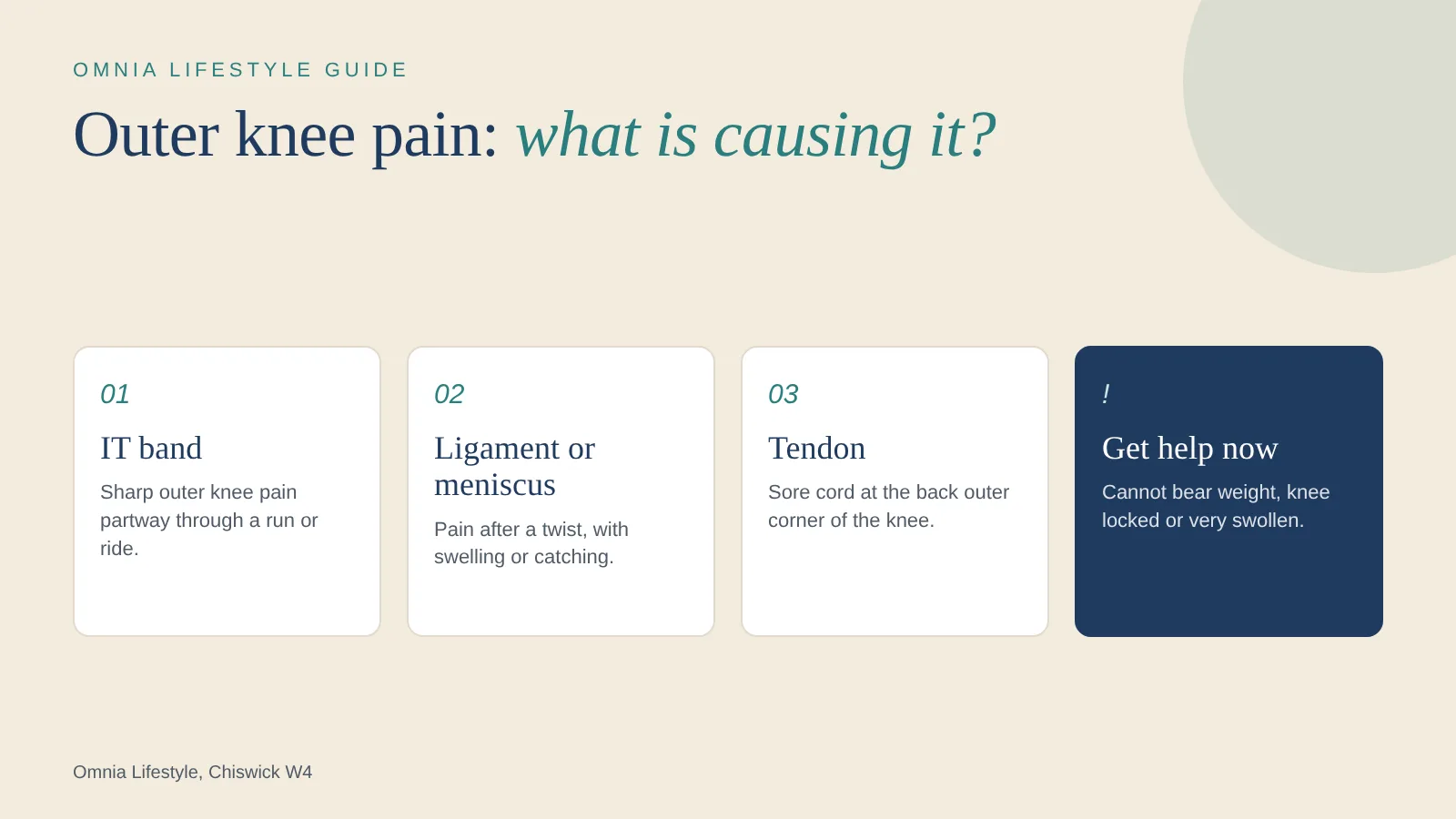
- Sharp pain on the outside of the knee during running or cycling that builds the further you go: iliotibial band syndrome
- Pain after a twist or a blow to the inside of the knee: lateral collateral ligament sprain or meniscus tear
- Catching, locking or swelling with pain on the outer joint line: lateral meniscus problem
- Pain at the back outer corner or bottom outside of the knee: hamstring (biceps femoris) or popliteus tendon
- Stiffness and aching, worse in the morning or after rest, usually over 50: osteoarthritis
IT band syndrome knee pain
The iliotibial band is a thick band of tissue running down the outside of the thigh from the hip to just below the knee. In iliotibial band syndrome the area where it passes the outer knee becomes irritated, usually because training has increased faster than the tissues can adapt.
Typical ITBS signs:
- Pain along the outside of the knee, sometimes spreading up the outer thigh
- Pain that starts at a predictable point in a run or ride, then gets sharper until you stop
- Worse running downhill, on cambered roads or going down stairs
- Usually no swelling and no pain at rest
- Tenderness just above the outer knee joint
Common triggers are a sudden increase in mileage, lots of downhill running, a new bike set-up and weakness in the hip muscles that control the knee. Stretching the IT band itself has limited effect because it is very stiff tissue, so treatment focuses on load and strength. Our outer thigh pain guide covers IT band pain that is felt higher up the leg.
Tendon on the outside of the knee
If the sore spot is a cord-like tendon at the back outer corner of the knee, it is likely to be the biceps femoris, one of the hamstrings, which attaches to the top of the fibula. Tendon pain here is often linked to sprinting, kicking or hill work and feels stiff at the start of activity. The popliteus tendon, deeper at the back outer knee, can become painful with downhill walking or running.
Tendon pain usually responds to a graded strengthening programme rather than rest alone. See our guide to pain behind the knee if your pain is more at the back.
Ligament and meniscus injuries
Lateral collateral ligament (LCL) sprain: the LCL runs down the outside of the knee. It is usually injured by a blow to the inside of the knee or a twisting fall, causing pain and tenderness on the outer side, sometimes with a feeling of the knee giving way.
Lateral meniscus tear: the meniscus is the cartilage cushion inside the knee. A tear can follow a twist, or develop gradually with age. It tends to cause pain on the outer joint line, swelling over the next day or so, and catching, clicking or locking. Pain on deep squatting is common. Read more about ligament injuries of the knee.
Outer knee pain when walking, kneeling or standing up
Outside of knee hurts when walking
Pain on the outside of the knee when walking, especially downhill or on stairs, can be ITBS, popliteus tendon pain or lateral osteoarthritis. Walking pain with swelling after a twist suggests a meniscus or ligament problem.
Pain on outside of knee when kneeling
Sharp pain on the outside of the knee when kneeling may be pressure on an irritated IT band or ligament, or the meniscus being squeezed in a deeply bent knee. Our guide to knee pain when bending or kneeling explains other causes.
Pain on outside of knee when standing up
Pain as you stand from a chair is common with osteoarthritis and with weakness in the thigh and hip muscles, which leaves the knee working harder. Strengthening usually helps.
Outer knee pain in both knees
Pain on the outside of both knees (bilateral knee pain) is often linked to training load, footwear or arthritis. If both knees are swollen and stiff with other joints affected, see your GP, as an inflammatory arthritis needs medical assessment.
When to see a GP or get urgent help
Ask for an urgent GP appointment, call NHS 111 or go to A&E if:
- You heard a snap or pop at the time of injury, or you cannot put weight on the leg
- The knee is very swollen, misshapen or locked and will not straighten
- The knee is hot and red, or you have a high temperature
- You have numbness down the outer shin, or your foot catches or drops when you walk
See your GP or a physiotherapist if: outer knee pain has not improved after two to three weeks of reduced activity, it keeps giving way, or pain is stopping you running or walking normally.
What helps outer knee pain at home
- Reduce, do not stop: cut running distance and avoid hills for a week or two, staying below the point where pain starts
- Use ice wrapped in a towel for up to 20 minutes after activity if it eases the pain
- Build hip and thigh strength with side-lying leg raises, bridges and sit to stands. Our exercises for knee pain guide shows how
- Check your set-up: worn running shoes, saddle height and cleat position can all load the outer knee
- Try a foam roller on the outer thigh muscles if it feels good, but do not roll directly over a sore knee
- Return gradually: increase running distance slowly once you can walk briskly and hop without pain
How we help in Chiswick
At Omnia Lifestyle our HCPC-registered physiotherapists examine the knee, hip and the way you move to find what is causing outer knee pain, then build a plan to settle it and get you back to running, cycling or walking.
- Physiotherapy in Chiswick: 70-minute initial assessment and treatment for £99, follow-ups from £70. Includes a strength and return-to-sport programme. Recognised by AXA Health, Aviva, WPA and Vitality.
- Sports massage in Chiswick: £65 for 30 minutes or £90 for 60 minutes, to ease tight thigh and hip muscles alongside strengthening.
- Home visit physiotherapy across West London from £110.
Frequently asked questions
How long does IT band syndrome take to heal?
Many people improve within four to eight weeks once training load is adjusted and hip strengthening begins. Longer-standing cases can take a few months.
Can I keep running with outer knee pain?
Often yes, if you run shorter distances on flat ground and stop before pain starts. Running through sharp pain usually makes ITBS last longer.
Is outer knee pain serious?
Usually not. Outer knee pain after a twisting injury with swelling, locking or giving way should be assessed, as it may be a ligament or meniscus injury.
Should I stretch my IT band?
Stretching the band itself makes little difference, but stretching the hip and thigh muscles may feel helpful. Strengthening the hip is more important.
What is the tendon on the outside of the knee?
The cord you can feel at the back outer corner is the biceps femoris hamstring tendon. The IT band also attaches just below the outer knee at the front.
Outer knee pain in Chiswick
Outer knee pain is assessed and treated at Omnia Lifestyle, 8 to 9 Bedford Corner, The Avenue, Chiswick W4 1LZ, close to Turnham Green station, on bus routes 94, E3 and 272. Limited parking is available on request when booking.
Read more about knee pain, inner knee pain and runner's knee, explore physiotherapy and sports massage, or book an assessment.
This article is general information, not medical advice. If you have any of the warning signs listed above, seek urgent medical attention.
Ready to book?
Physiotherapy



.jpg)
.jpg)