




The anterior cruciate ligament, or ACL, is one of the main ligaments holding the knee stable. A torn ACL is one of the best-known sports injuries, common in football, rugby, netball, basketball and skiing. It sounds alarming, and it is a significant injury, but with the right rehabilitation, with or without surgery, most people return to an active life.
This guide explains what a torn ACL is, what causes it, how painful it is, whether you can walk on it and what treatment and recovery involve.
Quick answer
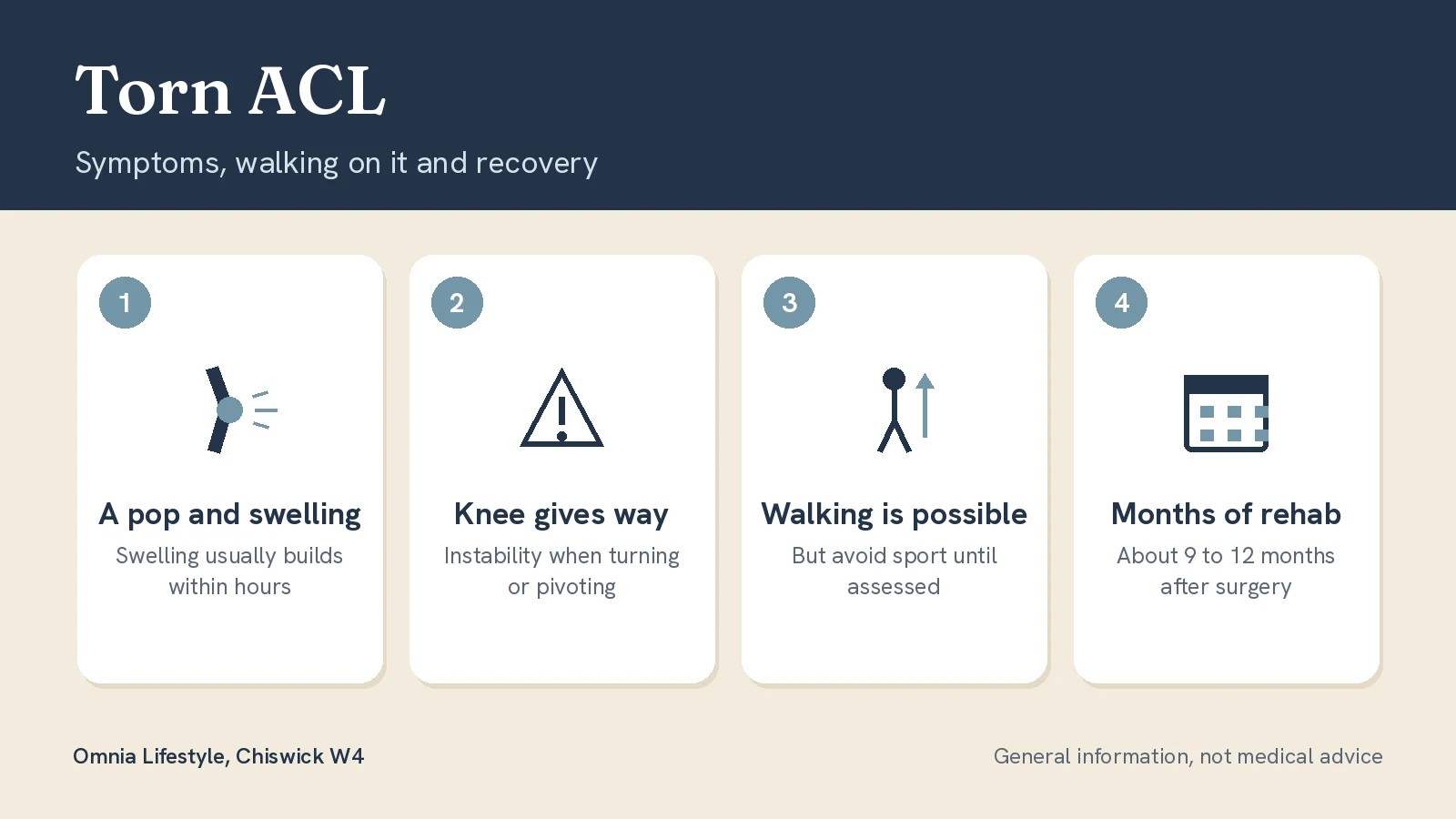
A torn ACL usually happens when you twist, pivot, stop suddenly or land awkwardly. Many people feel or hear a pop, the knee swells within a few hours and it may feel unstable or give way. Pain varies: it is often severe at first and eases over days. You can often walk on a torn ACL once the first pain settles, but the knee may give way when turning, so avoid sport until it has been assessed. Treatment is either structured rehabilitation alone or reconstruction surgery followed by rehabilitation. Return to pivoting sport after surgery usually takes about nine to twelve months.
What is the ACL?
The ACL runs through the middle of the knee, connecting the thigh bone to the shin bone. It stops the shin sliding forwards and controls twisting, which is why it matters most in sports that involve cutting, pivoting and landing. A tear can be partial or complete, and complete tears are more common.
What causes a torn ACL?
- Non-contact injuries, which are the most common: changing direction quickly, pivoting on a planted foot, stopping suddenly or landing from a jump with the knee collapsing inwards
- Contact injuries, such as a tackle or blow to the side of the knee
- Overstraightening of the knee, or a fall while skiing
Women and girls are several times more likely to tear their ACL than men in the same sports, linked to differences in anatomy, landing mechanics and muscle control. Structured warm-up programmes that train landing, balance and strength reduce the risk.
Symptoms of a torn ACL
- A pop or snapping feeling at the moment of injury
- Swelling that builds within a few hours
- Pain, often deep inside the knee
- A feeling that the knee is loose, unstable or giving way
- Difficulty straightening the knee fully or bearing weight at first
How painful is an ACL tear?
It varies a lot. Many people have severe pain at the moment of injury and for the first day or two, then find it settles surprisingly quickly as the swelling goes down. Others have less pain than expected, especially with a partial tear. Pain is not a reliable guide to how badly the ligament is damaged, so a knee that feels unstable needs assessing even if it does not hurt much.
Can you walk on a torn ACL?
Often, yes. Once the initial pain and swelling settle, most people can walk in a straight line, sometimes with a limp. Crutches help in the first days if walking is painful. The problem is turning, pivoting and changing direction, when the knee may give way. Repeated giving way can damage the meniscus and joint cartilage, so avoid sport, running and twisting activities until you have been assessed and have a plan.
Injuries that often come with an ACL tear
ACL tears often happen alongside a tear of the meniscus (the cartilage cushions in the knee), damage to the medial collateral ligament on the inner side, or bruising of the bone. These can affect symptoms and treatment choices.
How a torn ACL is diagnosed
A physiotherapist or doctor will ask how the injury happened and test the stability of the knee with specific tests, such as the Lachman test. An MRI scan confirms the tear and shows any other damage, and an X-ray may be used to rule out a fracture. Assessment is easier once the early swelling has reduced.
Treatment: rehabilitation, surgery or both
- Early stage. Protect the knee, use ice and elevation for swelling, use crutches if needed, and work early on getting the knee fully straight and the thigh muscles working again.
- Rehabilitation alone. Some people, particularly those who do not play pivoting sports and whose knee feels stable, do well with a structured programme of strength, balance and control exercises.
- Reconstruction surgery. The torn ligament is replaced with a graft, usually from the hamstring, patellar tendon or quadriceps tendon. It is usually advised for people returning to pivoting sports or whose knee keeps giving way.
Either way, physiotherapy is central. Strengthening before surgery, sometimes called prehabilitation, leads to better results afterwards. The decision about surgery is made with an orthopaedic surgeon.
How long does ACL recovery take?
- Rehabilitation without surgery: often three to six months to return to everyday activity and non-pivoting sport
- After reconstruction: crutches for the first few weeks, gentle running around three to four months, and return to pivoting sport usually at nine to twelve months
Returning too early increases the risk of a second ACL injury. Return to sport should be based on strength, hopping and control tests, not time alone. For general healing timelines, see soft tissue injury healing times.
When to seek medical help
Go to A&E or call 999 if:
- The leg looks deformed or a bone is visible
- Your foot is numb, cold or pale
- You have severe pain that painkillers do not ease
Get same-day care, at an urgent treatment centre or A&E, if:
- You heard a pop and the knee swelled quickly
- You cannot put any weight on the leg
- Your knee is locked and will not straighten
See your GP or a physiotherapist if:
- Your knee still feels unstable or gives way after the first week or two
- Swelling keeps coming back after activity
- You want a plan to return to sport
Frequently asked questions
Can a torn ACL heal on its own?
A completely torn ACL does not usually reattach. Many people still regain a stable, functional knee with rehabilitation, while others need reconstruction to return to pivoting sport.
Do I always need surgery for a torn ACL?
No. The choice depends on your activity level, how stable the knee feels and any other damage. It is decided with an orthopaedic surgeon, ideally after a period of rehabilitation.
How long will I be off work?
It depends on your job. People with desk jobs often return within a few weeks of surgery. Physical jobs can take several months.
When can I drive after ACL surgery?
You can drive when you can safely make an emergency stop and are off strong painkillers. Check with your surgeon and your insurer.
ACL rehabilitation in Chiswick
Knee and sports injuries are assessed and treated at Omnia Lifestyle in Chiswick, W4, close to Turnham Green station, on bus routes 94, E3 and 272. Limited parking is available on request when booking. Our physiotherapists provide assessment, rehabilitation before and after surgery and a staged return to sport, supported by Pixformance guided strength training, sports massage and InBody scans to check muscle balance between legs. We refer to your GP or an orthopaedic surgeon where imaging or surgery is needed.
Read more about sports injuries, see exercises for knee pain, when to worry about a sprained ankle and whether manual therapy helps sports injuries, explore physiotherapy, sports massage, Pixformance and InBody, or book an assessment.
This article is general information, not medical advice. If you have any of the warning signs listed above, seek medical attention.



.jpg)
.jpg)