





Most sprained ankles are painful, swollen and bruised, and still heal well with the right care. A few, though, turn out to be a fracture, a torn tendon or a more significant ligament injury that needs a different plan. Knowing the difference helps you avoid both an unnecessary trip to A&E and a missed injury.
This guide explains the signs that mean a sprained ankle should be checked, what normal recovery looks like, and when to worry if it is not getting better.
The short answer
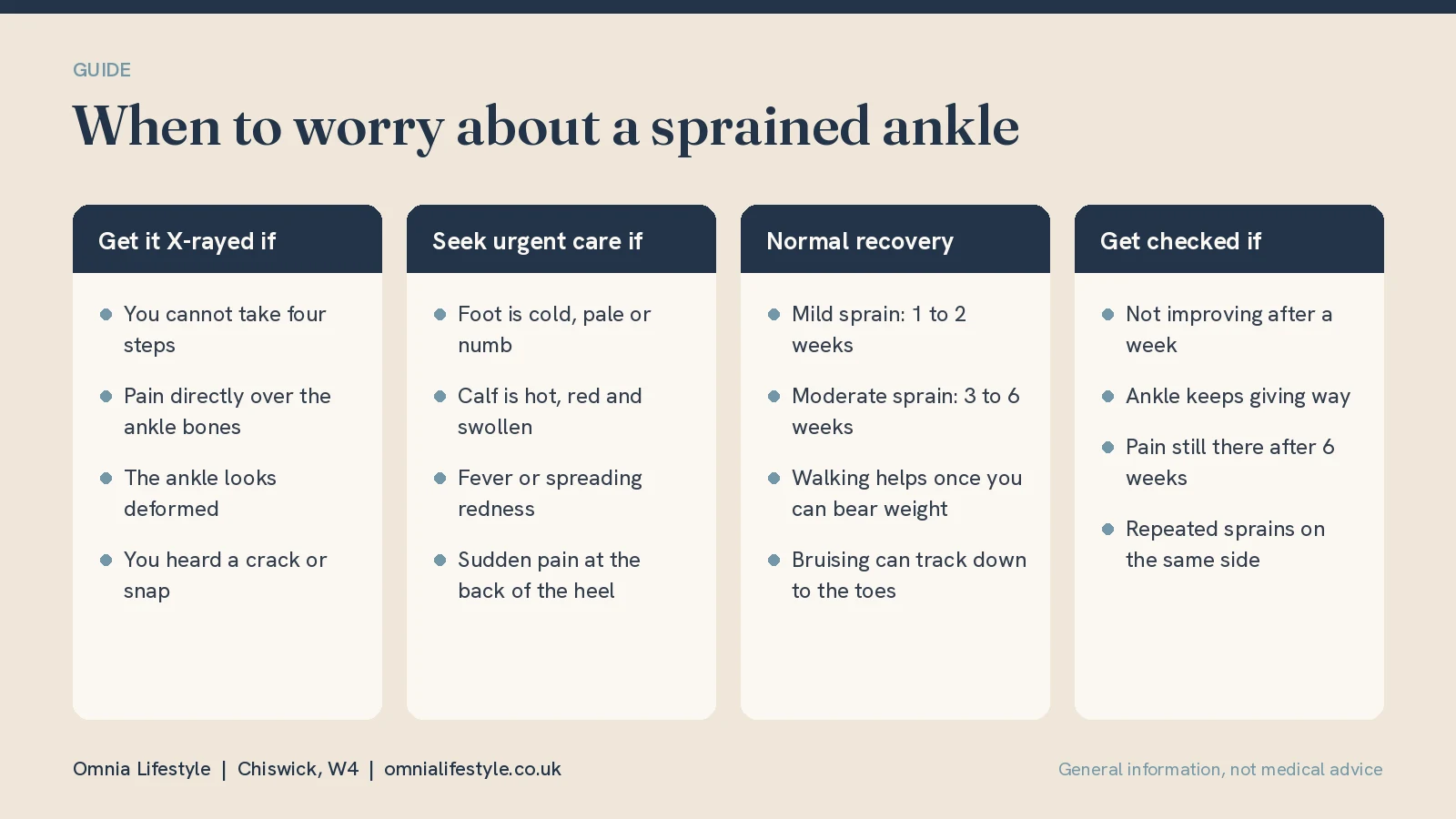
Get your ankle checked the same day if you cannot take four steps on it, there is pain when you press directly on the ankle or foot bones, the ankle looks deformed, or you heard a crack. Seek urgent care if the foot is cold, pale or numb, if your calf becomes hot, red and swollen, or if you have a fever with spreading redness.
Signs it could be a fracture
Clinicians use a checklist called the Ottawa ankle rules to decide who needs an X-ray. An X-ray is usually recommended if you could not take four steps straight after the injury and still cannot, or if there is tenderness when pressing on:
- The back edge or tip of either bony bump on the sides of the ankle
- The bone on the outer edge of the foot, halfway along
- The bone on the top inner side of the midfoot
Tenderness in the soft area just in front of and below the outer ankle bone is typical of a sprain rather than a fracture. Swelling and bruising alone do not mean the ankle is broken; a bad sprain can look dramatic.
Other injuries that can look like a sprain
- High ankle sprain: pain above the ankle joint, between the two lower leg bones, often after the foot is twisted outwards. It usually takes longer to recover than a standard sprain.
- Achilles tendon rupture: a sudden feeling of being kicked at the back of the heel, sometimes with a snap, and difficulty pushing off or rising onto the toes. This needs assessment within a day or two.
- Fracture at the base of the fifth toe bone: pain on the outer edge of the foot rather than the ankle.
- Tendon injury behind the outer ankle bone: clicking or snapping behind the ankle bone when you move the foot.
- Cartilage injury inside the joint: a deep ache, catching or swelling that persists for weeks after the sprain should have settled.
Children and teenagers with tenderness over a bone should be checked, because growth plate injuries can look like sprains.
When to seek urgent care
- The foot is cold, pale, blue or numb
- The ankle is obviously deformed or there is an open wound
- The calf becomes painful, hot, red and swollen, particularly if you have been immobile or in a boot, which can signal a blood clot
- There is spreading redness, heat or fever
- Pain is severe and not controlled with simple pain relief
- You have diabetes and reduced feeling in your feet
How long does a sprained ankle take to heal?
- Mild sprain: usually one to two weeks before walking feels normal.
- Moderate sprain: usually three to six weeks.
- Severe sprain: three months or more to return fully to sport.
Ligaments keep strengthening for months after the pain goes, which is why many people still notice some stiffness or weakness later on, especially if they did not do any rehabilitation.
Can I walk on my sprained ankle after three days?
Usually yes. If you can put weight through the ankle with manageable pain, walking helps it heal, because gentle loading guides the healing tissue. A support or a stiff trainer can make it more comfortable. If you still cannot bear weight after three days, the ankle should be checked.
What to do in the first few days
- Protect the ankle and raise it when resting
- Use ice wrapped in a cloth for 15 to 20 minutes every few hours
- Start gentle ankle movements as soon as pain allows
- Avoid heat, alcohol and hard massage for the first two to three days
- Check with a pharmacist before using anti-inflammatory medicines
Signs recovery is off track
- No improvement at all after a week
- Significant pain or swelling still present after six weeks
- The ankle keeps giving way on uneven ground
- Repeated sprains on the same side
Repeated sprains usually mean the balance system and supporting muscles have not fully recovered. Balance training roughly halves the risk of spraining the same ankle again, which is why rehabilitation matters even after the pain has gone.
Pain under the heel rather than at the ankle is often plantar fasciitis rather than a sprain. See our guide to plantar fasciitis exercises.
Frequently asked questions
Is it normal for bruising to spread to my toes?
Yes. Bruising often tracks down into the foot and toes over the first few days because of gravity. On its own it is not a sign of a fracture.
How can I tell if my ankle is sprained or broken?
You cannot always tell without an X-ray. A fracture is more likely if you cannot take four steps, have pain directly on the bone, see a deformity or heard a crack.
Should I wear an ankle support?
A support or brace can help you walk more comfortably in the early weeks and when returning to sport. It works best alongside exercises, not instead of them.
Can a bad sprain take longer to heal than a break?
Sometimes. A severe ligament injury can take as long as, or longer than, a simple fracture to recover fully.
Ankle sprain assessment in Chiswick
Ankle injuries are assessed and treated at Omnia Lifestyle in Chiswick, W4, close to Turnham Green station, on bus routes 94, E3 and 272. Limited parking is available on request when booking. Assessment checks for signs that need an X-ray and sets a rehabilitation plan to restore strength and balance.
Read more about sprains and strains and sports injuries, explore physiotherapy, or book an assessment.
This article is general information, not medical advice. If you have any of the warning signs listed above, seek medical attention.



.jpg)
.jpg)