





Knee pain is one of the most common reasons adults see a physiotherapist, and for most causes the first-line treatment is the same: exercise. Strengthening the muscles around the knee and hip reduces the load passing through the joint, and clinical guidelines recommend it ahead of scans, injections or surgery for the majority of people, including those with osteoarthritis.
This guide covers the exercises commonly used for knee pain, how hard to push, what to avoid while the knee is sore, and the warning signs that mean your knee should be assessed rather than exercised.
What is causing your knee pain
Knee pain is a symptom rather than a diagnosis. Where it hurts and what sets it off usually point toward the cause.
- Pain at the front of the knee, around or behind the kneecap. Often patellofemoral pain, sometimes called runner's knee. Typically worse on stairs, squatting, and after sitting for a long time with the knees bent.
- Aching and stiffness in people over 45. Often osteoarthritis. Pain is related to activity, and morning stiffness usually eases within 30 minutes.
- Pain just below the kneecap. Often patellar tendon pain, common in jumping and running sports.
- Pain along the inner or outer joint line, sometimes with catching or clicking after a twisting movement. This can indicate an irritated meniscus, the cartilage that cushions the joint.
- Pain on the outer side of the knee in runners and cyclists. Often related to the iliotibial band.
- Pain after a definite injury, such as a twist, tackle or fall. A ligament sprain is possible and should be assessed before you begin exercises.
Getting the cause right matters, because the loading that helps one problem can aggravate another.
General principles before specific exercises
Movement is usually better than rest. Resting a sore knee for more than a few days lets the thigh muscles weaken quickly, and a weaker leg puts more strain on the joint, not less. Staying active within tolerable limits is the better approach.
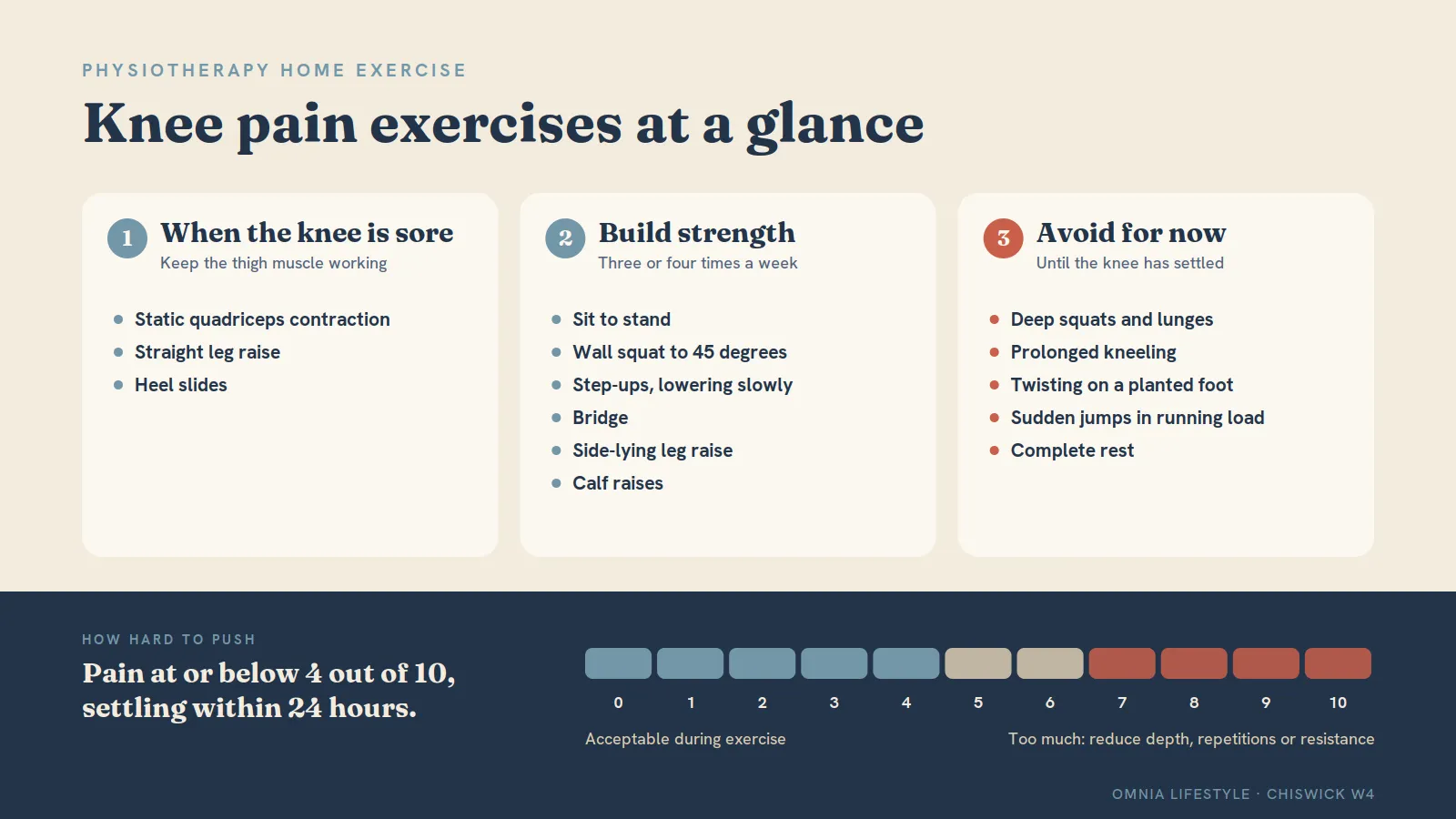
Some discomfort is acceptable. A useful guide is that pain during exercise should stay at or below about 4 out of 10, and should settle back to its usual level within 24 hours. Pain that is sharp, that climbs as you continue, or that leaves the knee more swollen the next day means the load was too high. Reduce the depth, the repetitions or the resistance rather than stopping altogether.
The hip matters as much as the knee. The muscles at the side and back of the hip control how the thigh bone moves over the knee. Weakness there is a common contributor to knee pain, which is why a good knee programme includes hip exercises.
Strength takes time. Expect to work at this three or four times a week for six to twelve weeks before judging the result.
Exercises when the knee is sore
Static quadriceps contraction
Sit or lie with your leg straight. Tighten the muscle at the front of your thigh, pushing the back of your knee down into the bed or floor. Hold for five to ten seconds, relax, and repeat 10 times. This keeps the thigh muscle working when other exercises are too uncomfortable.
Straight leg raise
Lie on your back with the other knee bent. Tighten your thigh, keep the knee straight, and lift the leg to the height of the opposite knee. Hold for three seconds and lower slowly. Build up to three sets of 10.
Heel slides
Lying on your back, slide your heel toward your bottom, bending the knee as far as is comfortable, then slide it back out. Repeat 10 to 15 times. This maintains the bending movement of the knee.
Exercises to build strength
Sit to stand
From a dining chair, stand up and sit down slowly without using your hands, keeping your knees in line with your toes. Build up to three sets of 10. Use a higher seat if this is painful and lower it as you improve.
Wall squat
Stand with your back against a wall and your feet about 30 centimetres away from it. Slide down until your knees are bent to roughly 45 degrees, hold for five to ten seconds, and slide back up. Keep the depth within the pain guide above. Go deeper only as it becomes comfortable.
Step-ups
Step up onto a low step with the affected leg, straighten the knee fully, and lower yourself back down slowly. The slow lowering is the most valuable part. Start with a step of 10 to 15 centimetres and hold a rail for balance.
Bridge
Lie on your back with knees bent and feet flat. Squeeze your buttocks and lift your hips until your body forms a straight line from shoulders to knees. Hold for three seconds and lower. Build up to three sets of 10.
Side-lying leg raise
Lie on your side with the affected leg on top and the lower knee bent for balance. Keeping the top leg straight and slightly behind you, lift it about 30 centimetres and lower slowly. This works the muscles at the side of the hip that control knee alignment.
Calf raises
Holding a worktop for balance, rise onto your toes, pause, and lower slowly. Build up to three sets of 12.
Stretching and general activity
Gentle stretches for the calf, the hamstrings at the back of the thigh and the quadriceps at the front can ease the feeling of tightness around the knee. Hold each for 20 to 30 seconds without bouncing.
Low-impact aerobic exercise complements the strengthening. Cycling, swimming, the cross trainer and brisk walking all keep the joint moving and help with weight management, which significantly reduces the load on the knee.
What to avoid, at least initially
- Deep squats and lunges beyond your comfortable range. Shallow and pain-guided is better than deep and painful.
- Prolonged kneeling and sitting with the knees fully bent.
- Twisting on a planted foot, particularly if the joint line is sore or the knee catches.
- Sudden increases in running distance, hills or speed work. Most running-related knee pain follows a jump in training load.
- Complete rest. It feels protective but weakens the muscles the knee depends on.
Why a generic exercise sheet sometimes fails
The exercises above suit most knee pain, but different causes respond to different loading. Tendon pain usually needs slow, heavy, progressive loading to recover. Patellofemoral pain tends to respond to hip strengthening and temporarily reducing deep knee bending. An irritable osteoarthritic knee often needs a gentler start and a longer build. A sheet aimed at the wrong problem can leave you sore and no stronger.
This is why assessment matters more than the list itself. It establishes what is driving the pain and sets the starting load at the right level.
When to seek medical attention
Seek urgent medical attention if:
- The knee is hot, red and swollen and you feel feverish or unwell
- You cannot put weight through the leg after an injury, or the knee looks misshapen
- The knee swelled rapidly, within a couple of hours of an injury
- The knee is locked and you cannot straighten it
- Your calf is painful, swollen, warm or red. This can be a sign of a blood clot. If it comes with breathlessness or chest pain, call 999
See your GP or a physiotherapist if:
- Pain has lasted more than a few weeks without improvement
- The knee gives way, catches or locks intermittently
- Swelling keeps returning
- Pain regularly wakes you at night
- Pain is stopping you from doing your usual work, sport or daily activities
What a physiotherapy assessment adds
An assessment identifies which structure is the source of the pain, tests the stability of the ligaments, measures strength and movement against the other leg, and looks at how you squat, step and walk. From there a programme is set at the right starting level and progressed as the knee adapts. Hands-on treatment, taping and advice on footwear or training load are added where they are relevant.
Frequently asked questions
Is walking good for knee pain?
Generally yes, within tolerance. Regular walking on level ground keeps the joint moving and the muscles working. Shorten the distance on sore days rather than stopping completely.
Should I exercise if I have knee osteoarthritis?
Yes. Exercise is the core recommended treatment for knee osteoarthritis. It does not wear the joint out, and people who strengthen consistently usually report less pain and better function.
Are squats bad for your knees?
No. Squatting is a normal movement and a useful strengthening exercise. While the knee is painful, keep the depth within comfort and progress gradually.
How long do knee exercises take to work?
Many people notice some improvement within two to four weeks. Meaningful strength gains take six to twelve weeks of regular work.
Should I use heat or ice?
Ice can help after activity if the knee is swollen or warm. Heat can ease stiffness before exercise. Neither treats the underlying cause.
Should I wear a knee support?
A simple elastic support can give comfort and confidence in the short term. It does not replace strengthening, and relying on one long term is not advised unless recommended after assessment.
Do I need a scan?
Not usually. Most knee pain is diagnosed from the history and a physical examination. Imaging is generally reserved for significant injuries, locking, or pain that fails to improve with treatment.
Knee pain assessment and treatment in Chiswick
Knee pain is assessed and treated at Omnia Lifestyle in Chiswick, W4, close to Turnham Green station, on bus routes 94, E3 and 272. Limited parking is available on request when booking. Assessment identifies the source of your knee pain and sets an exercise programme at the right level for it, so that your effort goes into the exercises that will help.
Read more about knee pain and osteoarthritis, see our guide to gait analysis, explore physiotherapy, or book an assessment.
This article is general information, not medical advice. If you have any of the warning signs listed above, seek medical attention.


.jpg)
.jpg)