






Book at our Chiswick clinic
Physiotherapy
Knee pain is one of the most common reasons people see a physiotherapist, whether it follows a twist on the pitch, builds up with running or comes on gradually with age and osteoarthritis. This guide is for anyone whose knee pain is lingering, limiting stairs, walking or sport, or making them wonder whether they need a scan. It explains what physiotherapy for knee pain involves, what NICE and the NHS say, and what it costs in Chiswick.
When to see someone: the NHS suggests seeing a GP if knee pain has not improved within a few weeks, and you can also see a physiotherapist directly. Physiotherapy at Omnia is with HCPC-registered physiotherapists, you do not need a GP referral, and a 70-minute first appointment with assessment and treatment is £99. Book online or call 020 4515 0000.
Quick answer
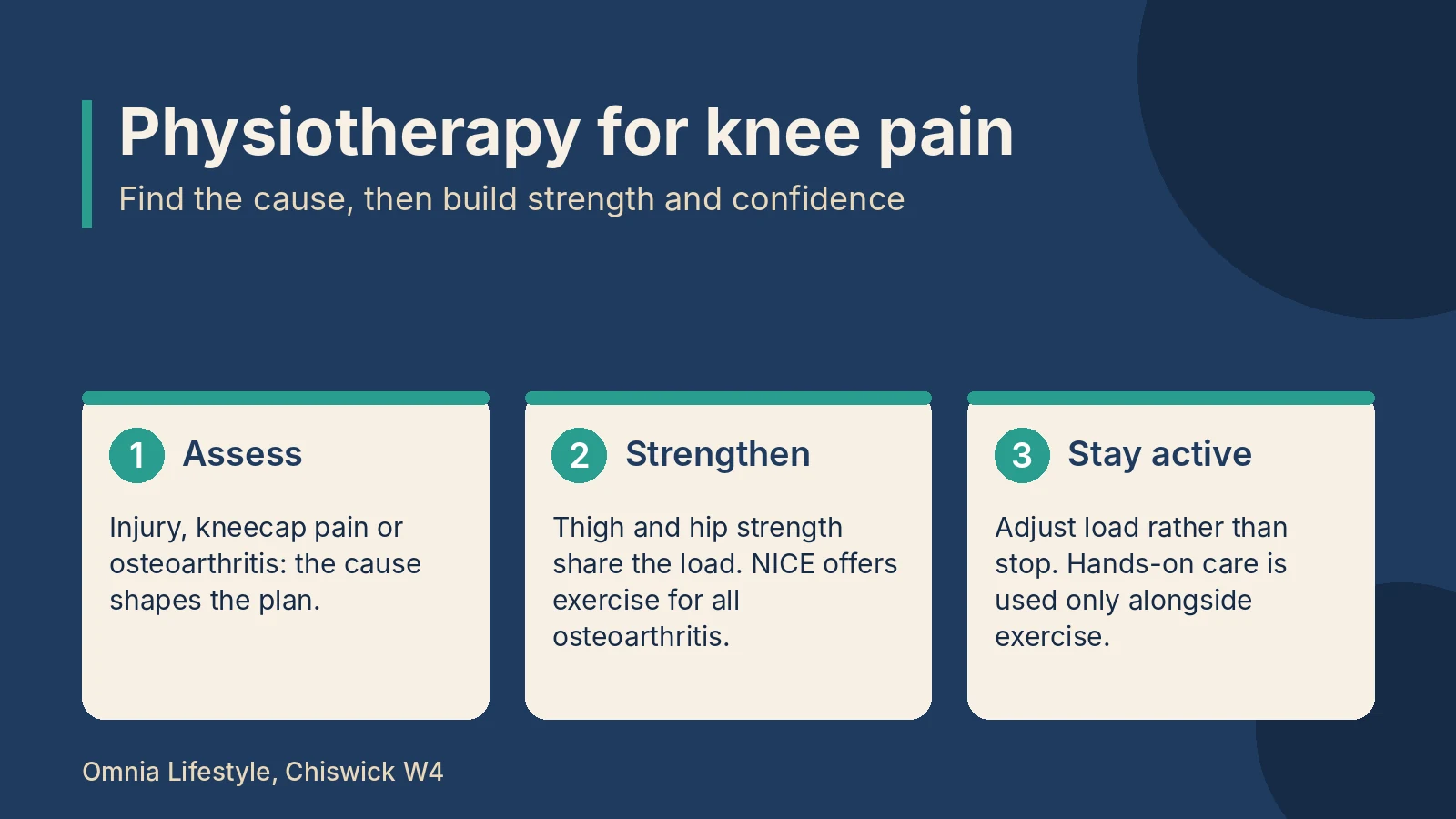
Physiotherapy for knee pain starts with working out the likely cause, then builds a plan around exercise to strengthen the muscles that support the knee, improve movement and restore confidence. For knee osteoarthritis, NICE says therapeutic exercise should be offered to everyone and that weight loss helps if you are overweight. Hands-on therapy is only advised alongside exercise. Physiotherapy cannot reverse joint changes, but regular exercise reduces pain and improves function for many people.
What physiotherapy for knee pain involves
Knee pain has many causes. The NHS lists sprains and strains, tendon problems, torn cartilage or ligaments and a dislocated kneecap after an injury, and osteoarthritis, bursitis and gout among causes with no obvious injury. A physiotherapist starts by narrowing this down, because the plan for a stiff, arthritic knee is different from the plan for kneecap pain in a runner.
- Assessment. How the pain started, where it is, what aggravates it, and tests of movement, strength, stability and how you walk, squat and climb stairs.
- Strengthening. Usually focused on the thigh (quadriceps and hamstrings) and hip muscles, which share the load on the knee.
- Mobility and flexibility. To restore bending and straightening where these are limited.
- Load management. Adjusting running, stairs, kneeling or gym work so the knee can settle while you stay active.
- Manual therapy. Joint mobilisation or soft tissue work to ease pain and stiffness, used alongside exercise.
- Advice on aids. Footwear, a walking stick on the opposite side, or a brace where it genuinely helps.
Many people search for physiotherapy for knee and hip pain together, and the two are often linked. Weak hip muscles can let the knee drift inwards, so your physiotherapist will usually check both. See our exercises for knee pain for the type of moves often included.
Physiotherapy for knee osteoarthritis: what NICE says
NICE guideline NG226 covers osteoarthritis in people aged 16 and over. Its main recommendations for the knee are:
- Diagnosis without a scan. Osteoarthritis can be diagnosed clinically, without imaging, in people aged 45 or over with activity-related joint pain and either no morning stiffness or stiffness lasting no longer than 30 minutes.
- Exercise for everyone. Offer therapeutic exercise tailored to the person, such as local muscle strengthening and general aerobic fitness, and consider supervised sessions.
- Pain at the start is expected. Joint pain may increase when you begin exercising, but regular, consistent exercise will benefit the joint.
- Weight. For people living with overweight or obesity, any weight loss is likely to help, and losing 10% of body weight is likely to be better than 5%.
- Manual therapy. Only consider it for hip or knee osteoarthritis, and only alongside therapeutic exercise.
- Not recommended. Acupuncture or dry needling, and electrotherapy including TENS, ultrasound, interferential, laser therapy and pulsed short-wave therapy, are not recommended for osteoarthritis.
- Supports. Walking aids such as a stick can be considered; insoles, braces and supports are not routinely advised unless the joint is unstable and exercise alone is not enough.
Read more in how to treat osteoarthritis and the stages of osteoarthritis.
Physiotherapy for knee pain and swelling
A swollen knee changes the plan. After a recent injury, the NHS suggests reducing weight on the knee, using a wrapped ice pack for up to 20 minutes every two to three hours, and simple painkillers. A physiotherapist will check whether the swelling points to a ligament or cartilage injury that needs a referral, then use gentle movement and muscle activation to stop the thigh muscles switching off. Swelling with heat, redness and a high temperature is different and needs urgent medical advice. See swollen knee causes and when to worry.
What happens at your first session
Your first appointment at Omnia lasts 70 minutes, so you are assessed and treated the same day. Wear shorts or loose trousers that can roll above the knee. Your physiotherapist will:
- Take a history of the pain, any injury and your activity goals.
- Screen for signs that need a doctor, imaging or a specialist opinion.
- Examine the knee, hip and foot, and watch how you walk, squat and step.
- Explain the likely cause and what to expect.
- Start treatment and teach two or three exercises you can do at home.
How many physio sessions for knee pain?
It depends on the cause and your goals. Some people with a minor strain or kneecap pain need a few sessions to get a clear diagnosis and a home programme they can progress alone. People with osteoarthritis, or those returning to running or sport, often do better with a supervised programme over several weeks, which NICE supports for osteoarthritis. Strength takes time to build, so expect to keep exercising for several months, even after sessions end. Your physiotherapist should agree measurable goals and review them regularly. See how many physiotherapy sessions you may need.
Physiotherapy for knee pain: cost
- First appointment: 70 minutes, £99, including assessment and treatment.
- Follow-up sessions: £70 for 30 minutes or £90 for 45 minutes.
- Consultation only: £50 for 30 minutes.
- Home visit physiotherapy: across West London from £110, useful if stairs or travel are difficult.
Physiotherapy at Omnia is recognised by AXA Health, Vitality, WPA and Aviva; policies vary, so check your cover. See physiotherapy costs in the UK.
Physiotherapy for knee pain at home
- Stay active within comfort. Short, regular walks are usually better than resting completely or doing too much on one day.
- Strengthen little and often. Sit-to-stand, straight leg raises, step-ups and bridges are common starting points. Mild discomfort during exercise is usually acceptable, but pain that is sharp or worse the next day means you should scale back.
- Use ice for flare-ups. Wrapped, for up to 20 minutes.
- Try low-impact exercise. Cycling and swimming load the knee less than running.
- Consider gentle movement practices. Tai chi is a low-impact option some people with knee osteoarthritis enjoy.
For older adults, balance work matters too, as knee pain and weak legs raise the risk of falls. Our balance exercises for seniors are a safe place to start.
Who should take extra care
- After a knee injury with a pop, rapid swelling or giving way. This may be a ligament or cartilage injury and needs assessment before exercise.
- Older adults with knee pain. Physiotherapy for knee pain in old age focuses on strength, balance and walking confidence; tell your physiotherapist about other conditions and medicines.
- People taking blood thinners. The NHS notes bleeding into the joint is more likely, so new swelling should be checked.
- Teenagers. Pain below the kneecap in active young people may be Osgood Schlatter disease, which the NHS lists as a cause of knee pain in teenagers and young adults. A GP or physiotherapist can advise on managing activity.
When to see a doctor urgently
Call NHS 111 or get urgent medical help if:
- Your knee is very painful, or you cannot move it or put any weight on it
- Your knee is badly swollen or has changed shape
- Your knee locks, gives way or painfully clicks
- You have a very high temperature, or feel hot, cold or shivery, with redness or heat around the knee
A hot, swollen, red knee with fever can be a sign of joint infection or gout and needs to be seen the same day. Do not start physiotherapy until this has been checked.
Frequently asked questions
When should I see a physio for knee pain?
The NHS suggests getting help if knee pain has not improved within a few weeks of self-care. It is also worth seeing a physiotherapist sooner if pain is stopping you walking, working or exercising, or if you want advice before returning to sport. If you have any of the urgent signs above, see a doctor first.
Does physiotherapy help knee osteoarthritis?
Yes. NICE says therapeutic exercise should be offered to everyone with osteoarthritis, and a physiotherapist can tailor and supervise it. Exercise does not reverse joint changes, but it often reduces pain and improves function. NICE also notes pain may rise at first when you start, and that sticking with exercise long term increases the benefit.
Do knee physiotherapy machines or ultrasound help?
For knee osteoarthritis, NICE does not recommend TENS, ultrasound, interferential, laser or pulsed short-wave therapy because there is not enough evidence of benefit. Exercise, weight management and education are the core treatments. Equipment should only ever be an add-on, never a replacement for an exercise programme.
Do I need a scan before physiotherapy for knee pain?
Not usually. NICE says osteoarthritis can be diagnosed without imaging in people aged 45 or over with typical symptoms. For injuries, a physiotherapist can assess the knee and refer you for a scan or specialist opinion if signs suggest a significant ligament or cartilage tear, or if you are not improving as expected.
Physiotherapy for knee pain in Chiswick
Our clinic is at 8 to 9 Bedford Corner, The Avenue, Chiswick W4 1LZ, close to Turnham Green station, on bus routes 94, E3 and 272. Limited parking is available on request when booking. Physiotherapists, acupuncturists and massage therapists work under one roof, so treatments can be combined where that suits you.
Read more about knee pain and osteoarthritis, see runner's knee exercises, or read physio after knee replacement if surgery is planned.
Book physiotherapy in Chiswick: first appointment £99, including assessment and treatment. Book online or call 020 4515 0000.
This article is general information, not medical advice. If you have any of the warning signs above, seek medical attention.
Ready to book?
Physiotherapy




.jpg)
.jpg)
