


Book at our Chiswick clinic
Physiotherapy
Golfer's elbow causes pain on the inner side of the elbow, and despite its name most people who get it have never played golf. It is common in people who grip, lift or twist repeatedly, from tradespeople and gym-goers to keen gardeners and racquet players. Like tennis elbow on the outside of the elbow, it responds best to gradually loading the tendon rather than resting it completely.
This guide explains what golfer's elbow is, the exercises that help, changes to daily tasks that reduce strain, how long recovery takes, and the symptoms that need checking.
Quick answer
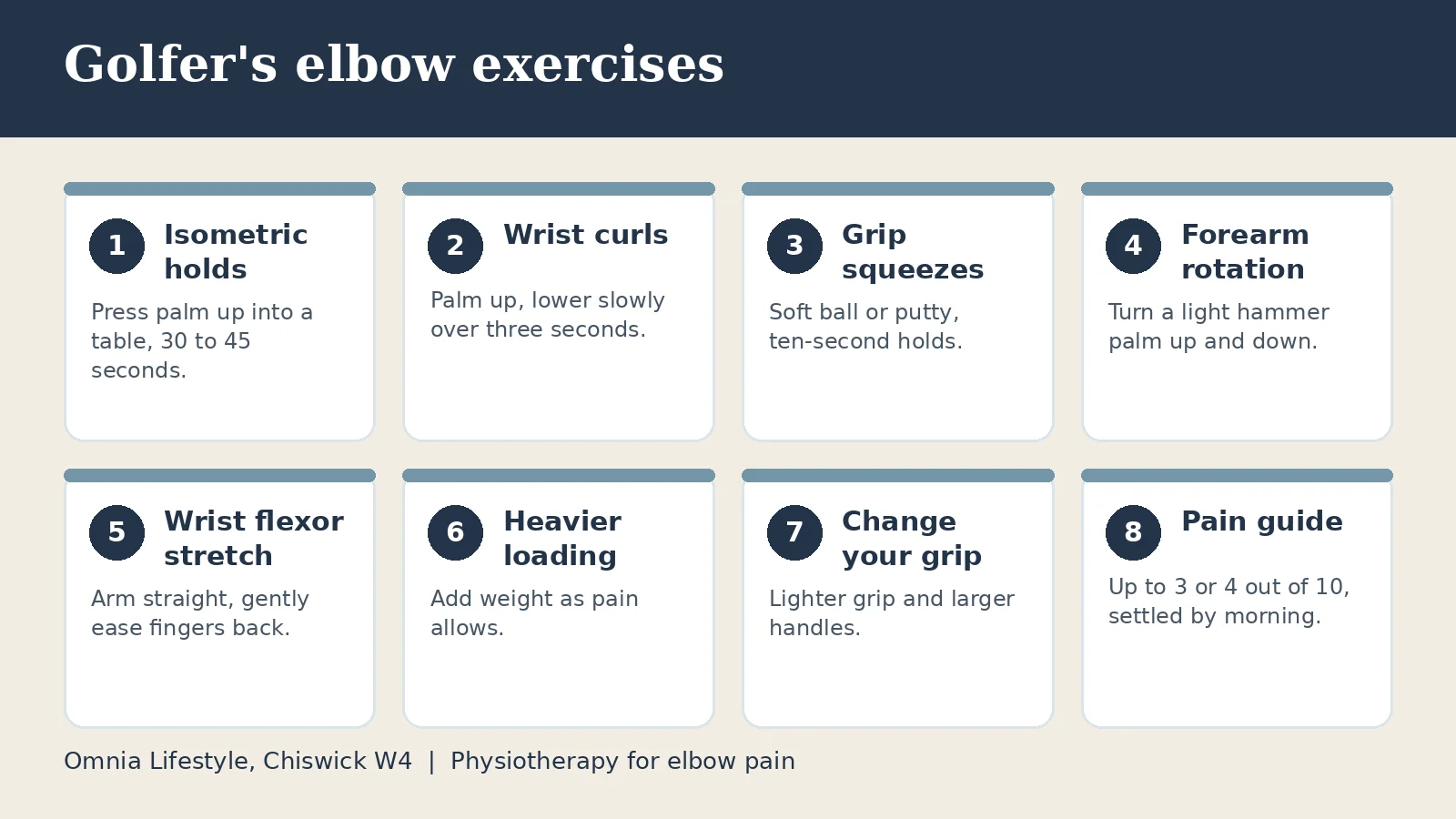
Golfer's elbow is a tendon problem where the forearm muscles that bend the wrist attach to the inner elbow. Ease it with isometric holds, then strengthen with slow wrist curls, grip work and forearm rotation, keeping pain to around 3 or 4 out of 10 and settled by the next morning. Reduce heavy gripping and lifting with the palm up for a while. Most people improve over six to twelve weeks, though some cases take longer. Tingling in the ring and little fingers should be assessed.
What golfer's elbow is
Medically called medial epicondylalgia, golfer's elbow affects the tendon that attaches the wrist and finger flexor muscles to the bony bump on the inside of the elbow. Repeated gripping, lifting and wrist bending, especially when the load increases suddenly, can overload the tendon faster than it adapts. It is mainly a tendon overload problem rather than inflammation.
Typical symptoms
- Pain and tenderness on the inner side of the elbow
- Pain when gripping, lifting, shaking hands or turning a door handle
- Pain when bending the wrist towards the palm against resistance
- Stiffness and a weaker grip
When to get it checked
See a GP or physiotherapist if you have tingling or numbness in the ring and little fingers, which can mean the ulnar nerve is involved, if the elbow is swollen, hot or red, if pain followed a fall or a pop, or if you cannot fully straighten or bend the elbow.
The principles that matter
Reduce aggravating load, do not stop using the arm. Tendons need the right amount of load to recover.
Progress gradually. Increase weight or repetitions every week or two as the pain allows.
Use pain as a guide. Discomfort up to about 3 or 4 out of 10 is acceptable during exercise if it settles by the next morning.
Exercises to start with
1. Isometric holds
Sit with your forearm resting on a table, palm facing up. Press the palm upwards into the underside of the table, or hold your other hand on top as resistance, without moving. Hold for 30 to 45 seconds at a moderate effort, five times. This often eases tendon pain.
2. Wrist curls
With your forearm supported and palm up, hold a light weight or a tin of beans. Curl the wrist up, then lower slowly over three seconds. Three sets of 15. The slow lowering phase is the most important part.
3. Grip squeezes
Squeeze a soft ball or putty and hold for 10 seconds, ten times. Increase firmness as it becomes easy.
Exercises to progress to
4. Forearm rotation
Hold a light hammer or a small weight at one end, elbow bent and supported. Slowly turn the palm up and down. Three sets of 10 each way.
5. Wrist flexor stretch
Hold your arm out straight, palm up. With the other hand, gently ease the fingers back towards you until you feel a stretch along the inner forearm. Hold for 30 seconds, three times.
6. Heavier loading
As symptoms settle, increase the weight for wrist curls and grip work and add everyday tasks such as carrying shopping, building up gradually over several weeks.
Changes to everyday tasks
- Lift with your palm facing down or use both hands where possible.
- Use a lighter grip, and larger handles on tools, pens and racquets.
- Take regular breaks from repetitive gripping, typing or tool use.
- In the gym, reduce heavy pulling, curls and grip-intensive exercises for a while, and use straps where appropriate.
- Check your technique in golf, racquet sports and climbing.
What else can help
An elbow brace worn just below the joint can ease pain during activity for some people. Steroid injections may give short-term relief but often do not help in the long term, and can make recurrence more likely, so they are usually reserved for specific cases after discussion with your GP. Acupuncture and soft tissue work can ease pain alongside a loading programme.
How long does golfer's elbow take to heal?
Many people notice improvement within six to twelve weeks of consistent exercise. Tendon problems that have been present for a long time can take several months. Keeping up strength work once the pain settles helps prevent it returning.
Frequently asked questions
What is the difference between golfer's and tennis elbow?
Golfer's elbow affects the inner side of the elbow and the muscles that bend the wrist. Tennis elbow affects the outer side and the muscles that straighten it. See our tennis elbow exercises.
Should I rest golfer's elbow?
Reduce the activities that clearly aggravate it, but keep using the arm and start loading exercises. Complete rest tends to leave the tendon weaker.
Can I keep going to the gym?
Usually yes, with changes. Reduce heavy gripping and pulling, and keep training the rest of your body.
Should I use ice or heat?
Either can ease discomfort. Ice suits a sore, irritated elbow after activity. Neither treats the cause.
Does a brace help?
Some people find a counterforce brace reduces pain during activity. It works best alongside exercise.
Elbow pain treatment in Chiswick
Elbow pain is assessed and treated at Omnia Lifestyle, 8 to 9 Bedford Corner, The Avenue, Chiswick W4 1LZ, close to Turnham Green station, on bus routes 94, E3 and 272. Limited parking is available on request when booking. Assessment confirms the cause, checks the nerve and neck, and sets a loading programme matched to your work, sport and daily tasks.
Read more about sports injuries, see how to treat tennis elbow, explore physiotherapy and acupuncture, or book an assessment.
This article is general information, not medical advice. If you have any of the warning signs listed above, seek assessment.
Ready to book?
Physiotherapy


.jpg)
.jpg)