


Book at our Chiswick clinic
Physiotherapy
Shin splints are one of the most common running injuries, especially for people who are new to running, returning after a break or increasing their mileage quickly. The pain usually builds along the inside edge of the shinbone and can make every run feel harder, but with the right changes most people recover fully without stopping exercise altogether.
This guide explains what shin splints are, how to tell them apart from a stress fracture, the exercises that help, how to return to running, and when shin pain needs to be checked.
Quick answer
Shin splints, or medial tibial stress syndrome, cause aching along the inner edge of the shinbone, usually from increasing running load too quickly. Reduce running rather than stopping all activity, strengthen the calves, the muscles under the arch and the hips, then return gradually with a walk-run plan and slightly shorter, quicker strides. Most people improve within two to six weeks. Pain in one small spot, pain at rest or at night, or pain when hopping can mean a stress fracture and needs assessment.
What shin splints are
The muscles of the lower leg attach along the inner edge of the shinbone. When running load rises faster than the bone and these tissues can adapt, the lining of the bone becomes irritated and painful. It is a bone stress problem, which is why the answer is a gradual build in load rather than either pushing through or complete rest.
Common triggers
- A sudden increase in distance, speed, hills or number of runs a week
- Starting running, or returning after time off
- Running mainly on hard surfaces, or a change of surface
- Worn-out shoes, or a sudden change of footwear
- Weak calf and hip muscles
- Low energy intake, low vitamin D or, in women, missed periods, which all reduce bone health
Shin splints or a stress fracture?
Shin splints usually cause diffuse tenderness along several centimetres of the inner shin, pain that eases during a run once warmed up, and aching afterwards. A stress fracture is more likely if:
- The pain is in one small spot you can cover with a fingertip
- It hurts at rest or wakes you at night
- Hopping on the affected leg is painful
- Pain is getting worse rather than better despite reducing running
These signs need assessment, and sometimes a scan, because a stress fracture needs a longer break from impact.
Pain that comes on during exercise with a feeling of tightness, numbness or weakness in the foot, and settles within minutes of stopping, can be a different condition called exertional compartment syndrome and should also be assessed. Severe, increasing pain and tightness after an injury is an emergency.
The principles that matter
Reduce, do not stop. Cut running to a level that does not increase pain, and keep fit with cycling, swimming or cross-training.
Strengthen. Stronger calf, foot and hip muscles absorb more of the load that would otherwise pass to the bone.
Build back gradually. Increase total weekly running by small steps, and add hills and speed last.
Exercises for shin splints
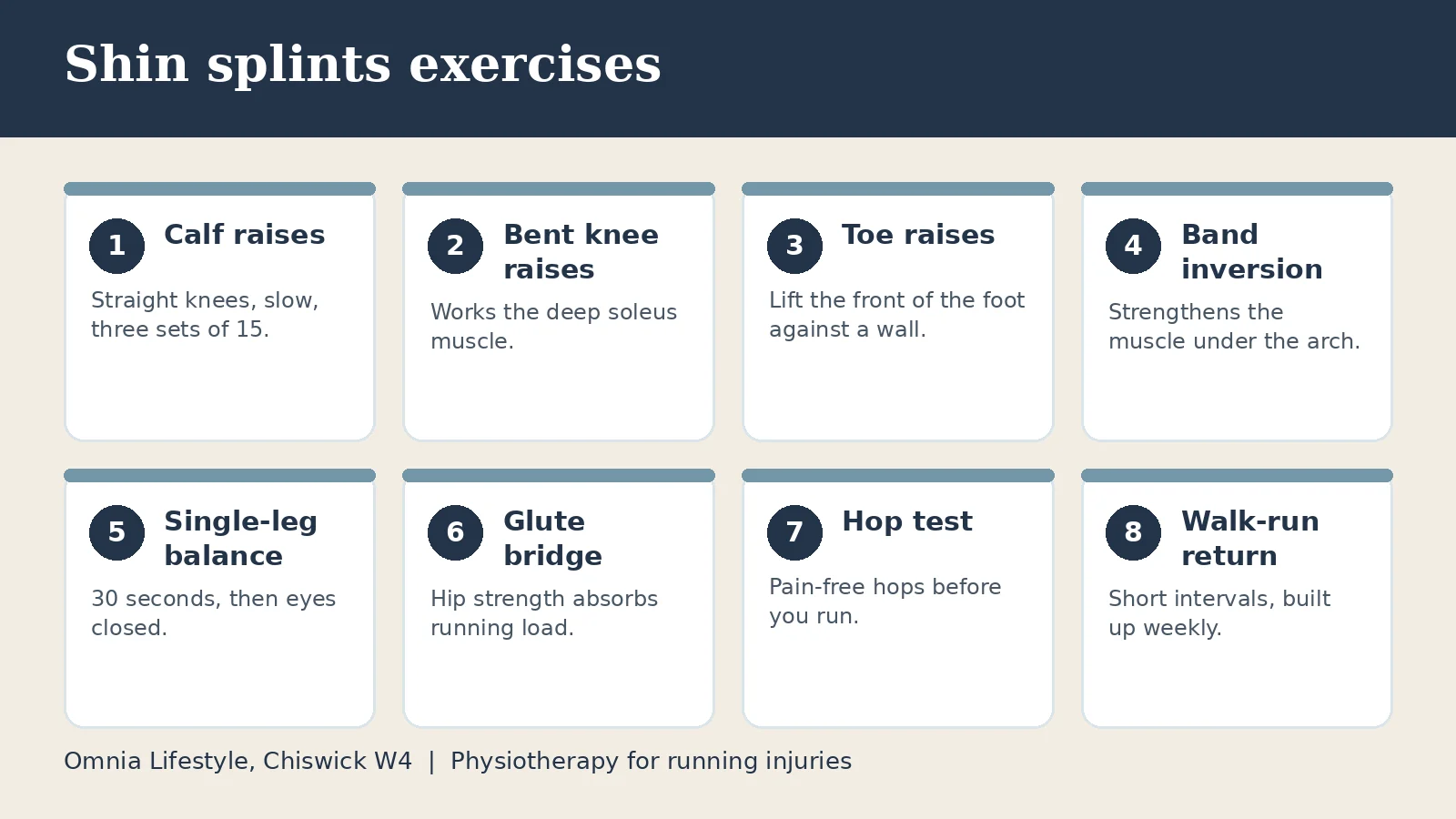
1. Calf raises
Stand holding a worktop and rise onto your toes, then lower slowly over three seconds. Build up to three sets of 15, then progress to one leg at a time.
2. Bent knee calf raises
Do the same with your knees slightly bent, or sitting with a weight on your knees, to work the soleus, the deep calf muscle that takes much of the running load.
3. Toe raises
Stand with your back against a wall and heels a little way from it. Lift the front of both feet off the floor, then lower slowly. Three sets of 15. This strengthens the muscle at the front of the shin.
4. Band inversion
Sit with a resistance band around the inside of your foot. Turn the sole of your foot inwards against the band, then return slowly. Three sets of 15. This works the tibialis posterior, a muscle that supports the arch and attaches along the inner shin.
5. Single-leg balance
Stand on one leg for 30 seconds, three times each side. Make it harder by closing your eyes or standing on a cushion.
6. Glute bridge
Lie on your back with knees bent, lift your hips and hold for five seconds. Build up to three sets of 10, then progress to single-leg bridges. Strong hips help control how your leg lands.
7. Hop test
Before you run again, you should be able to hop 10 to 20 times on the affected leg without pain. If you cannot, keep strengthening for another week.
Returning to running
- Start with walk-run intervals, such as one minute running and one minute walking, for 20 minutes on alternate days.
- Increase the running portion each week if pain stays at or below 3 out of 10 during the run and has settled by the next morning.
- Use softer surfaces, such as grass or trails, while building up.
- Shorten your stride slightly. Increasing your step rate by around 5 to 10 per cent reduces the load on the shin with each step.
- Add hills, speed and long runs last, one at a time.
What to avoid
- Running through pain that is getting worse during the run
- Large jumps in weekly distance
- Complete rest for weeks, which leaves the bone and muscles less prepared
- Under-eating while training, which harms bone health
Frequently asked questions
How long do shin splints take to heal?
Most people improve within two to six weeks of sensible changes, although a full return to previous running can take two to three months.
Should I ice my shins?
Ice can ease pain after running but does not treat the cause. Load management and strength do.
Do compression socks or new trainers help?
Some runners find compression comfortable, and replacing worn shoes is sensible. Neither replaces strengthening and a gradual build in load.
Can I keep running with shin splints?
Often yes, at reduced volume, if pain stays mild and settles by the next morning. Stop and get checked if pain becomes sharp or localised.
Why do shin splints keep coming back?
Usually because running load rose again too quickly, or strength work stopped once the pain settled. Keep two strength sessions a week as part of your training.
Shin pain assessment in Chiswick
Shin and running injuries are assessed and treated at Omnia Lifestyle, 8 to 9 Bedford Corner, The Avenue, Chiswick W4 1LZ, close to Turnham Green station, on bus routes 94, E3 and 272. Limited parking is available on request when booking. Assessment checks for signs of a stress fracture, looks at strength and how you run, and builds a plan to get you back to running safely.
Read more about sports injuries, see what gait analysis shows, explore physiotherapy and sports massage, read our Achilles tendinopathy exercises, or book an assessment.
This article is general information, not medical advice. If you have any of the warning signs listed above, seek assessment before continuing to run.
Ready to book?
Physiotherapy



.jpg)
.jpg)