


Book at our Chiswick clinic
Physiotherapy
A hamstring strain usually happens in a split second: a sharp pain in the back of the thigh while sprinting, kicking or stretching for a ball. It is one of the most common injuries in football, rugby, running and racquet sports, and one of the most likely to happen again if rehabilitation stops too soon.
This guide explains how hamstring strains are graded, what to do in the first few days, the exercises that rebuild strength, the return-to-sport checks that reduce the chance of re-injury, and when an injury needs urgent specialist review.
Quick answer
For a hamstring strain, protect the leg for the first few days but keep it gently moving, then start loading early with isometric holds and bridges. Progress to single-leg Romanian deadlifts and Nordic curls, which also reduce the risk of future strains, and rebuild running speed step by step. Mild strains often recover in one to three weeks and moderate strains in four to eight. A pop high near the buttock, large bruising or difficulty walking needs prompt specialist assessment.
How hamstring strains are graded
- Grade 1 (mild): a few fibres strained. Tightness and pain, but you can usually walk normally and may finish the session.
- Grade 2 (moderate): a partial tear. Sudden pain, often limping, bruising after a day or two and weakness when bending the knee.
- Grade 3 (severe): a complete or near-complete tear, sometimes pulling the tendon off the bone near the buttock. Severe pain, extensive bruising and difficulty walking.
When to seek urgent assessment
See a sports medicine doctor or orthopaedic specialist promptly, ideally within days, if you felt a pop high up near the sitting bone, have extensive bruising down the back of the thigh, can feel a gap, or cannot walk without significant difficulty. These can be signs of a tendon avulsion, which sometimes needs surgery and is best repaired early.
The first few days
- Protect it: avoid sprinting and stretching into pain.
- Keep moving: walk as normally as comfort allows. Early, gentle movement helps the healing tissue line up properly.
- Compression and elevation can help limit swelling.
- Ice wrapped in a cloth may ease pain.
Stage 1: early loading
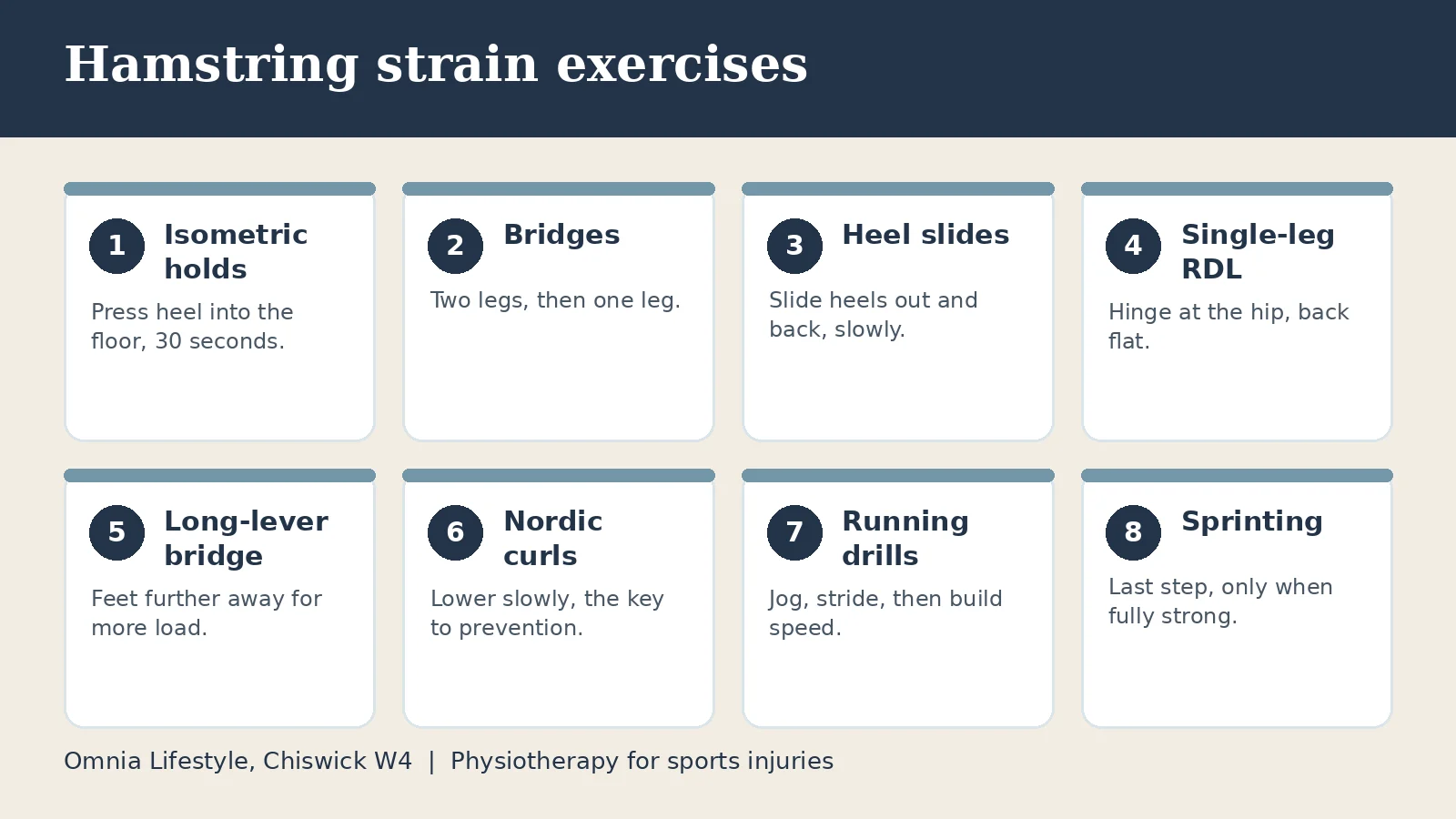
1. Isometric holds
Lie on your back with your knee bent. Press your heel gently down into the floor as if trying to drag it towards you, without moving. Hold for 30 seconds at a comfortable effort, five times. Increase the effort as pain settles.
2. Bridges
Lie on your back with knees bent and lift your hips. Hold for five seconds and lower slowly. Build to three sets of 10, then progress to single-leg bridges.
3. Heel slides
Lie on your back, slowly slide your heel away until the leg is nearly straight, then pull it back. Three sets of 10, within comfort.
Stage 2: strength
4. Single-leg Romanian deadlift
Stand on the injured leg with a slight bend in the knee. Hinge forward at the hip, keeping your back flat, as your other leg extends behind you. Return to standing. Start with body weight and add a weight as you get stronger. Three sets of 8 to 10.
5. Long-lever bridges
Do bridges with your feet further from your hips, which places more load on the hamstrings.
6. Nordic hamstring curls
Kneel with your ankles held by a partner or anchored under a sofa. Keeping your body straight from knees to shoulders, lower yourself forwards as slowly as you can, catching yourself with your hands. Start with a small range and low numbers. Research shows regular Nordic curls substantially reduce the risk of hamstring injuries in sport.
Stage 3: running and speed
- Jog comfortably on flat ground
- Build up to strides at 60 to 70 per cent of your top speed
- Progress to 80 and then 90 per cent over several sessions
- Add acceleration, deceleration and changes of direction
- Sprint at full speed only when everything else is pain free
Before returning to sport
- Hamstring strength similar on both sides
- Full, pain-free range of movement
- Pain-free sprinting at full speed
- Sport-specific drills completed without hesitation
Most re-injuries happen in the first few weeks back, often because sport resumed before strength and speed had fully returned. Keeping Nordic curls in your weekly routine after you return is one of the best protections.
Frequently asked questions
How long does a hamstring strain take to heal?
Mild strains often take one to three weeks, moderate strains four to eight weeks, and severe tears three months or more, sometimes with surgery.
Should I stretch a pulled hamstring?
Not aggressively in the first days. Gentle movement within comfort is fine, and strength work is more important than stretching for recovery.
Heat or ice?
Ice can ease pain early on. Heat may feel better for stiffness after the first few days. Neither replaces loading.
Can sports massage help?
Massage can ease tightness and help you feel ready to train, but it works best alongside a progressive strength programme. See sports massage in Chiswick.
Is back pain linked to hamstring problems?
Sometimes. Pain in the back of the thigh can be referred from the lower back or from an irritated sciatic nerve. See our sciatica exercises guide if pain travels below the knee.
Hamstring injury treatment in Chiswick
Hamstring injuries are assessed and treated at Omnia Lifestyle, 8 to 9 Bedford Corner, The Avenue, Chiswick W4 1LZ, close to Turnham Green station, on bus routes 94, E3 and 272. Limited parking is available on request when booking. Assessment grades the injury, checks for signs that need specialist review and sets a rehabilitation plan through to full-speed return to sport.
Read more about sports injuries, explore physiotherapy and Pixformance guided strength training, or book an assessment.
This article is general information, not medical advice. If you have any of the warning signs listed above, seek prompt specialist assessment.
Ready to book?
Physiotherapy


.jpg)
.jpg)