


Book at our Chiswick clinic
Physiotherapy
Rounded shoulders, a forward head and an aching upper back are the signature of modern life: hours at a desk, on a laptop and looking down at a phone. The good news is that a few simple posture exercises, done regularly, can make you feel more upright and comfortable. You do not need to hold a perfect position all day. What matters is moving often and building strength in the muscles that hold you up.
This guide gives eight posture exercises you can do at home, at the gym or with resistance bands, with gentler versions for seniors, plus desk tips that make a real difference.
Quick answer
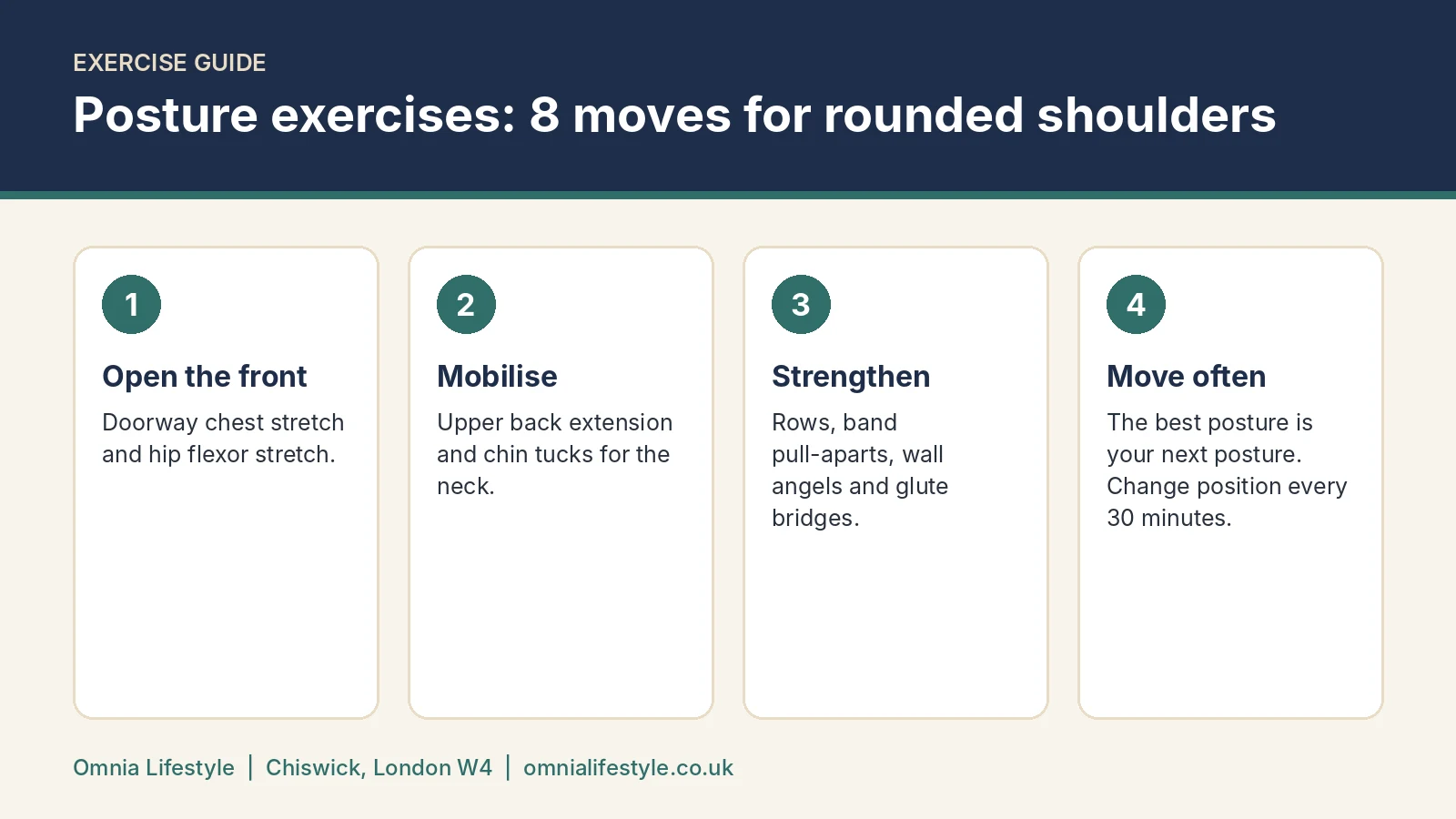
The most useful posture exercises open up the chest and hips, mobilise the upper back and strengthen the muscles between the shoulder blades and around the hips. Try chin tucks, a doorway chest stretch, upper back extension, band pull-aparts, rows, wall angels, glute bridges and a hip flexor stretch, three or four times a week. Change position at least every 30 minutes during the day.
Does posture really matter?
Research shows that no single posture is right for everyone, and the link between posture and pain is weaker than once thought. Staying in any one position for a long time is the bigger problem. Even so, many people with rounded shoulders and neck or upper back aches feel better when they strengthen their upper back, stretch tight areas and move more often. These exercises help you feel stronger and more comfortable whatever your natural shape.
8 posture exercises
1. Chin tucks
Sit or stand tall. Gently draw your chin straight back, as if making a double chin, keeping your eyes level. Hold for 3 seconds and release. Repeat 10 times. This strengthens the deep neck muscles and counters a forward head.
2. Doorway chest stretch
Place your forearms on either side of a door frame at shoulder height and step one foot forwards until you feel a stretch across the chest. Hold for 30 seconds, twice. Tight chest muscles pull the shoulders forwards.
3. Upper back extension
Sit in a chair with your hands supporting your head. Gently lean back over the top of the chair, then return. Repeat 10 times. You can also lie over a rolled towel or foam roller placed across your upper back.
4. Band pull-aparts
Hold a light resistance band in front of you at shoulder height with straight arms. Pull it apart by squeezing your shoulder blades together, then return slowly. Three sets of 15.
5. Rows
Loop a band around a sturdy post, or use light dumbbells while leaning forward. Pull your elbows back past your body, squeeze your shoulder blades, and lower slowly. Three sets of 12. At the gym, use a seated cable row.
6. Wall angels
Stand with your back, head and bottom against a wall, arms bent in a W shape against the wall. Slowly slide your arms up into a Y and back down, keeping contact with the wall as much as is comfortable. Three sets of 10.
7. Glute bridges
Lie on your back with knees bent and feet flat. Squeeze your glutes and lift your hips until your body forms a straight line from shoulders to knees. Lower slowly. Three sets of 12. Strong glutes support your pelvis and lower back.
8. Hip flexor stretch
Kneel on one knee with the other foot in front. Tuck your pelvis under, squeeze the glute of the kneeling leg and shift forwards gently until you feel a stretch at the front of the hip. Hold for 30 seconds, twice on each side. See hip flexor stretches for more.
Posture exercises with resistance bands
Resistance bands make posture exercises easy to do at home or while travelling. Band pull-aparts, rows, external rotations (elbow at your side, rotating the forearm outwards) and face pulls (pulling the band towards your forehead with elbows high) all target the upper back and the back of the shoulders.
Posture exercises at the gym
At the gym, focus on pulling exercises: seated cable rows, face pulls, lat pulldowns to the front and reverse flys. A good rule is to do at least as much pulling as pushing, so that chest and shoulder pressing is balanced.
Posture exercises for women and men
The same exercises work for everyone. Women who are pregnant or have recently had a baby, or who have a larger bust, often find upper back strengthening especially helpful. Men who lift weights often benefit from more pulling and chest stretching to balance heavy pressing.
Posture exercises for seniors
Older adults can do seated versions: chin tucks, seated shoulder blade squeezes, seated rows with a light band, and seated upper back extension in a sturdy chair. Standing tall with good balance also matters, so see balance exercises for seniors. If you have osteoporosis, avoid forceful bending forwards and check new exercises with your physiotherapist.
Desk tips that help posture
- Screen at eye level, about an arm's length away
- Elbows at your sides, forearms supported
- Feet flat on the floor, hips slightly higher than knees
- Use a separate keyboard and mouse with a laptop
- Stand up, walk or stretch every 30 minutes
- Hold your phone up rather than looking down
See the damage of sitting all day and how to reverse it.
How long until posture improves?
Most people feel less stiff and more upright within two to four weeks of regular exercise. Building real strength takes six to twelve weeks of doing the exercises three or four times a week.
When to see a professional
- Neck or back pain that has lasted more than six weeks
- Pain, pins and needles or weakness spreading into the arms
- A noticeable curve or change in your spine, or loss of height
- Pain that wakes you at night or comes with feeling unwell
Frequently asked questions
Can you fix bad posture?
You can improve how your body feels and moves at any age with regular exercise and movement. Your natural shape may not change completely, and that is normal.
Do posture correctors work?
They can remind you to sit up for short periods, but they do not build strength. Exercise works better in the long term.
How often should I do posture exercises?
Stretches can be done daily. Strengthening exercises work best three or four times a week.
Can posture cause headaches?
Long periods with your head forward can contribute to tension-type headaches. See how to relieve a tension headache.
Posture assessment in Chiswick
Our physiotherapists assess posture, movement and strength and build a personal exercise plan, at Omnia Lifestyle, 8 to 9 Bedford Corner, The Avenue, Chiswick W4 1LZ, close to Turnham Green station, on bus routes 94, E3 and 272. Limited parking is available on request when booking. Styku 3D body scanning and Pixformance guided training are also available.
Explore physiotherapy in London, read upper back pain between the shoulder blades, or book an assessment.
This article is general information, not medical advice. If you have any of the warning signs listed above, speak to a health professional.
Ready to book?
Physiotherapy


.jpg)
.jpg)