


Book at our Chiswick clinic
Physiotherapy
Tight hip flexors are one of the most common complaints among people who sit for long periods, runners, cyclists and anyone returning to exercise. They can make the front of the hips feel stiff, limit your stride and, for some people, contribute to lower back discomfort. The good news is that a few minutes of the right stretches and exercises each day can make a real difference.
This guide covers seven hip flexor stretches and exercises, with options for beginners and older adults, how they relate to lower back pain, how often to do them and when hip pain needs a physiotherapist.
Quick answer
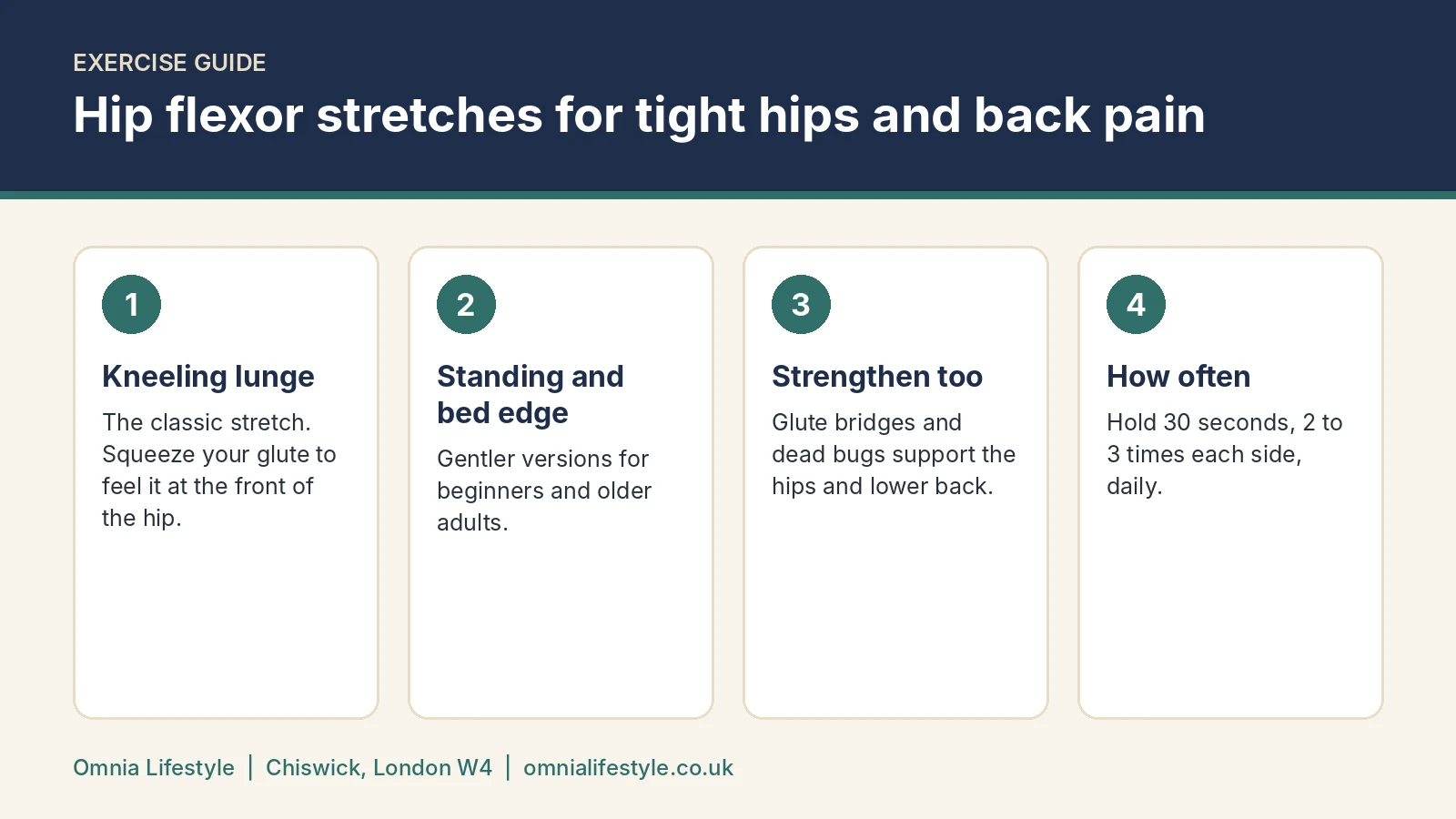
The best hip flexor stretch for most people is the half-kneeling hip flexor stretch: kneel on one knee, tuck your pelvis under, squeeze the glute of the kneeling leg and shift gently forward until you feel a stretch at the front of the hip. Hold for 30 seconds, two to three times each side, daily. Gentler standing and bed-edge versions suit beginners and seniors. Add glute bridges and dead bugs to strengthen the muscles that support the hips and lower back.
What are the hip flexors?
The hip flexors are the muscles that lift your thigh towards your body, for example when you climb stairs, run or kick. The main ones are the iliopsoas (the psoas and iliacus, which attach to the lower spine and pelvis), the rectus femoris (one of the quadriceps), the tensor fasciae latae and the sartorius. Because the psoas attaches to the lumbar spine, tight or overworked hip flexors can affect how your lower back feels.
Signs of tight hip flexors
- Stiffness at the front of the hip, especially after sitting
- A shorter stride when walking or running
- Difficulty standing fully upright after getting out of a chair
- An ache in the lower back after long periods of standing
- Struggling to straighten the hip in a lunge
7 hip flexor stretches and exercises
1. Half-kneeling hip flexor stretch
Kneel on your right knee on a cushion with your left foot flat in front. Tuck your pelvis under as if flattening your lower back and squeeze your right glute. Shift your weight gently forward until you feel a stretch at the front of the right hip. Keep your back upright. Hold for 30 seconds, then swap sides.
2. Half-kneeling stretch with side reach
From the position above, raise your right arm overhead and lean slightly to the left. This targets the psoas higher up towards the lower back. Hold for 30 seconds each side.
3. Standing hip flexor stretch
Stand in a split stance with one foot about a stride in front of the other, holding a wall or chair for balance. Tuck your pelvis, squeeze the glute of the back leg and bend the front knee slightly until you feel the stretch at the front of the back hip. Hold for 30 seconds each side. This is a good option if kneeling is uncomfortable.
4. Bed-edge hip flexor stretch
Lie on your back near the edge of a firm bed. Hug one knee to your chest and let the other leg hang gently off the edge of the bed. Relax and breathe for 30 to 60 seconds, then swap sides. This gentle version suits beginners, older adults and anyone with knee problems.
5. Couch stretch (advanced)
Kneel with your back to a sofa or wall, with one shin resting up against it and the other foot flat in front. Slowly bring your upper body upright. This is a strong stretch for the hip flexors and quadriceps, so only use it once the gentler versions feel easy.
6. Glute bridge
Lie on your back with your knees bent and feet flat. Squeeze your glutes and lift your hips until your body forms a straight line from shoulders to knees. Hold for two seconds and lower slowly. Do 2 to 3 sets of 10 to 12. Strong glutes help the hip flexors relax and support the lower back.
7. Dead bug
Lie on your back with your arms pointing to the ceiling and your hips and knees bent at 90 degrees. Keeping your lower back gently pressed to the floor, slowly lower the opposite arm and leg, then return. Do 2 to 3 sets of 8 to 10 each side. This trains the deep core muscles to work with the hip flexors.
Hip flexor stretches for lower back pain
Tight hip flexors are often blamed for lower back pain. The research is mixed: hip flexor tightness alone does not explain most back pain, but many people find that hip stretches combined with strengthening and regular movement make their back feel better. Start with stretches 1, 3 and 4, and add exercises from our guide to lower back pain exercises. Avoid arching your lower back during any stretch, as this moves the stretch away from the hip.
Hip flexor stretches for beginners
If you are new to stretching, start with the standing and bed-edge stretches. Hold each stretch for 20 to 30 seconds, breathe slowly and stop at a comfortable stretch, not pain. Once these feel easy, move to the half-kneeling stretch.
Hip flexor stretches for seniors
For older adults, safety and balance come first. Use the standing stretch while holding a sturdy chair or worktop, or the bed-edge stretch. Avoid kneeling on hard floors, and get up and down slowly. If you have had a hip replacement, check with your surgeon or physiotherapist which positions are safe for you.
Hip flexor stretches for men and women
The same stretches work for everyone. Men often have less natural hip flexibility, so may need to start with gentler versions. Women who are pregnant should avoid lying flat on the back for long periods later in pregnancy and avoid overstretching, as pregnancy hormones make joints looser. A physiotherapist can advise on safe options.
Hip flexor stretches for pain: what to watch for
A stretch should feel like a pull at the front of the hip, not sharp or pinching pain. Pinching deep in the groin during a stretch, clicking with pain or pain that lingers after stretching may point to a hip joint problem, such as femoroacetabular impingement, or a hip flexor strain. In these cases, stop and get assessed. If pain is on the outside of the hip, see hip bursitis exercises.
How often should you stretch your hip flexors?
Hold each stretch for around 30 seconds, two to three times each side, once or twice a day. Most people notice a difference within two to four weeks. If you sit for long periods, getting up and moving every 30 to 60 minutes matters as much as stretching. See posture exercises for a full desk-worker routine.
A simple printable routine
- Half-kneeling hip flexor stretch: 30 seconds, 2 to 3 times each side
- Standing or bed-edge stretch: 30 seconds, 2 times each side
- Glute bridge: 2 to 3 sets of 10 to 12
- Dead bug: 2 to 3 sets of 8 to 10 each side
When to get help
- Call 999 or go to A&E if you cannot put weight on your leg after a fall, especially if you are older.
- Get same-day medical advice for hip pain with fever, a hot swollen joint or feeling unwell, or for back pain with numbness around the bottom or genitals or new bladder or bowel problems.
- See your GP or a physiotherapist if hip pain lasts more than a few weeks, wakes you at night or keeps getting worse.
Frequently asked questions
Can tight hip flexors cause lower back pain?
They can contribute for some people, but they are rarely the only cause. A combination of stretching, strengthening and regular movement works best.
Should I stretch my hip flexors every day?
Yes, daily gentle stretching is safe for most people and gives the best results.
Why are my hip flexors always tight?
Long periods of sitting, running or cycling, and weak glutes or core muscles are the most common reasons.
Is it better to stretch or strengthen tight hip flexors?
Both. Stretching eases the feeling of tightness, and strengthening the glutes and core helps stop it coming back.
Physiotherapy for hip pain in Chiswick
If tight hips or hip pain are not improving, our physiotherapists at Omnia Lifestyle can assess the cause and give you a personal exercise plan. We are at 8 to 9 Bedford Corner, The Avenue, Chiswick W4 1LZ, close to Turnham Green station, on bus routes 94, E3 and 272. Limited parking is available on request when booking. Physiotherapy starts from £70 for 30 minutes.
Explore physiotherapy in Chiswick, sports massage and MSK therapy, or book an appointment.
This article is general information, not medical advice. Stop any exercise that causes sharp pain, and seek medical attention if you have any of the warning signs listed above.
Ready to book?
Physiotherapy


.jpg)
.jpg)