


Book at our Chiswick clinic
Physiotherapy
A sprained ankle is one of the most common injuries in sport and everyday life, usually from rolling the foot inwards on a kerb, a pothole or an awkward landing. Most sprains heal well, but up to a third of people have ongoing pain or keep re-spraining the same ankle, often because rehabilitation stopped as soon as walking felt normal.
This guide sets out the ankle sprain exercises to do at each stage of recovery, how long recovery takes, the balance training that cuts the risk of it happening again, and when an ankle needs an X-ray.
Quick answer
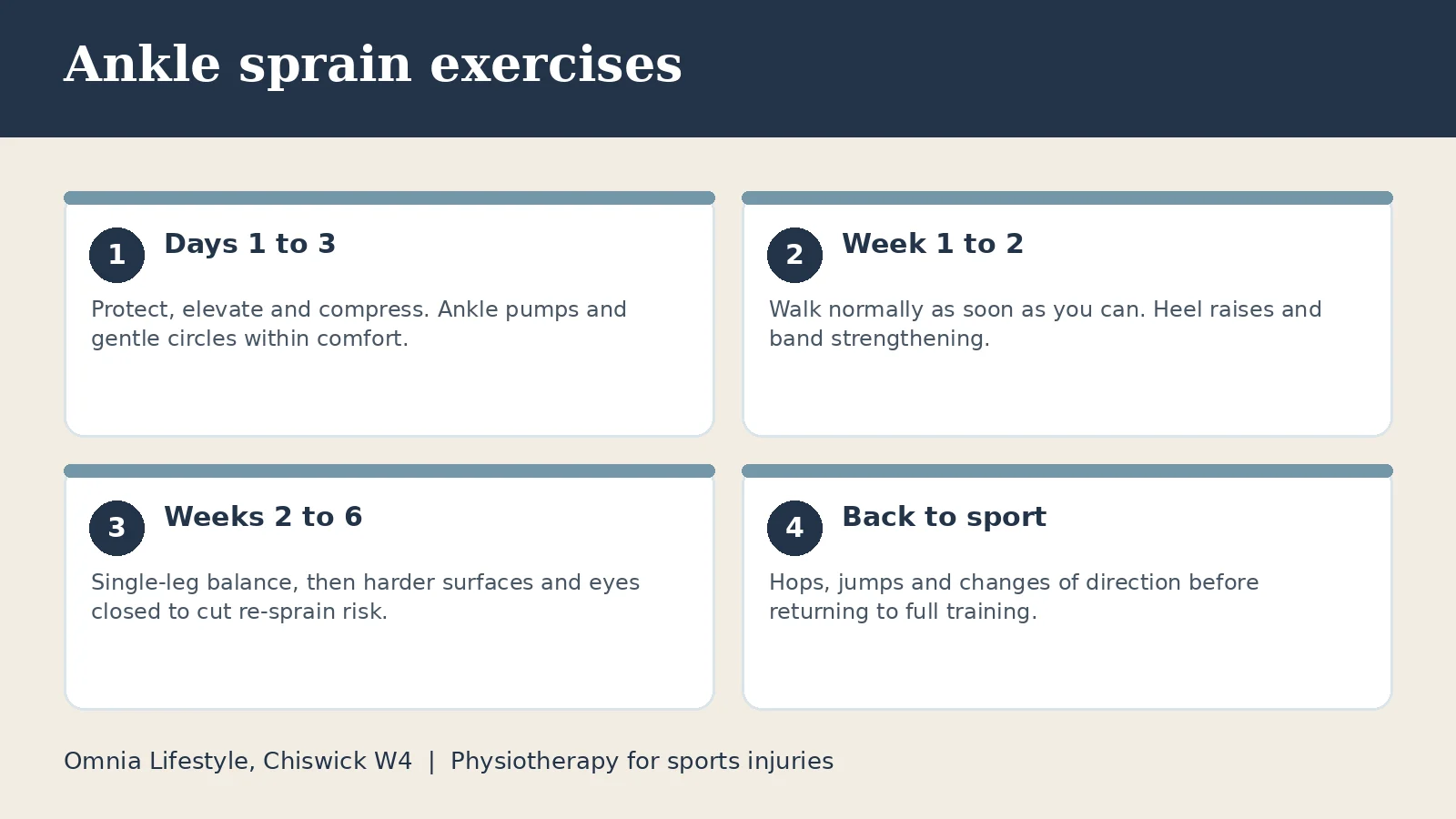
In the first few days, protect, elevate and compress the ankle and keep it moving gently with ankle pumps and circles. Walk normally as soon as you can. Then add heel raises and resistance band exercises, followed by single-leg balance training, which is the single best way to prevent another sprain. Mild sprains usually recover in two to six weeks, more severe sprains in six to twelve. If you cannot take four steps or have tenderness over the ankle bones, get it checked for a fracture.
Check for a fracture first
Go to a minor injuries unit, urgent treatment centre or A&E if:
- You could not take four steps straight after the injury, and still cannot
- There is tenderness when you press on the bony bumps on either side of the ankle, or along the outside edge of the foot
- The ankle or foot looks deformed, or the skin is broken over the injury
- You have numbness, pins and needles or a cold, pale foot
Our guide on when to worry about a sprained ankle explains these signs in more detail.
Stage 1: the first few days
Protect and calm it. Rest from activities that clearly worsen pain, raise the ankle above the level of your hip when sitting, and use a compression bandage or support if it helps. Ice wrapped in a cloth for 10 to 15 minutes can ease pain.
Keep it moving. Gentle movement within comfort speeds recovery and reduces stiffness:
- Ankle pumps: point your foot down and pull it up, 20 times every hour or two while awake.
- Ankle circles and the alphabet: trace the letters of the alphabet with your big toe.
- Walking: put weight through the foot as soon as pain allows, using crutches briefly if needed, and aim for a normal heel-to-toe walk.
Stage 2: strength (usually from the first or second week)
- Heel raises: holding a worktop, rise onto your toes on both feet and lower slowly. Build up to three sets of 15, then progress to the injured side only.
- Band eversion: sitting with a resistance band around the outside of your foot, turn the sole of your foot outwards against the band, then return slowly. Three sets of 15. These muscles on the outside of the ankle help stop it rolling again.
- Band inversion and dorsiflexion: work the inside and front of the ankle in the same way.
- Calf stretch: stand facing a wall with the injured leg behind, heel down, and lean forward until you feel a stretch. Hold for 30 seconds.
Stage 3: balance (the part most people skip)
A sprain damages the small nerve receptors in the ligaments that tell your brain where your ankle is. Balance training retrains that sense, and research shows it substantially reduces the risk of spraining the same ankle again.
- Single-leg stand: stand on the injured leg near a worktop for 30 seconds. Repeat three times.
- Make it harder: close your eyes, stand on a cushion or folded towel, or turn your head while balancing.
- Add movement: balance on one leg while throwing and catching a ball, or reaching in different directions with the other foot.
Keep balance exercises going for at least six to eight weeks, even after the ankle feels normal.
Stage 4: back to sport
Before returning to running, football, netball, tennis or any sport with sudden changes of direction, you should be able to:
- Do 25 single heel raises on the injured side
- Balance on the injured leg for 30 seconds with your eyes closed
- Hop on the spot and forwards without pain or giving way
- Jog, then run, then change direction and side-step comfortably
Build up from straight-line jogging to sprints, hops, jumps and cutting movements over a few weeks. Many athletes wear a brace or tape for sport for several months after a significant sprain.
How long does a sprained ankle take to heal?
- Mild sprain: often two to six weeks to return to normal activity
- Moderate sprain: usually six to twelve weeks
- Severe sprain: three months or more, and some need specialist review
Swelling can linger for weeks, especially at the end of the day. Pain, swelling or a feeling of the ankle giving way that persists beyond six to eight weeks should be assessed.
Why some ankles keep giving way
Repeated sprains are usually caused by weak muscles around the ankle, poor balance and returning to sport too soon, rather than by the ligament never healing. A full rehabilitation programme reduces this risk. Persistent giving way despite rehabilitation, or a sprain that never quite settles, can mean a more significant injury and may need imaging or a specialist opinion.
Frequently asked questions
Should I walk on a sprained ankle?
Yes, as soon as pain allows, unless a fracture is suspected. Early, gentle weight bearing speeds recovery.
Heat or ice for a sprained ankle?
Ice can ease pain in the first few days. Heat is more useful later for stiffness. Neither replaces exercise.
Should I wear an ankle support?
A compression support can help with comfort early on, and a brace or tape is useful for sport for a few months afterwards. It should not replace strengthening and balance work.
Can I drive with a sprained ankle?
Only when you can brake firmly and safely in an emergency. Check with your insurer if you are unsure.
Do I need physiotherapy?
Many mild sprains recover with a home programme. Physiotherapy helps when recovery is slow, the sprain was severe, you play sport, or the ankle keeps giving way.
Ankle sprain treatment in Chiswick
Ankle sprains are assessed and treated at Omnia Lifestyle, 8 to 9 Bedford Corner, The Avenue, Chiswick W4 1LZ, close to Turnham Green station, on bus routes 94, E3 and 272. Limited parking is available on request when booking. Assessment checks the ligaments and stability of the ankle, and your rehabilitation is progressed from movement to strength, balance and sport-specific training.
Read more about sports injuries, explore physiotherapy, see our Achilles tendinopathy exercises and hamstring strain guide, or book an assessment.
This article is general information, not medical advice. If you have any of the warning signs of a fracture listed above, seek medical attention.
Ready to book?
Physiotherapy



.jpg)
.jpg)