


Book at our Chiswick clinic
Physiotherapy
Runner's knee is the common name for pain around or behind the kneecap, known medically as patellofemoral pain. It is the most frequent cause of knee pain in runners, and also common in cyclists, people who play team sports and anyone who does a lot of stairs or squatting. It rarely means damage inside the knee, and it responds well to the right strengthening and a few changes to how you train.
This guide explains what runner's knee is, the exercises that help, changes to your running that reduce load on the kneecap, how long recovery takes, and when knee pain needs to be checked.
Quick answer
Runner's knee causes an ache around or behind the kneecap, worse on stairs, squatting, running downhill or after sitting for a long time. The best evidence supports strengthening both the thigh and hip muscles, alongside temporarily reducing running and hills. Wall sits, sit to stand, step-downs, side-lying leg raises and bridges are a good starting programme, and slightly shorter, quicker running strides reduce load on the knee. Most people improve within six to twelve weeks.
What runner's knee is
The kneecap glides in a groove at the end of the thighbone. When the load through that joint rises faster than it can adapt, the area becomes sensitive. Common triggers include a jump in running distance, more hills or downhill running, deep squats or lunges, a lot of stair climbing, and weakness in the thigh and hip muscles that control how the knee moves.
The term runner's knee is sometimes also used for iliotibial band pain on the outside of the knee. This guide covers pain at the front of the knee, around the kneecap.
Typical symptoms
- A dull ache around or behind the kneecap
- Pain going down stairs or hills, squatting, kneeling or running
- Pain after sitting with the knees bent for a long time, sometimes called the cinema sign
- Clicking or grinding without significant swelling
When knee pain needs checking
See a GP or physiotherapist if your knee is swollen, locks or gives way, if you cannot fully straighten it, or if pain followed a twisting injury. Seek same-day care for a hot, red, swollen knee, especially with fever.
The principles that matter
Adjust load, do not stop. Reduce running distance, hills and deep squatting to a level that keeps pain low, and keep fit with activities that do not aggravate it.
Strengthen the hip and the thigh. Research shows combining hip and knee strengthening gives better results than either alone.
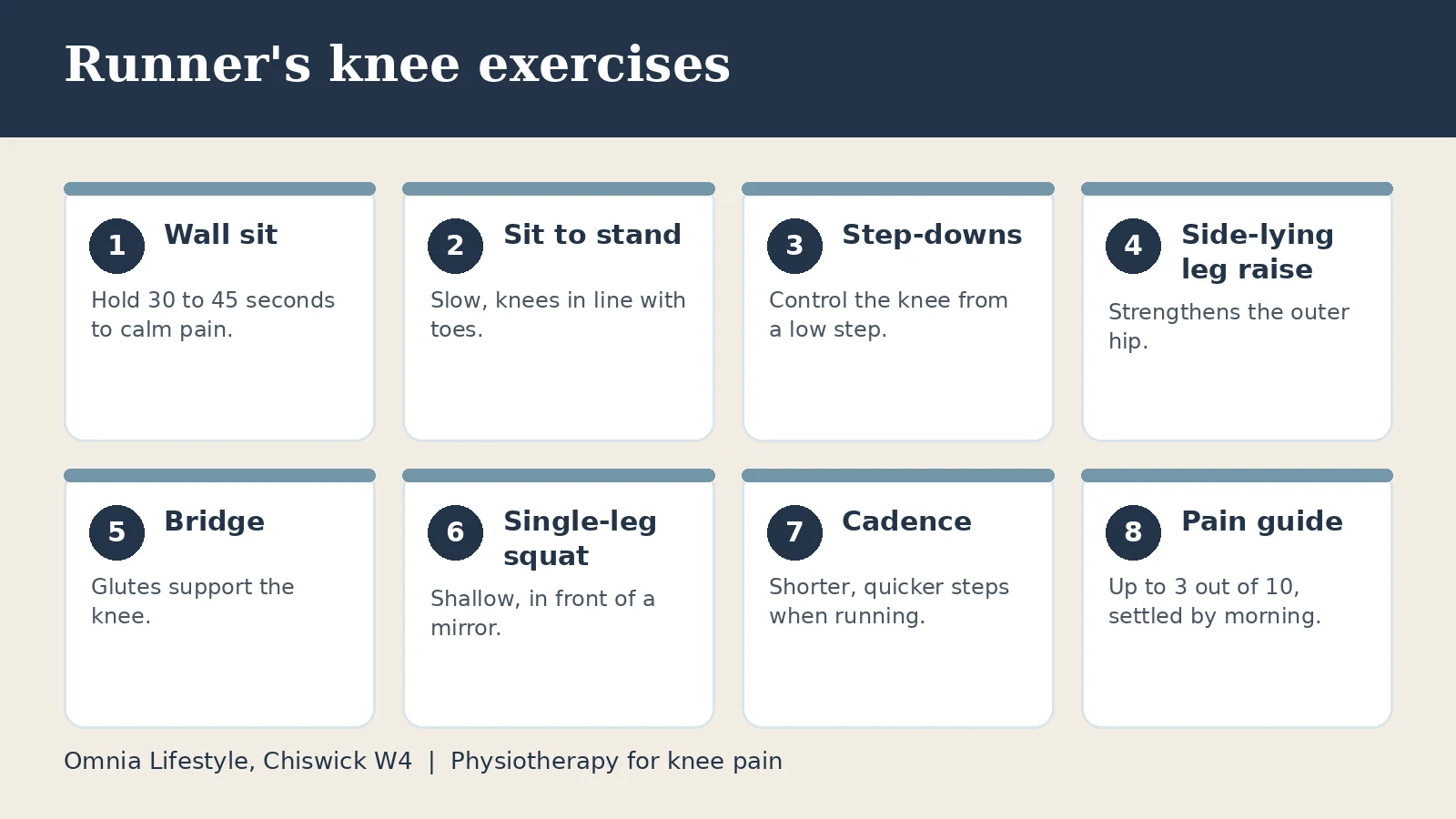
Use pain as a guide. Discomfort up to about 3 out of 10 during exercise is acceptable if it settles by the next morning.
Exercises for runner's knee
1. Wall sit
Lean against a wall and slide down into a shallow squat, knees bent to about 45 degrees or less if that is uncomfortable. Hold for 30 to 45 seconds, five times. Sustained holds like this often ease pain.
2. Sit to stand
From a chair, stand up and sit down slowly with your knees in line with your toes. Three sets of 10. Use a higher seat if a low one is painful.
3. Step-downs
Stand on a low step on the affected leg. Slowly lower the other heel towards the floor, keeping your knee in line with your second toe, then return. Three sets of 10. Start with a very low step.
4. Side-lying leg raise
Lie on your side with the top leg straight and slightly behind you. Lift it towards the ceiling, keeping your toes pointing forwards, and lower slowly. Three sets of 15. This strengthens the outer hip muscles that stop the knee falling inwards.
5. Bridge
Lie on your back with knees bent and lift your hips, holding for five seconds. Build to three sets of 10, then progress to single-leg bridges.
6. Single-leg squat
In front of a mirror, stand on one leg and bend the knee a little, keeping it in line with your toes and your pelvis level. Three sets of 8. Increase the depth gradually as control improves.
Changes to your running
- Shorten your stride slightly. Increasing your step rate by around 5 to 10 per cent reduces the load through the kneecap with each step.
- Reduce hills, especially downhill, while the knee settles.
- Build distance gradually, adding one change at a time.
- Taping or a knee support can ease pain in the short term for some runners, while strength builds.
- Check your footwear. Replace worn shoes, and avoid sudden changes of shoe type.
What to avoid, at least initially
- Deep squats and lunges into pain
- Long downhill runs
- Sitting for long periods with the knees bent; stand and stretch your legs regularly
- Complete rest, which leaves the muscles weaker
Frequently asked questions
How long does runner's knee take to heal?
Many people notice improvement within four to six weeks and recover fully within six to twelve weeks, although long-standing pain can take longer.
Can I keep running with runner's knee?
Often yes, at a reduced distance on flatter routes, if pain stays mild during the run and settles by the next morning.
Is cycling good for runner's knee?
It can be, if the saddle is high enough that your knee does not bend sharply. A low saddle and heavy gears can aggravate the kneecap.
Do I need a scan?
Usually not. Runner's knee is diagnosed from your symptoms and examination. Scans are considered if there is swelling, locking or a history of injury.
Will it lead to arthritis?
Most people with runner's knee recover without long-term problems. Keeping your thigh and hip muscles strong supports the knee for the future.
Knee pain treatment in Chiswick
Knee pain is assessed and treated at Omnia Lifestyle, 8 to 9 Bedford Corner, The Avenue, Chiswick W4 1LZ, close to Turnham Green station, on bus routes 94, E3 and 272. Limited parking is available on request when booking. Assessment confirms the cause, looks at strength and how you run, and sets a programme that gets you back to running comfortably.
Read more about knee pain, see our general guide to exercises for knee pain, read about gait analysis, explore physiotherapy, or book an assessment.
This article is general information, not medical advice. If your knee is swollen, locking or giving way, seek assessment.
Ready to book?
Physiotherapy


.jpg)
.jpg)