


Book at our Chiswick clinic
Physiotherapy
Your back has gone, your knee aches every time you climb the stairs, or a pain in your neck will not shift, and you are trying to decide who to see. Physiotherapists, osteopaths and chiropractors all treat muscle and joint problems, and their work overlaps, but their training, approach and availability differ in ways that matter.
This guide compares physio vs osteopath vs chiropractor, explains how each is regulated in the UK, what a session involves, what it costs, and which is likely to suit back pain, knee pain and sciatica.
Quick answer
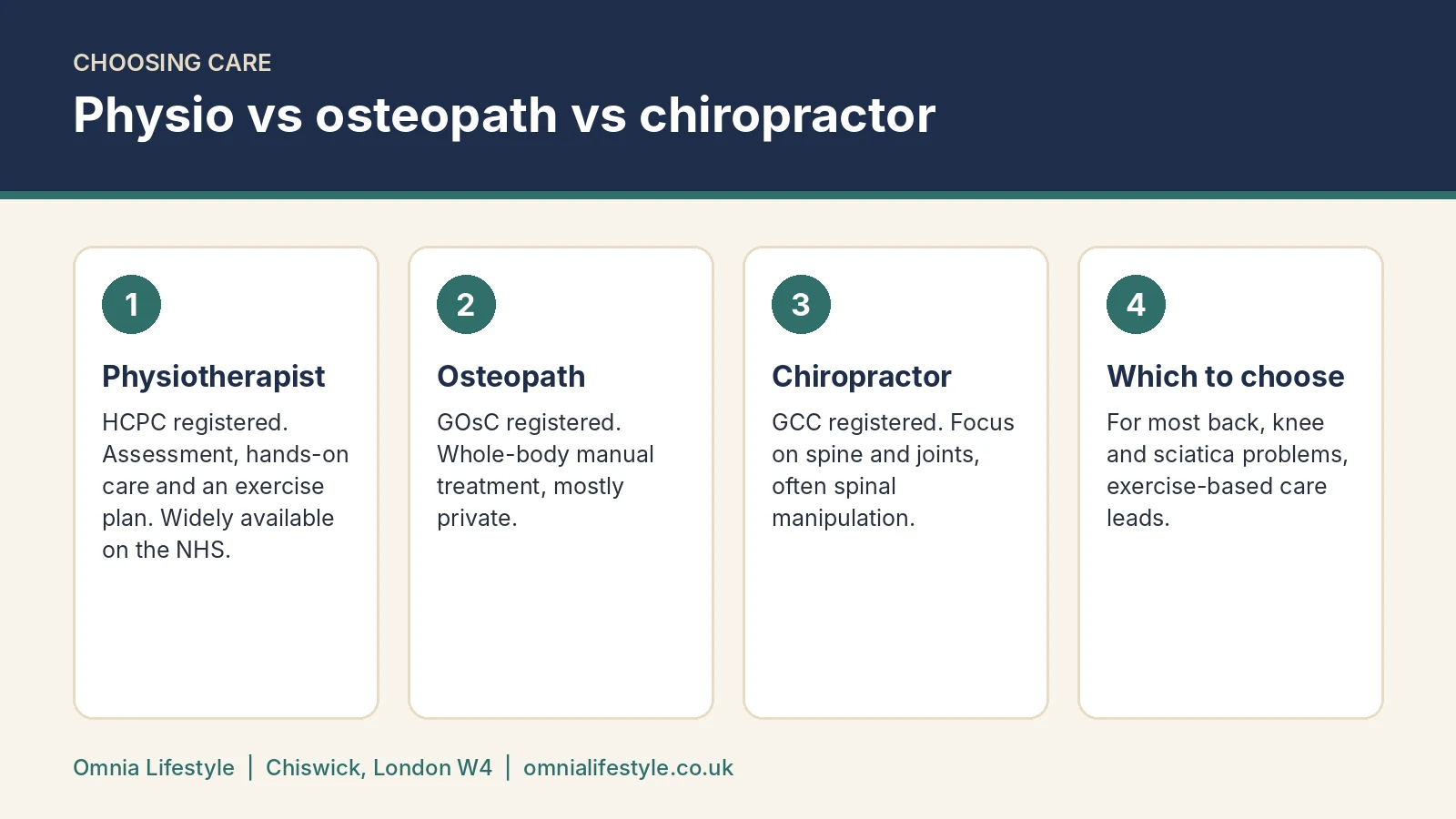
All three are regulated health professionals in the UK who treat musculoskeletal problems. Physiotherapists focus on assessment, hands-on treatment and exercise-based rehabilitation, and are widely available on the NHS. Osteopaths use whole-body manual techniques such as soft tissue work, stretching and joint manipulation, and are mostly private. Chiropractors focus on the spine and joints, often using spinal manipulation, and are also mostly private. For most back, knee and sciatica problems, the best evidence supports exercise-based care, with hands-on treatment as part of a package, which is the core of physiotherapy.
Physio vs osteopath vs chiropractor: the main differences
Physiotherapist
- Regulated by: the Health and Care Professions Council (HCPC). Many are also members of the Chartered Society of Physiotherapy.
- Training: a three-year degree, or a two-year pre-registration master's, with clinical placements across hospital and community settings.
- Approach: diagnosis first, then a mix of hands-on treatment such as mobilisation and soft tissue work, and a progressive exercise plan. Physiotherapists also treat people after surgery, strokes and breathing problems.
- Where: widely available on the NHS, in private clinics and in sport.
Osteopath
- Regulated by: the General Osteopathic Council (GOsC).
- Training: usually a four-year integrated master's degree.
- Approach: whole-body, hands-on treatment, including soft tissue massage, stretching, joint mobilisation and manipulation, with exercise and lifestyle advice.
- Where: mostly private, with limited NHS availability.
Chiropractor
- Regulated by: the General Chiropractic Council (GCC).
- Training: usually a four or five-year integrated master's degree.
- Approach: focuses on the spine and joints, with spinal manipulation, often called adjustment, as a common technique, alongside soft tissue work and exercise.
- Where: almost entirely private.
In practice, there is a lot of overlap. Many physiotherapists use manipulation, and many osteopaths and chiropractors prescribe exercises. The individual practitioner's skills and approach matter as much as the title.
What the evidence says
NICE guidance on low back pain and sciatica recommends exercise as the first-line treatment, and says manual therapy, including spinal manipulation, mobilisation and soft tissue techniques, should only be considered as part of a treatment package that includes exercise. This applies whichever profession delivers it. Rehabilitation through exercise also has strong evidence for knee osteoarthritis, kneecap pain, tendon problems and shoulder pain.
Manipulation of the neck carries a very small risk of serious complications, so it is worth discussing the benefits and risks with any practitioner who suggests it.
Physio or osteopath for back pain?
Both can help. For a new episode of back pain, staying active and simple exercises are what matter most, and either can provide reassurance and hands-on relief. For back pain that keeps coming back or has lasted months, a structured exercise plan is the most reliable route to lasting improvement, which is where physiotherapy is strongest. See lower back pain exercises and back pain.
Physio or osteopath for knee pain?
For most knee problems, including osteoarthritis, runner's knee and kneecap pain, physiotherapy is usually the better first choice, because strengthening the muscles around the knee and hip has the strongest evidence. See knee pain exercises and runner's knee exercises.
Physio or osteopath for sciatica?
Sciatica usually improves within weeks to a few months. Staying active, nerve-friendly exercise and pain relief are the mainstays, and physiotherapy is commonly recommended. Manipulation is generally avoided if you have significant weakness or numbness. See sciatica exercises and how long sciatica lasts.
How much does each cost?
Private sessions are broadly similar across the three professions. In London, physiotherapy typically costs £60 to £110 a session, osteopathy £55 to £95 and chiropractic £45 to £90, with first appointments usually costing more. Many private health insurers cover all three, although some require a GP referral. At Omnia in Chiswick, a 70-minute first physiotherapy appointment with treatment is £99, and follow-ups start from £70. See physiotherapy costs in the UK.
How to choose
- Check registration. Physiotherapist, osteopath and chiropractor are protected titles. Check the HCPC, GOsC or GCC register.
- Look for assessment first. A good practitioner explains what is wrong before treating.
- Expect exercises. Whatever the profession, a plan you can follow at home is a good sign.
- Ask about the plan. You should know roughly how many sessions you need and how progress will be measured.
- Be wary of long prepaid courses or claims that regular treatment is needed indefinitely.
Looking for an alternative to an osteopath in Chiswick?
Omnia Lifestyle does not offer osteopathy or chiropractic, but if you want hands-on treatment with a clear plan, our physiotherapists combine assessment, soft tissue work and joint mobilisation with exercise. Our MSK therapy is a 60-minute physiotherapist-led hands-on session for £90, and our manual therapy service includes sports and deep tissue massage.
When to seek urgent help
- Numbness around your bottom or genitals, or loss of bladder or bowel control, needs A&E or a 999 call
- Back or neck pain after a significant fall or accident
- Pain with fever, unexplained weight loss or a history of cancer
- Sudden severe neck pain with headache, dizziness or problems with vision or speech
Frequently asked questions
Is a physio or osteopath better?
Neither is better for everyone. Physiotherapy has a stronger focus on exercise-based rehabilitation, which has the best evidence for most muscle and joint problems.
Can I see a physio without a GP referral?
Yes. You can book private physiotherapy directly, and many NHS areas also allow self-referral. See can you self-refer to physiotherapy.
What is the difference between a chiropractor and an osteopath?
Chiropractors tend to focus on the spine and use spinal manipulation more often. Osteopaths take a whole-body approach with a broader range of hands-on techniques.
How many sessions will I need?
Many problems need three to six sessions. See how many physiotherapy sessions you need.
Physiotherapy in Chiswick
Physiotherapy is available at Omnia Lifestyle, 8 to 9 Bedford Corner, The Avenue, Chiswick W4 1LZ, close to Turnham Green station, on bus routes 94, E3 and 272. Limited parking is available on request when booking. Our HCPC-registered physiotherapists see patients from Chiswick, Hammersmith, Acton, Ealing, Brentford, Kew and across London.
Explore private physiotherapy in London, read what is manual therapy, or book an appointment.
This article is general information, not medical advice. If you have any of the warning signs listed above, seek medical attention.
Ready to book?
Physiotherapy



.jpg)
.jpg)