





Good balance is one of the most important things to protect as we get older. It keeps you walking confidently, getting up from a chair easily and, above all, avoiding falls. The encouraging news is that balance responds well to practice at any age, and a short, regular programme at home makes a measurable difference.
This guide sets out a safe home programme of balance and strength exercises, seated options for anyone who cannot yet stand safely, how to progress, and when to have your balance assessed.
Why balance exercises matter
Falls are the most common cause of injury in older people, and fear of falling can lead people to do less, which weakens the muscles and balance they rely on. Research reviews have found that exercise programmes built around balance and functional movement reduce the rate of falls in older people living at home by around a quarter. Tai chi has also been shown to reduce falls.
NHS guidance recommends that adults aged 65 and over do activities that improve strength, balance and flexibility on at least two days a week, alongside regular walking or other activity.
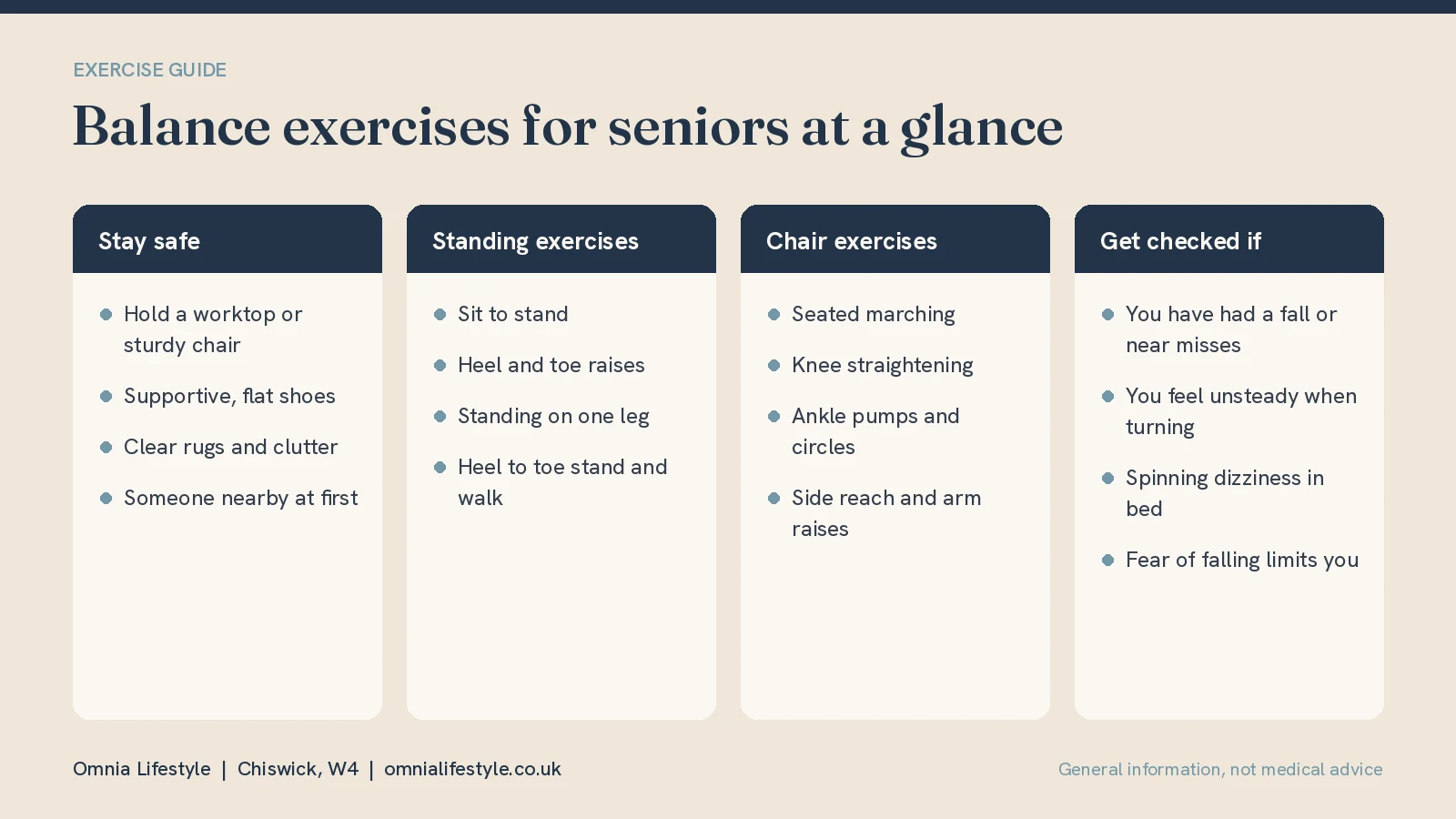
Before you start: staying safe
- Use a kitchen worktop or a sturdy chair without wheels for support, placed where you can hold it at any moment.
- Wear supportive, flat shoes rather than slippers or socks.
- Clear the space of rugs, cables and clutter.
- Have someone nearby the first few times, particularly if you have fallen before.
- Stop and sit down if you feel dizzy, faint or unwell.
Do the exercises three times a week to begin with. Most take only a few minutes.
Standing balance exercises
Sit to stand
Sit towards the front of a sturdy chair with your feet slightly behind your knees. Lean forward and stand up, using your hands on the chair or your thighs if needed, then sit back down slowly and with control. Repeat five to 10 times. As it becomes easier, fold your arms across your chest. This builds the leg strength that underpins balance.
Heel raises
Stand holding the worktop with your feet hip-width apart. Rise up onto your toes, hold for a second, and lower slowly. Repeat 10 times.
Toe raises
Holding the worktop, lift your toes and the front of your feet off the floor while keeping your heels down, then lower slowly. Repeat 10 times. This strengthens the muscles that stop you catching your toes and tripping.
Standing on one leg
Holding the worktop with both hands, lift one foot slightly off the floor and hold for up to 10 seconds, keeping your body upright. Repeat three times on each leg. Progress by holding with one hand, then with a fingertip.
Heel to toe stand
Holding the worktop, place one foot directly in front of the other so the heel touches the toes of the back foot. Hold for 10 seconds, then swap feet. Repeat three times.
Heel to toe walk
With the worktop alongside you, walk forward placing the heel of one foot directly in front of the toes of the other, as if on a tightrope. Take 10 steps, turn carefully, and repeat. Look ahead rather than at your feet.
Sideways walking
Holding the worktop, step sideways 10 steps one way and 10 steps back, keeping your toes facing forward.
Chair exercises for balance and strength
If standing exercises are not yet safe for you, or on days when you feel less steady, seated exercises keep the muscles working. Sit tall on a sturdy chair with your feet flat on the floor.
Seated marching
Lift one knee, then the other, as if marching, for 30 seconds. Build up to a minute.
Knee straightening
Straighten one knee so your foot lifts off the floor, hold for three seconds and lower slowly. Repeat 10 times on each leg.
Ankle pumps and circles
Point your toes down and then pull them up towards you 10 times, then circle each ankle 10 times each way.
Seated side reach
Holding the seat with one hand, reach the other arm up and slightly over to the side, feeling a gentle stretch, and return. Repeat five times each side. This trains the trunk control that keeps you steady when reaching.
Arm raises
Raise both arms in front of you to shoulder height and lower slowly. Repeat 10 times. Holding a light bottle of water adds challenge.
How to progress
Balance improves by being gently challenged. Once an exercise feels easy and steady, make it slightly harder in one way at a time: hold on with less support, hold positions for longer, or add more repetitions. Never progress to letting go of support until you are completely steady holding it lightly, and only practise with your eyes closed if a physiotherapist has advised it.
Other ways to improve balance
- Tai chi combines slow, controlled weight shifting with focus and is one of the best-studied activities for reducing falls.
- Regular walking keeps the legs strong and the balance system practised.
- A home check: good lighting, secure rugs and a rail on the stairs all reduce risk.
- Eyesight, hearing and medication reviews, since all three affect balance.
When to have your balance assessed
Call 999 if dizziness or unsteadiness comes on suddenly with slurred speech, facial drooping, weakness or numbness in an arm or leg, double vision or a severe headache.
See your GP or a physiotherapist if:
- You have had a fall, or more than one near miss, in the past year
- You feel unsteady when walking or turning
- You have spinning dizziness when you turn over in bed or look up
- You have blacked out or felt faint
- Fear of falling is stopping you from going out or doing things
What a balance assessment adds
Unsteadiness has several possible causes, including weak legs, the inner ear balance system, eyesight, blood pressure, medication and the feet. An assessment tests each of these, measures your balance and walking, and checks for treatable causes such as BPPV, where a simple repositioning manoeuvre can stop positional dizziness. You then get a programme set at the right level and progressed safely.
Frequently asked questions
How often should older people do balance exercises?
At least two or three times a week. Many people find a few minutes each day easy to fit around the kettle boiling or the television.
How long before balance improves?
Many people notice they feel steadier within six to eight weeks of regular practice. Keep going, because the benefits fade if you stop.
Are chair exercises enough?
They are a good starting point and keep muscles working, but standing exercises train balance more directly. Move on to supported standing exercises when you feel safe to do so.
Can balance exercises help dizziness?
Some types of dizziness respond well to specific vestibular exercises, but the right ones depend on the cause. Dizziness should be assessed before starting a programme.
Is it too late to improve balance at 80 or 90?
No. Trials of balance and strength training include people in their 80s and 90s, and improvements are seen at every age.
Balance assessment and treatment in Chiswick
Balance and dizziness are assessed at Omnia Lifestyle in Chiswick, W4, close to Turnham Green station, on bus routes 94, E3 and 272. Limited parking is available on request when booking. Home visits are also available for people who find travelling difficult.
Read more about balance and dizziness, explore vestibular assessment and rehabilitation, tai chi and qi gong classes and home visit physiotherapy, see our guide to Brandt-Daroff exercises for vertigo, or book an assessment.
This article is general information, not medical advice. If you have any of the warning signs listed above, seek medical attention.


.jpg)
.jpg)