


Book at our Chiswick clinic
Tai Chi & Qi Gong
Tai chi is often described as meditation in motion: slow, flowing movements linked with calm breathing and close attention. It looks gentle, and it is, but it has also been studied more than almost any other mind and body practice. That research gives a clear picture of what tai chi is good for, and where the claims run ahead of the evidence.
This guide explains what tai chi is, what the name means, the benefits with the strongest research behind them, what tai chi is less likely to do, and how to start safely.
Quick answer
Tai chi is a Chinese mind and body exercise made up of slow, continuous movements, controlled weight shifts and relaxed breathing. Yes, it is good for you. The strongest evidence shows it improves balance and reduces falls in older adults, and eases pain and stiffness in long-term conditions such as knee osteoarthritis and fibromyalgia. It may also help stress, mood and sleep. It is low impact and suits most ages, but it is not an efficient way to lose weight on its own.
What is tai chi?
Tai chi, also written taiji or tai chi chuan, began in China several hundred years ago as a martial art. Today most people practise it for health. A tai chi session usually includes gentle warm-ups, breathing exercises and a sequence of movements called a form, performed slowly and smoothly so that one movement flows into the next.
Three things make tai chi different from most exercise:
- Slowness: moving slowly keeps the muscles working throughout each movement and trains balance and control.
- Weight shifting: you move your weight gradually from one leg to the other, which strengthens the legs and trains the body's sense of position.
- Attention and breath: your focus stays on posture, movement and slow breathing, which is why tai chi often feels calming.
What does tai chi mean?
The full name, tai chi chuan or taijiquan, is usually translated as "supreme ultimate fist" or "supreme ultimate boxing". Tai means great or supreme, chi (ji) means ultimate or extreme, and chuan (quan) means fist, referring to its roots as a martial art. The name comes from the Chinese idea of taiji, the balance of yin and yang shown in the familiar black and white symbol.
Despite the similar spelling in English, the "chi" in tai chi is a different Chinese word from qi (often also written chi), which means vital energy. Thai chi and tia chi are common misspellings; tai chi has no connection with Thailand.
Styles of tai chi
The main family styles are Chen, Yang, Wu and Sun. Chen style is the oldest and includes some faster, more powerful movements. Yang style is the most widely practised, with large, even movements. Wu style uses smaller, more compact movements, and Sun style includes a lively stepping pattern. Simplified forms, such as short sequences designed for older adults or people with arthritis, are often used in health programmes and research.
What is walking tai chi?
Walking tai chi takes the slow, controlled stepping of tai chi and practises it as a walking exercise for balance. Our guide to tai chi walking explains how to do it step by step.
Benefits of tai chi: what the research shows
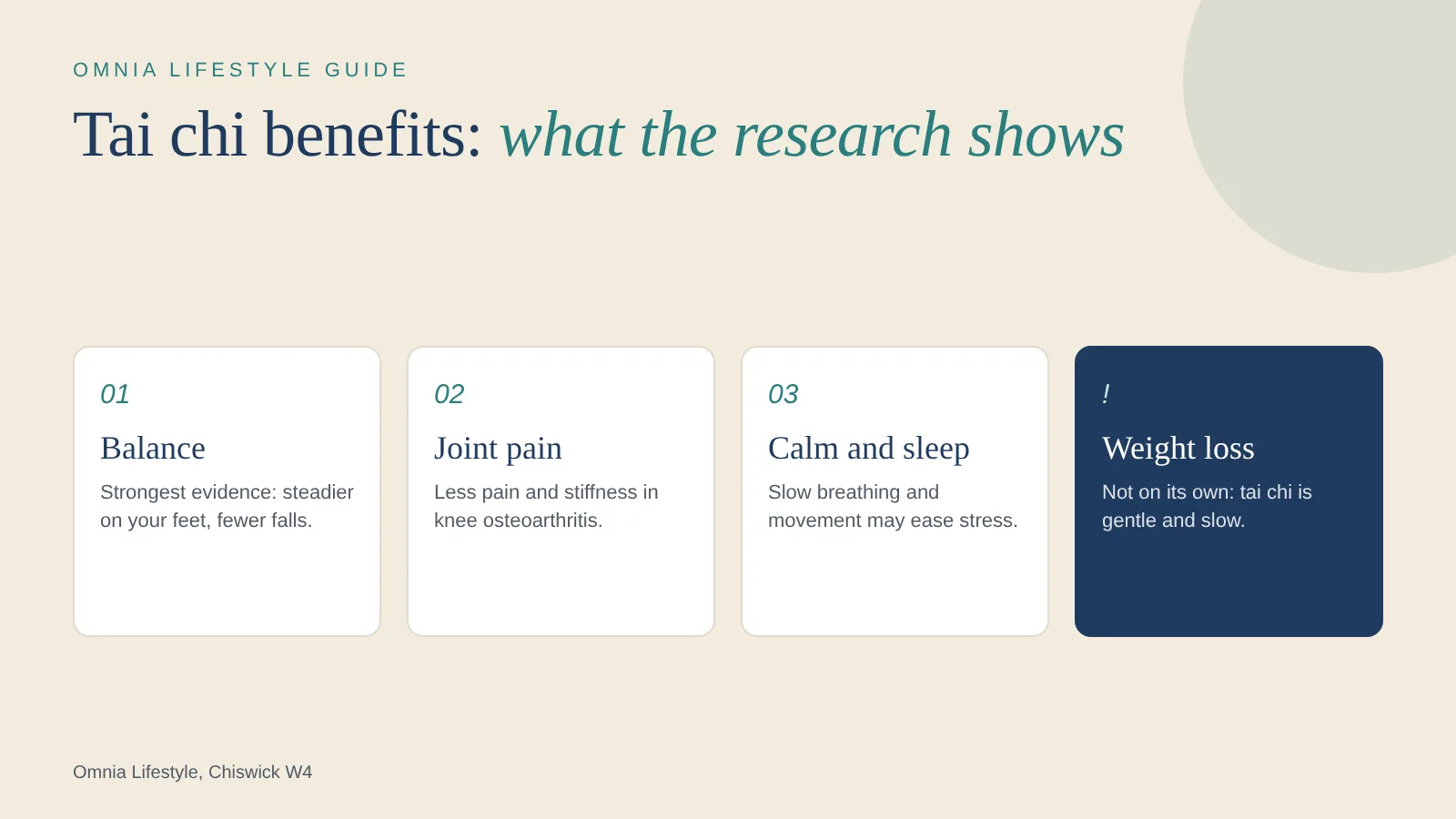
Tai chi has been tested in a large number of clinical trials. The benefits below are listed roughly in order of how strong the evidence is.
Better balance and fewer falls
This is the best established benefit. Tai chi trains standing on one leg, controlled weight transfer and awareness of where your feet are, and trials in older adults show it reduces the risk of falling. The NHS includes tai chi among the activities older adults can do to improve strength, balance and flexibility. Read more about tai chi for balance and falls.
Less pain and stiffness in long-term musculoskeletal conditions
Tai chi has good evidence for easing pain and improving physical function in knee osteoarthritis, and it is widely recommended for people with arthritis. A large 2026 review in the British Journal of Sports Medicine, drawing on 1,744 trials of tai chi and related traditional Chinese exercise, found benefits for long-term musculoskeletal pain and function, with the strongest evidence in knee osteoarthritis. You can see what the review found or read our summary of tai chi and musculoskeletal pain.
Fibromyalgia
Trials in people with fibromyalgia have found that regular tai chi can reduce pain and fatigue and improve sleep and wellbeing, and in some studies it compared well with standard aerobic exercise.
Stress, anxiety and mood
The combination of slow movement, breathing and focused attention helps many people feel calmer. Studies suggest tai chi can reduce stress and symptoms of anxiety and depression, although the trials are generally smaller and less consistent than those for balance. It can be a helpful part of looking after your mental health, but it is not a replacement for treatment for depression.
Sleep
Several studies, particularly in older adults, have reported better sleep quality with regular tai chi. This may come from a mix of physical activity, relaxation and a steady routine.
Heart health and blood pressure
Tai chi is a moderate-intensity activity for many people, and some studies show small improvements in blood pressure and fitness. It can be a gentle way back into activity for people who find other exercise difficult, including some people with heart or lung conditions under medical guidance.
Bones and osteoporosis
Evidence that tai chi increases bone density is limited and mixed. For people with osteoporosis, its main value is likely to be better balance and strength, which lower the chance of a fall and therefore of a fracture.
Thinking and memory
Some studies in older adults suggest tai chi may help aspects of thinking, such as attention and memory, perhaps because it combines physical activity with learning and remembering sequences. The research here is still developing.
10 benefits of tai chi at a glance
- Improves balance and steadiness
- Reduces the risk of falls in older adults
- Eases pain and stiffness in knee osteoarthritis
- Helps long-term muscle and joint pain
- Can reduce fibromyalgia symptoms
- Strengthens the legs and hips without impact
- Improves flexibility and posture
- Helps you feel calmer and less stressed
- May improve sleep quality
- Builds confidence in moving, at any age
Is tai chi good for weight loss?
Not on its own. Traditional tai chi is slow, so it burns fewer calories than brisk walking, cycling or swimming. It can still support weight management by making regular movement easier to start and to keep up, building leg strength and helping with stress, which affects eating for many people. For weight loss, combine it with changes to diet and other activity that raises your heart rate.
Tai chi benefits for women and men
The benefits apply to everyone. Women around and after the menopause may find tai chi useful for balance, joint stiffness, sleep and stress, although there is little research on menopause symptoms specifically. Men often come to tai chi for stiff backs, hips and knees, or as a way to keep moving after injury. Older adults of any sex benefit most from the balance training. Read more about whether tai chi is good for older adults.
How often should you do tai chi, and when?
Most studies use sessions of around an hour, two or three times a week, for at least twelve weeks. Shorter daily practice at home also helps, and consistency matters more than the length of any single session. There is no single best time of day. Traditionally tai chi is practised in the morning, but the best time is the one you can stick to. The NHS advises adults to be active every day, building towards at least 150 minutes of moderate activity a week, with strength and balance activities on at least two days. Tai chi can count towards the strength and balance part. See how often to practise tai chi or qi gong.
Tai chi or qi gong?
Qi gong is a related practice that uses simpler, repeated movements and a stronger focus on breathing. It is often easier for complete beginners or people with limited mobility. Read tai chi or qi gong for beginners to decide where to start, or try our tai chi exercises for beginners at home.
Is tai chi safe? When to check with a GP
Tai chi is one of the safest forms of exercise, and movements can be adapted for most people. Speak to your GP before starting if you:
- Have had a fall in the last year or often feel unsteady
- Get dizzy or light-headed, especially when standing or turning
- Have a heart condition, or blood pressure that is not well controlled
- Have had recent surgery, particularly on a hip, knee, back or eyes
- Have severe osteoporosis or a recent fracture
- Are pregnant and new to tai chi
Stop and call 999 if you have:
- Chest pain or tightness that does not ease with rest
- Sudden severe breathlessness
- A drooping face, weakness or numbness on one side, or slurred speech
Stop practising and seek advice if joint pain gets worse during or after sessions rather than easing over the following weeks.
How we help in Chiswick
Tai chi and qi gong are taught at Omnia Lifestyle in small group classes and one-to-one sessions, within a clinic that also treats many of the conditions people take up tai chi for, such as joint pain, poor balance and stress.
- Tai chi and qi gong classes in Chiswick: group classes are £15 a session, and beginners are welcome.
- One-to-one tai chi or qi gong: £50, useful if you want to learn at your own pace or adapt movements around a health condition.
- Physiotherapy and balance assessment: if pain, weakness or dizziness make movement difficult, we can assess what is holding you back first.
See how much tai chi classes cost in London and what happens in a tai chi class, or book a class.
Frequently asked questions
What is tai chi good for?
Tai chi is best supported for improving balance and reducing falls, and for easing pain and stiffness in knee osteoarthritis and other long-term muscle and joint conditions. Many people also use it for stress, mood and sleep.
What does tai chi do to the body?
It works the leg and core muscles through slow weight shifts, trains balance and coordination, moves the joints through a comfortable range and encourages slow breathing, which helps the body relax.
Is tai chi a martial art?
Yes, it began as one, and some people still study its self-defence applications. Most classes today focus on health, balance and relaxation, and no contact or sparring is involved.
Is tai chi good for osteoporosis?
Tai chi is generally a safe choice for people with osteoporosis and can improve balance and strength, which helps prevent falls. Evidence that it builds bone density is limited, so it works best alongside any treatment your GP recommends.
Is tai chi good for arthritis?
Yes, particularly knee osteoarthritis, where tai chi is widely recommended. Movements can be made smaller or done seated on painful days. Read more about tai chi for arthritis.
How long before I notice benefits?
Many people feel calmer after a single session. Changes in balance, strength and pain usually build over eight to twelve weeks of regular practice.
Start tai chi at Omnia Lifestyle
Whether you want to feel steadier on your feet, ease stiff joints or simply find a calmer way to exercise, tai chi is a good place to start. Classes run at Omnia Lifestyle, 8 to 9 Bedford Corner, The Avenue, Chiswick W4 1LZ, close to Turnham Green station, on bus routes 94, E3 and 272. Limited parking is available on request when booking.
This article is general information, not medical advice. If you have any of the warning signs listed above, seek medical attention.
Ready to book?
Tai Chi & Qi Gong

.jpg)
.jpg)