


Book at our Chiswick clinic
Physiotherapy
Achilles tendon pain is common in runners, walkers and anyone who has recently increased their activity, and it is notoriously slow to settle with rest alone. The tendon needs the right kind of load to recover, and for most people a structured calf-strengthening programme is the most effective treatment available.
This guide explains the two main types of Achilles tendinopathy, the exercises that help each, how much pain is acceptable while you exercise, how long recovery takes, and the warning signs of a rupture that needs emergency care.
Quick answer
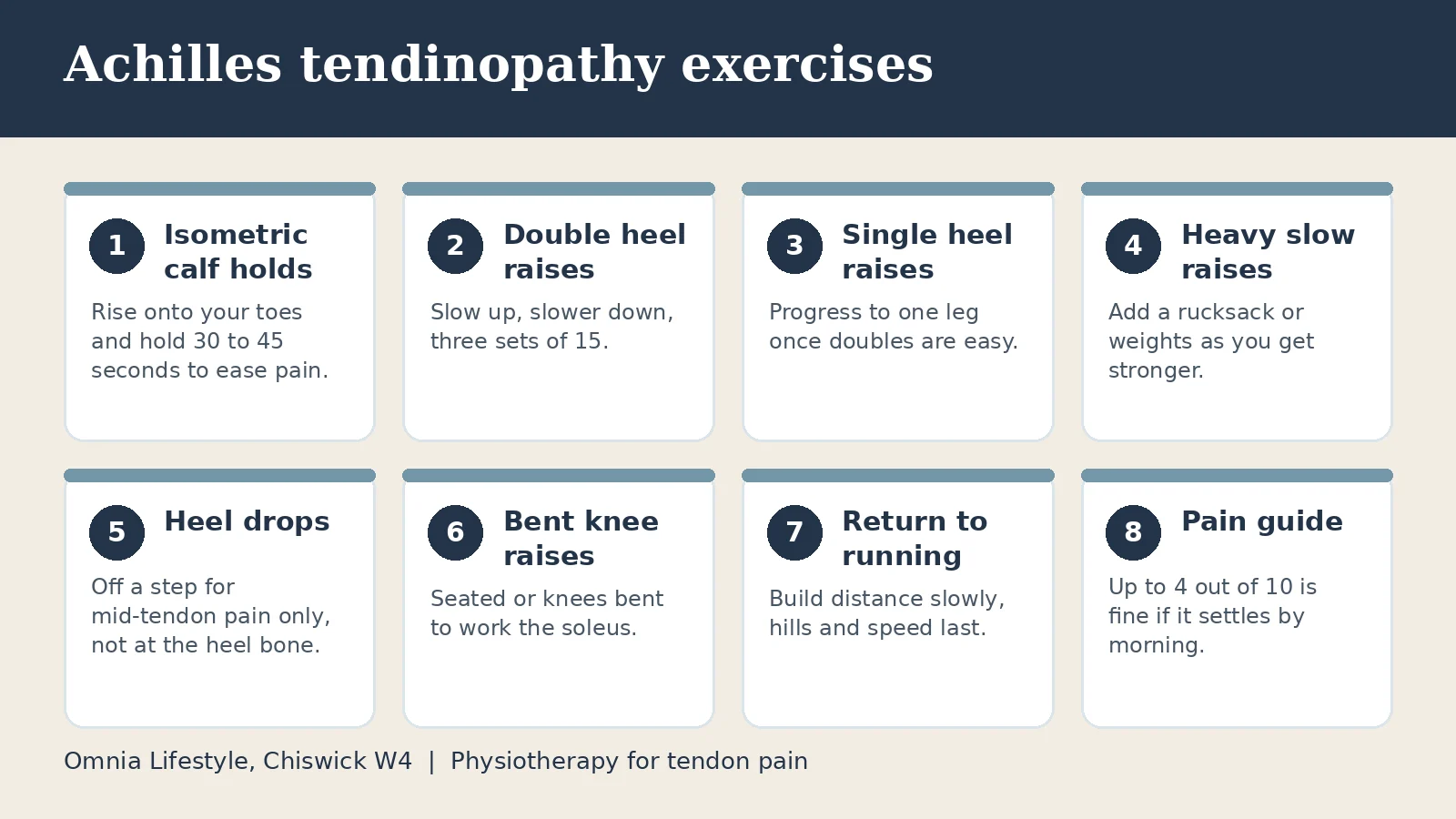
Achilles tendinopathy responds best to progressive calf strengthening, not rest. Start with isometric holds on your toes to ease pain, then build up through double and single heel raises to slow, heavy raises with added weight. Mild discomfort up to about 4 out of 10 is acceptable if it settles by the next morning. Most people improve over three to six months. A sudden snap or feeling of being kicked in the back of the heel needs same-day assessment.
What Achilles tendinopathy is
The Achilles tendon joins the calf muscles to the heel bone and takes huge loads with every step, jump and stride. When the load increases faster than the tendon can adapt, for example a jump in running distance, more hills or speed work, new footwear or a return to sport after a break, the tendon becomes painful and stiff. It is not usually an inflammation, which is why anti-inflammatory measures alone rarely fix it.
Mid-portion tendinopathy
Pain and sometimes a thickened area two to six centimetres above the heel. This is the most common type and responds well to loading, including heel drops off a step.
Insertional tendinopathy
Pain where the tendon attaches to the back of the heel bone. Here, dropping the heel below the level of a step compresses the sore area and often makes it worse, so exercises are done on flat ground.
The principles that matter
Load, do not rest. Tendons recover by being loaded gradually. Complete rest eases pain for a while but leaves the tendon weaker when you return.
Use pain as a guide. Discomfort up to about 4 out of 10 during exercise is acceptable if it has settled by the following morning. Morning stiffness that is clearly worse than usual means you did too much the day before.
Be patient. Tendons adapt slowly. Expect to keep going for at least three months, and longer if the pain has been present for a long time.
Exercises to start with
1. Isometric calf holds
Stand holding a worktop and rise onto your toes on both feet, or on the painful side only if you can. Hold for 30 to 45 seconds, then lower. Repeat five times with a rest between holds. Sustained holds like this often reduce tendon pain for a few hours and are a good starting point when the tendon is irritable.
2. Double heel raises
Stand on flat ground holding a worktop. Rise onto your toes over two to three seconds, then lower slowly over three seconds. Build up to three sets of 15.
3. Bent knee heel raises
Do the same movement with your knees slightly bent, or sitting with a weight on your knees. This works the soleus, a deep calf muscle that takes much of the load when running.
Exercises to progress to
4. Single heel raises
Once double raises are easy, progress to the painful side only, still slowly. Build up to three sets of 15.
5. Heel drops off a step (mid-portion only)
Stand on the edge of a step on the balls of your feet. Rise up on both feet, then lift the good foot and lower slowly on the painful side until your heel drops just below the step. Use both feet to rise again. Avoid this exercise if your pain is at the heel bone itself.
6. Heavy slow heel raises
Add weight with a rucksack or dumbbells, or use a calf-raise machine, keeping the movement slow. Heavier, slower loading is what builds real tendon capacity, and is usually done three times a week.
7. Return to running and sport
When you can do around 25 single heel raises on the painful side without significant pain, start a gradual return: short, flat runs first, with hills, speed work and jumping added last. Add hopping and skipping before returning to sport that involves sprinting or changes of direction.
What to avoid, at least initially
- Complete rest for weeks at a time
- Aggressive calf stretching, especially for insertional pain, where stretching compresses the sore area
- Sudden increases in distance, hills, speed or jumping
- Very flat or worn-out shoes while the tendon is sore; a small heel lift can help in the short term
- Steroid injections into or around the Achilles, which are generally avoided because of the risk of weakening the tendon
Certain antibiotics, known as fluoroquinolones, are linked to tendon problems. If Achilles pain starts while taking them, speak to the prescriber promptly.
When to seek urgent attention
Go to A&E or a minor injuries unit the same day if you feel a sudden snap or pop at the back of the ankle, feel as though you have been kicked in the heel, or suddenly cannot push off or stand on tiptoe. These can be signs of an Achilles rupture, which is treated best when caught early.
See a GP or physiotherapist if pain is getting worse despite a few weeks of sensible loading, there is significant swelling, or both tendons are painful without an obvious reason.
What a physiotherapy assessment adds
An assessment confirms whether the pain is mid-portion or insertional, checks for other causes of heel pain such as plantar fasciitis, measures calf strength against the other side and looks at your running or training load. Your programme is then set at the right starting level and progressed as the tendon adapts, so you avoid both under-loading and flare-ups. If heel pain under the foot is also a problem, see our guide to plantar fasciitis exercises.
Frequently asked questions
How long does Achilles tendinopathy take to heal?
Many people notice improvement within six to twelve weeks of consistent loading, but full recovery often takes three to six months, and longer for long-standing problems.
Can I keep running with Achilles tendinopathy?
Often yes, at a reduced level, if pain stays at or below about 4 out of 10 during the run and settles by the next morning. Flat routes, shorter distances and no speed work are the usual adjustments.
Should I stretch my Achilles?
Gentle calf stretching is fine for mid-portion pain if it feels comfortable, but strengthening matters far more. For insertional pain, avoid stretching that drops the heel down.
Does shockwave therapy work?
Shockwave therapy can help some people with persistent tendinopathy who have not improved with exercise. It works best alongside a loading programme rather than instead of it.
Should I use ice?
Ice may ease pain after activity, but it does not treat the underlying problem. Loading does.
Achilles and heel pain treatment in Chiswick
Achilles tendon pain is assessed and treated at Omnia Lifestyle, 8 to 9 Bedford Corner, The Avenue, Chiswick W4 1LZ, close to Turnham Green station, on bus routes 94, E3 and 272. Limited parking is available on request when booking. Your physiotherapist sets a loading programme matched to your tendon and your sport, and progresses it at each visit.
Read more about sports injuries, explore physiotherapy and sports massage, see what gait analysis shows, read our shin splints guide, or book an assessment.
This article is general information, not medical advice. If you have any of the warning signs of a rupture listed above, seek urgent medical care.
Ready to book?
Physiotherapy


.jpg)
.jpg)