


Book at our Chiswick clinic
Physiotherapy
Pain on the outside of your shoulder when you lift your arm, reach for a high shelf or lie on that side at night is one of the most common shoulder problems. It is often called shoulder impingement, and the good news is that the right exercises help most people get better without surgery.
This guide explains shoulder impingement symptoms and tests, eight shoulder impingement exercises in three stages, exercises to avoid, how long recovery takes and when other treatment is considered.
Quick answer
Shoulder impingement, now often called subacromial pain or rotator cuff related shoulder pain, causes pain when lifting the arm, especially between shoulder and head height. Treatment is mainly exercise: first settle the pain with gentle movement and isometric holds, then strengthen the rotator cuff and shoulder blade muscles with resistance bands, then rebuild overhead strength. Most people improve within 6 to 12 weeks, though full recovery can take three to six months. Surgery is rarely needed.
What is shoulder impingement?
Shoulder impingement syndrome describes pain from the tendons of the rotator cuff and the bursa, a small fluid-filled sac, that sit in the space beneath the bony tip of the shoulder. The traditional explanation was that these tissues get pinched when you raise your arm. Researchers now think the problem is more often an irritated, overloaded tendon that has not been strong enough for the demands placed on it, which is why strengthening works so well.
It is common in people who do repeated overhead work or sport, such as swimming, tennis, painting or decorating, and in people over 40 as tendons change with age.
Shoulder impingement symptoms
- Pain on the front or outer side of the shoulder, sometimes spreading down the upper arm
- A painful arc: pain when lifting your arm out to the side between roughly shoulder and head height, easing above and below this
- Pain reaching overhead, reaching behind your back or putting on a coat
- Pain lying on the affected side at night
- Weakness or a catching feeling when lifting
Frozen shoulder is different: it causes severe stiffness in every direction, even when someone else moves your arm for you. See frozen shoulder exercises and what causes shoulder pain.
Shoulder impingement test
A physiotherapist or doctor diagnoses shoulder impingement mainly from your history and examination. Common clinical tests include the painful arc test, the Hawkins-Kennedy test, where the arm is raised in front and turned inwards, and Neer's test, where the straight arm is lifted. These help point towards the problem but are not definitive. Scans are not usually needed at first. An ultrasound may be arranged if you are not improving, if strength is very poor or after an injury, to check for a rotator cuff tear.
Shoulder impingement exercises
Use this pain rule: discomfort up to 3 or 4 out of 10 during exercise is acceptable if it settles within an hour and is no worse the next morning. If pain is sharper or lasts, reduce the load.
Stage 1: settle the pain
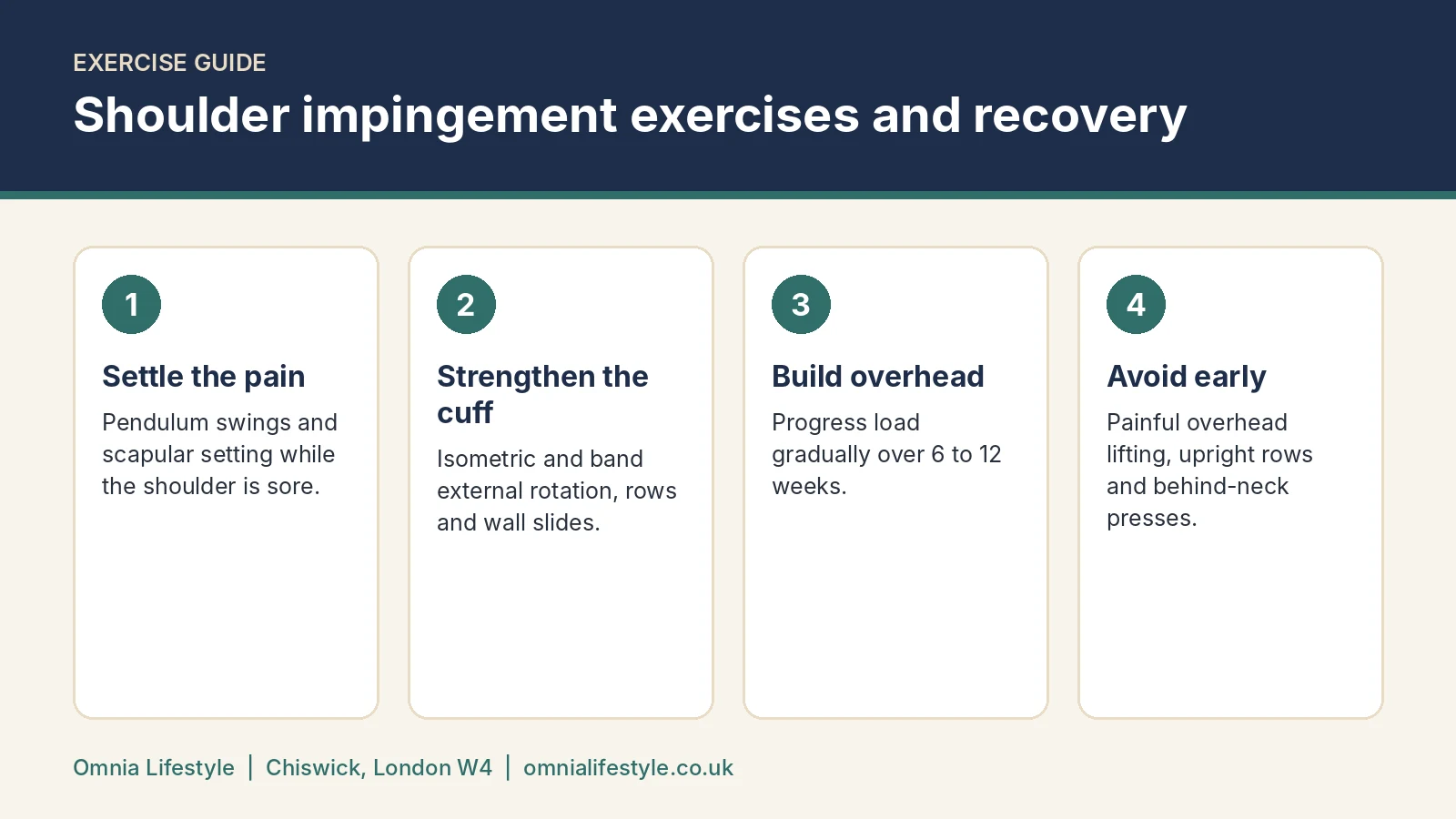
- Pendulum swings. Lean forward with your good hand on a table and let the sore arm hang. Gently swing it in small circles and side to side for 30 to 60 seconds. Repeat two or three times a day.
- Shoulder blade setting. Sitting tall, gently draw your shoulder blades back and down, hold for 5 seconds and relax. Repeat 10 times.
- Isometric external rotation. Stand side-on to a wall with your elbow bent to 90 degrees at your side and the back of your wrist against the wall. Push gently outwards into the wall without moving, hold for 30 to 45 seconds, rest, and repeat 5 times. Isometric holds often ease tendon pain.
Stage 2: strengthen the rotator cuff and shoulder blade
- Resistance band external rotation. With a rolled towel between your elbow and your side and the elbow bent to 90 degrees, hold a band and rotate your forearm outwards, then slowly return. Three sets of 10 to 15.
- Resistance band rows. Anchor a band at chest height. Pull your elbows back, squeezing your shoulder blades together, then slowly return. Three sets of 12 to 15.
- Side-lying external rotation. Lie on your good side with a light weight in the top hand, elbow at your side bent to 90 degrees. Rotate the forearm up towards the ceiling and slowly lower. Three sets of 10 to 12.
Stage 3: build overhead strength
- Wall slides. Face a wall with your forearms on it. Slide your arms up as far as is comfortable, keeping the shoulder blades gently drawn back, then slide down. Three sets of 10.
- Scaption raises. Holding light weights, raise your arms forwards and slightly out to the sides, thumbs up, to shoulder height, and lower slowly. Three sets of 10 to 12, increasing height and weight over the weeks as pain allows.
Helpful stretches
- Doorway chest stretch: forearm on a door frame, step gently forwards until you feel the front of the chest stretch. Hold for 30 seconds.
- Upper back extension: lie over a rolled towel placed across your upper back and let your arms rest by your head for one to two minutes. Better upper back movement takes strain off the shoulder.
For more, see shoulder exercises for pain.
Shoulder impingement exercises to avoid
- Painful overhead lifting, such as heavy overhead presses, early in recovery
- Upright rows
- Behind-the-neck presses and pulldowns
- Dips and very deep press-ups
- Sleeping on the painful side, where possible
- Complete rest, which weakens the tendon further
Shoulder impingement recovery time
Many people notice improvement within four to six weeks of regular exercise, and most improve substantially within three months. Full recovery can take three to six months, and occasionally longer if the problem has been present for a long time. Progress is rarely a straight line, so judge it over weeks rather than days.
Shoulder impingement treatment
- Physiotherapy. The first-line treatment: a progressive exercise plan, advice on adapting activities and hands-on treatment where helpful.
- Pain relief. Paracetamol or anti-inflammatory gel or tablets, discussed with a pharmacist.
- Steroid injection. Can ease pain for some weeks and make it easier to exercise, but does not fix the tendon on its own.
- Acupuncture and laser therapy. Some people use these for pain relief alongside exercise.
Shoulder impingement surgery
An operation called subacromial decompression was once common. A large UK trial published in 2018 found it was no more effective than a placebo procedure for pain and function. Surgery is now rarely recommended for impingement alone, and is mainly considered for other problems, such as a significant rotator cuff tear.
When to see a doctor
- Call 999 if shoulder or arm pain comes with chest pain, breathlessness, sweating or feeling sick
- You cannot lift your arm after a fall or injury
- The shoulder is hot, red and swollen, or you feel feverish
- Pain is severe and constant at night, or you have unexplained weight loss
- No improvement after six to eight weeks of exercise
Frequently asked questions
Can shoulder impingement heal on its own?
Some mild cases settle with rest from aggravating activity, but most improve faster and more completely with a structured exercise plan.
How often should I do shoulder impingement exercises?
Stage 1 exercises can be done daily. Strengthening exercises are best three to four times a week, allowing recovery between sessions.
Can I go to the gym with shoulder impingement?
Usually yes, with changes. Keep training legs and core, choose pain-free upper body exercises and avoid painful overhead lifting until your physiotherapist advises.
Is there a shoulder impingement exercises PDF?
At Omnia, your physiotherapist gives you a personalised written programme with the right exercises and loads for your stage of recovery.
Shoulder physiotherapy in Chiswick
Shoulder impingement is assessed and treated at Omnia Lifestyle, 8 to 9 Bedford Corner, The Avenue, Chiswick W4 1LZ, close to Turnham Green station, on bus routes 94, E3 and 272. Limited parking is available on request when booking. Our HCPC-registered physiotherapists combine hands-on treatment with a progressive exercise plan.
Read more about neck and shoulder pain, explore physiotherapy in London and MSK therapy, or book an assessment.
This article is general information, not medical advice. If you have any of the warning signs listed above, seek medical attention.
Ready to book?
Physiotherapy



.jpg)
.jpg)