


Book at our Chiswick clinic
Physiotherapy
If you have been told to "see a physio" for back pain, a sports injury or after an operation, you might wonder what actually happens and how it helps. Physiotherapy is one of the most widely used treatments for pain and movement problems in the UK, both in the NHS and privately, yet many people are unsure what a physiotherapist does beyond giving out exercises.
This guide explains what physiotherapy is, what physiotherapists do, the conditions they treat, what to expect at an appointment and how someone becomes a physiotherapist in the UK.
Quick answer
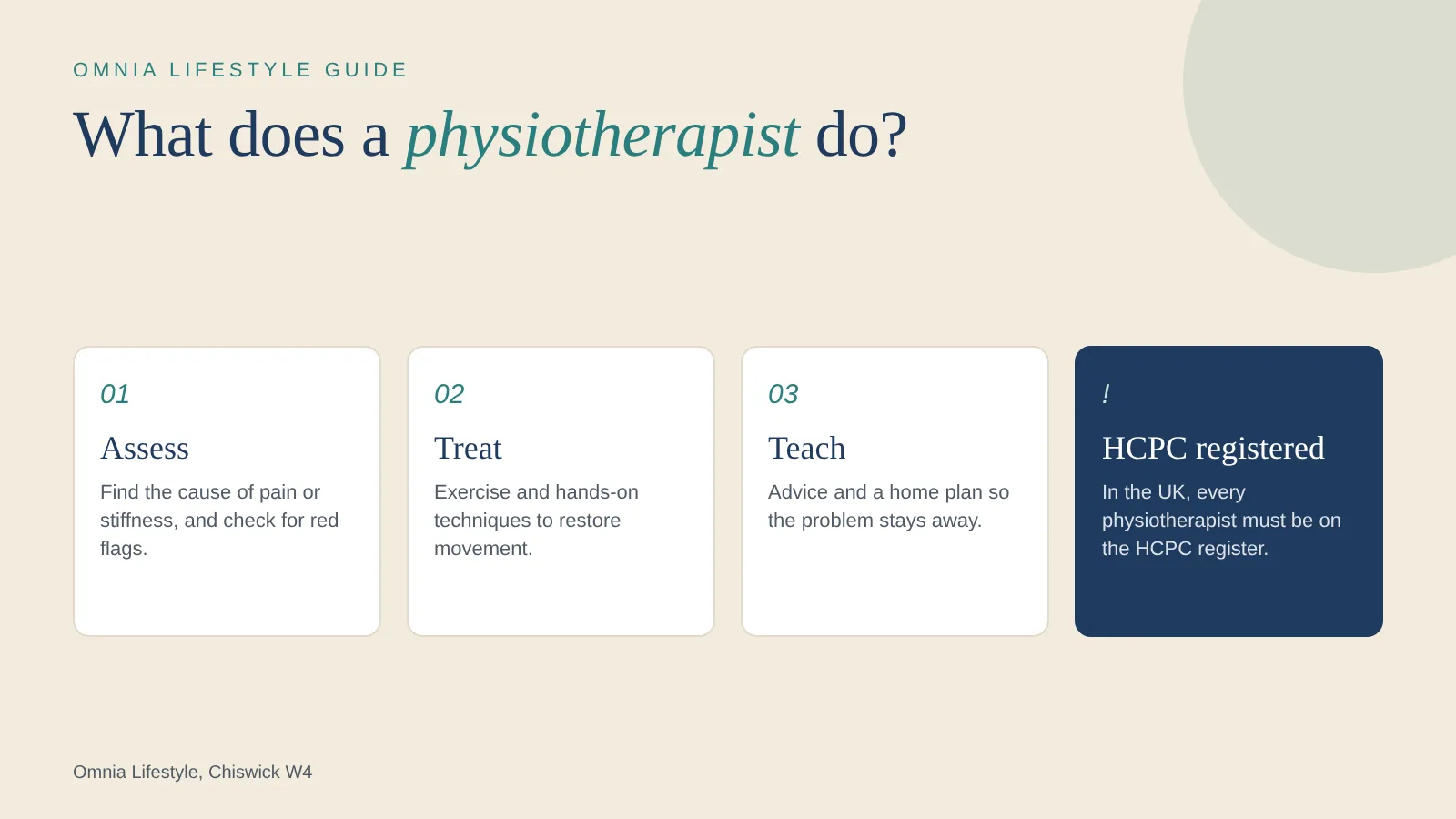
A physiotherapist is a regulated healthcare professional who helps people restore movement and function after injury, illness or surgery. They assess how you move, identify the cause of pain or stiffness, and treat it with exercise, hands-on techniques and advice. In the UK, physiotherapists must hold an approved degree and be registered with the Health and Care Professions Council (HCPC). Most people with muscle and joint problems can book directly.
What is physiotherapy?
Physiotherapy is a healthcare profession that helps people move better, reduce pain and get back to the activities that matter to them. It treats the body as a whole, looking not just at the sore area but at the strength, flexibility, control and habits that affect it.
Physiotherapy meaning in simple terms: treatment that uses movement, exercise, hands-on therapy and education, rather than medication or surgery, to help the body heal and work well. The word comes from the Greek for "nature" or "physical" and "healing".
Physiotherapy and physical therapy: is there a difference?
No. Physical therapy is the term used in the United States and some other countries, while the UK, Ireland, Australia and much of Europe use physiotherapy. In the UK both "physiotherapist" and "physical therapist" are protected titles, so anyone using them must be registered with the HCPC. "Physio" is simply the short form.
What does a physiotherapist do?
The role of a physiotherapist is to find out why you are having a problem with pain or movement, treat it, and give you the tools to manage it yourself. In practice, that means:
- Assessment: asking about your symptoms, health, work and goals, then examining posture, movement, strength, flexibility and the painful area
- Diagnosis and explanation: working out the likely cause and explaining it in plain language, including what is safe to do
- Screening: checking for warning signs that need a GP, scan or specialist, and referring on when needed
- Exercise prescription: a tailored programme to restore movement, strength, balance and fitness, progressed as you improve
- Hands-on treatment: techniques such as joint mobilisation, soft tissue massage and stretching to reduce pain and stiffness in the short term
- Other techniques: some physiotherapists also use acupuncture or dry needling, taping, or exercise equipment
- Advice and education: on activity, posture, work set-up, sport, sleep and pacing, so the problem is less likely to return
A good physiotherapist sees exercise and self-management as the main treatment, with hands-on work used to help you move more comfortably while you build strength.
What is physiotherapy good for?
Physiotherapists work across many areas of healthcare. The most common is musculoskeletal (MSK) physiotherapy, which covers muscles, joints, tendons, ligaments and nerves. Read what MSK physiotherapy is for more detail.
- Back and neck pain, including sciatica. See back pain.
- Joint problems, such as knee, shoulder and hip pain and osteoarthritis
- Sports injuries, such as sprains, strains and tendon problems. See sports injuries.
- Rehabilitation after surgery, such as joint replacements and ligament repairs
- Dizziness and balance problems, through vestibular rehabilitation
- Neurological conditions, such as stroke, multiple sclerosis and Parkinson's disease
- Breathing and heart conditions, through respiratory and cardiac rehabilitation
- Pelvic health, including pregnancy-related pain and bladder problems
- Persistent pain that has lasted for months
What happens at a physiotherapy appointment?
A first appointment usually has three parts. Your physiotherapist will talk with you about your problem, examine how you move and where the pain comes from, then explain what they have found and agree a plan. Treatment usually starts in the same session, and you leave with exercises to begin at home. Follow-up sessions check progress, adjust your exercises and add hands-on treatment where it helps.
Wear comfortable clothing so the area can be examined, such as shorts for knee and hip problems or a vest top for shoulder problems. Our guides to your first physiotherapy appointment and what to wear for physiotherapy explain more.
Physiotherapist, osteopath, chiropractor or massage therapist?
Physiotherapists, osteopaths and chiropractors all treat muscle and joint problems, but their training and approach differ. Physiotherapists tend to focus most on exercise and rehabilitation, alongside hands-on care. A massage therapist eases muscle tension but does not diagnose. See physio vs osteopath vs chiropractor and physiotherapy vs massage.
What do you need to be a physio?
To work as a physiotherapist in the UK you need to complete a degree approved by the HCPC and register with the HCPC before you can practise. Routes include:
- A three-year BSc in physiotherapy (four years in Scotland)
- A two-year pre-registration MSc for people who already have a relevant degree
- A physiotherapy degree apprenticeship, combining work and study
Training includes anatomy, physiology, exercise science and clinical placements. Once registered, physiotherapists must keep their skills up to date to stay on the register. Many are also members of the Chartered Society of Physiotherapy, the professional body. You can check any physiotherapist's registration on the HCPC website.
When to see a GP or get urgent help instead
Physiotherapy is the right first step for most muscle and joint problems, but some symptoms need medical care first.
Call 999 or go to A&E if you have: back pain with numbness around your bottom or genitals, new problems controlling your bladder or bowels, or weakness in both legs. These can be signs of cauda equina syndrome. Also call 999 for chest pain, sudden weakness on one side of the body or a serious injury.
See your GP or call NHS 111 if you have: pain with a high temperature, unexplained weight loss, pain that is severe and constant at night, a hot, red, swollen joint, or a history of cancer with new back pain.
How to get the most from physiotherapy
- Do your exercises: most of the benefit comes from what you do between sessions
- Be specific about your goals, such as running a 10k, lifting your grandchild or sitting through a meeting
- Tell your physiotherapist what is not working, so the plan can be adjusted
- Bring scan reports and a list of your medicines to the first appointment
- Expect a plan, not a quick fix: see how many physiotherapy sessions you are likely to need
How we help in Chiswick
At Omnia Lifestyle, physiotherapy is delivered by our HCPC-registered physiotherapists Mohammad Heidari and Khushbu Tiwari. Every first appointment includes a full assessment, treatment in the same session and a plan you understand.
- Physiotherapy in Chiswick: 70-minute initial assessment and treatment £99; follow-up 45 minutes £90 or 30 minutes £70; 30-minute consultation £50
- Home visit physiotherapy across West London from £110
- Vertigo and BPPV assessment and treatment £50
- Pixformance guided training £50 a session
Physiotherapy at Omnia is recognised by AXA Health, Aviva, WPA and Vitality. For a full breakdown of costs across the UK, see how much physiotherapy costs.
Frequently asked questions
What is the role of a physiotherapist?
To assess, diagnose and treat problems with movement and pain, using exercise, hands-on techniques and advice, and to help you manage your condition yourself.
Do I need a GP referral to see a physiotherapist?
Not for private physiotherapy, although some health insurers ask for one before they cover treatment. Many NHS areas also accept self-referral. See can you self-refer to physiotherapy.
Does physiotherapy work?
Exercise-based physiotherapy is a well-evidenced treatment for most muscle and joint problems, including back pain and osteoarthritis. Read does physiotherapy work.
Does physiotherapy hurt?
Assessment and treatment may cause some temporary discomfort, and exercises can leave you a little sore at first, but physiotherapy should not make your pain significantly worse. Tell your physiotherapist if it does.
What is the difference between a physio and a physiotherapist?
There is none. Physio is the everyday short form of physiotherapist and physiotherapy.
Physiotherapy in Chiswick
Physiotherapy is available at Omnia Lifestyle, 8 to 9 Bedford Corner, The Avenue, Chiswick W4 1LZ, close to Turnham Green station, on bus routes 94, E3 and 272. Limited parking is available on request when booking.
Explore physiotherapy in Chiswick and MSK therapy, or book an assessment.
This article is general information, not medical advice. If you have any of the warning signs listed above, seek urgent medical attention.
Ready to book?
Physiotherapy



.jpg)
.jpg)