


Book at our Chiswick clinic
Physiotherapy
Inner knee pain, also called medial knee pain, is felt on the inside of the knee, the side closest to your other leg. It might be a deep ache after walking, a sharp pain when you twist or straighten the leg, or a tender spot just below the joint that hurts when you climb stairs or lie with your knees together.
The inside of the knee takes more load than the outside when you walk, which is why wear, tendon irritation and cartilage problems often show up here first. This guide explains the common causes of pain on the inside of the knee, how to ease it quickly, and when it needs to be checked.
Quick answer
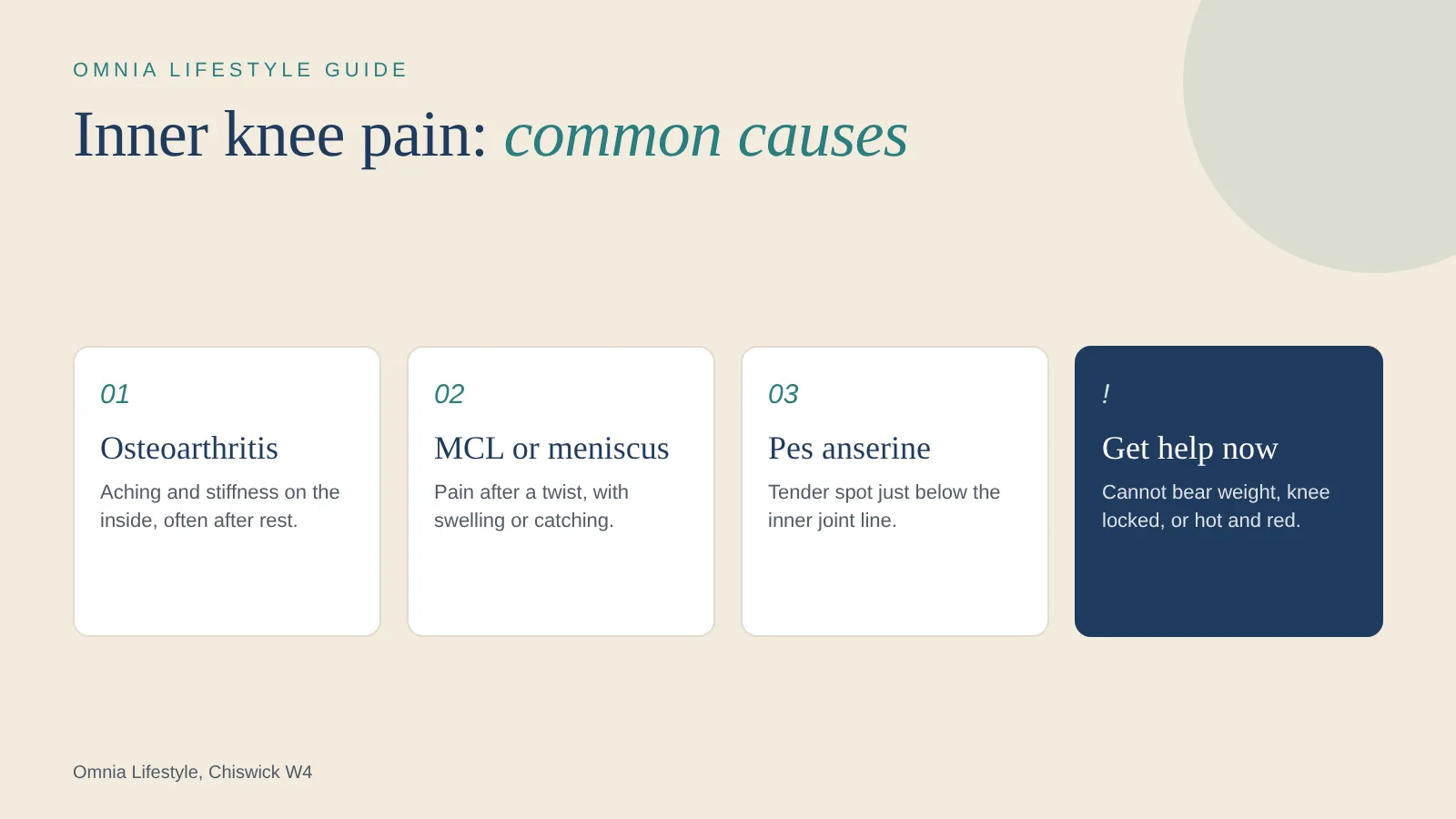
Inner knee pain is usually caused by osteoarthritis, a medial collateral ligament (MCL) sprain, a medial meniscus tear or pes anserine tendinopathy, a tendon and bursa problem just below the inside of the knee. Most cases improve with activity changes and strengthening over a few weeks. Get urgent help if you cannot bear weight, the knee locks or it is hot, red and swollen.
Why does the inside of my knee hurt?
The main structures on the inside of the knee are the inner half of the joint and its meniscus cartilage, the medial collateral ligament, the pes anserine tendons and bursa, and the inner edge of the kneecap. The common causes are:
- Osteoarthritis: the inner compartment is the part of the knee most often affected by osteoarthritis. It causes an aching pain on the inside of the knee, stiffness after rest and sometimes swelling, usually from middle age onwards. See the stages of osteoarthritis.
- MCL sprain: the medial collateral ligament runs down the inside of the knee. It is often injured when the knee is pushed inwards, such as in a football tackle or a skiing fall, causing pain, tenderness and sometimes a feeling of instability.
- Medial meniscus tear: a twisting injury, or gradual wear in older adults, can tear the inner cartilage. It causes pain on the inner joint line, swelling, and sometimes catching or locking.
- Pes anserine tendinopathy and bursitis: pain and tenderness about two to three fingers' width below the inner joint line, common in runners and in people with knee osteoarthritis.
- Kneecap pain: patellofemoral pain is often felt around the inner edge of the kneecap, worse on stairs, squatting and sitting for long periods. See runner's knee.
- Plica irritation: a fold of joint lining on the inner side of the kneecap can become irritated with repetitive bending, causing pain and clicking.
Tendonitis inside of the knee
When people talk about tendonitis on the inside of the knee, they usually mean pes anserine tendinopathy. Three tendons, from the sartorius, gracilis and semitendinosus muscles, join together and attach just below the inside of the knee, with a small fluid-filled sac (bursa) beneath them. The area can become irritated by:
- A sudden increase in running, especially on hills or cambered surfaces
- Knee osteoarthritis, which changes how the knee is loaded
- Tight hamstrings or weak hip and thigh muscles
- Carrying extra body weight
Typical symptoms are tenderness to touch on the inner shin just below the knee, pain climbing stairs or getting up from a chair, and pain at night when the knees press together. It usually settles with load management, strengthening and sometimes a pillow between the knees in bed.
Why does the inside of my knee hurt when I extend it?
Pain on the inside of the knee when you straighten it fully can come from:
- A medial meniscus tear, where a flap of cartilage is pinched as the knee straightens, sometimes with a block to full straightening
- An MCL sprain, because the ligament is tightest when the knee is straight
- Osteoarthritis, where swelling or bony changes make the last part of straightening stiff and sore
- Plica irritation as the fold of lining glides over the bone
If your knee cannot fully straighten after an injury, or keeps locking, get it assessed.
How to relieve inner knee pain quickly
There is no way to fix inner knee pain in seconds, but these steps often ease it quickly while the cause is treated:
- Change position: if you have been sitting, stand and walk a few steps. If you have been on your feet, sit with the leg supported
- Use ice or heat: ice wrapped in a towel for up to 20 minutes for a recent injury or flare, or warmth for a stiff, arthritic knee
- Try gentle movement: slowly bend and straighten the knee 10 times while sitting, and tighten the thigh muscle for five seconds at a time
- Put a pillow between your knees in bed if pain wakes you when lying on your side
- Take painkillers such as paracetamol or ibuprofen, or use an anti-inflammatory gel, if suitable for you
For lasting relief, build strength in the thigh and hip muscles. Our exercises for knee pain guide is a good place to start.
When to see a GP or get urgent help
Ask for an urgent GP appointment, call NHS 111 or go to A&E if:
- You heard a pop or snap and the knee swelled quickly
- You cannot put weight on the leg
- The knee is locked and will not straighten
- The knee is hot, red and swollen, or you have a high temperature
- Your calf is swollen, warm and painful
In children and teenagers, pain on the inside of the knee with a limp can come from a hip problem. Get them seen by a GP promptly, and the same day if they cannot bear weight.
See your GP or a physiotherapist if: inner knee pain has not improved after two to three weeks, the knee keeps giving way, or pain is limiting walking, sport or sleep.
What helps inner knee pain long term
- Strengthen the thigh and hip muscles: sit to stands, step-ups, bridges and side-lying leg raises help control how the knee is loaded
- Keep active: walking, cycling and swimming are usually well tolerated
- Modify, do not stop: reduce hills, deep squats and twisting sports for a while, and build back gradually
- Manage body weight if relevant, as it reduces load through the inner knee
- Check your footwear and replace worn running shoes
How we help in Chiswick
At Omnia Lifestyle our HCPC-registered physiotherapists examine the knee, hip and the way you move to identify which structure is causing inner knee pain, screen for anything that needs a scan or GP review, and agree a plan to settle the pain and rebuild strength.
- Physiotherapy in Chiswick: 70-minute initial assessment and treatment for £99, follow-ups from £70. Recognised by AXA Health, Aviva, WPA and Vitality.
- Pixformance guided training: £50 a session, to build leg strength with real-time feedback on technique.
- Sports massage: from £65 for 30 minutes, for tight thigh and hamstring muscles alongside exercise.
Frequently asked questions
Is inner knee pain serious?
Usually not. Most inner knee pain comes from arthritis, a minor sprain or tendon irritation. Pain after an injury with swelling, locking or giving way should be assessed.
Is walking good for inner knee pain?
Usually yes, at a comfortable pace and distance. If walking makes the pain clearly worse the next day, shorten your walks and build up gradually.
How long does pes anserine tendinopathy take to heal?
Many people improve within a few weeks to a few months with strengthening and changes to activity. It can take longer if knee osteoarthritis is also present.
Can inner knee pain come from the hip?
Yes. Hip problems can refer pain to the inside of the knee, particularly in children, teenagers and people with hip arthritis.
Should I wear a knee support?
A support can make the knee feel more comfortable for some activities, but it does not replace strengthening exercises.
Inner knee pain in Chiswick
Inner knee pain is assessed and treated at Omnia Lifestyle, 8 to 9 Bedford Corner, The Avenue, Chiswick W4 1LZ, close to Turnham Green station, on bus routes 94, E3 and 272. Limited parking is available on request when booking.
Read more about knee pain, outer knee pain and knee pain in women, explore physiotherapy in Chiswick, or book an assessment.
This article is general information, not medical advice. If you have any of the warning signs listed above, seek urgent medical attention.
Ready to book?
Physiotherapy


.jpg)
.jpg)