


Book at our Chiswick clinic
Physiotherapy
Pain behind the knee can feel like a tight, pulling sensation when you straighten your leg, a dull ache after standing or walking, or a sharp twinge when you sprint or squat. The back of the knee is a crossroads of tendons, muscles, blood vessels and nerves, so there are several possible causes.
Most are muscle, tendon or joint problems that respond well to the right exercises. One cause, a blood clot in the leg, needs urgent attention, so it is worth knowing the signs. This guide explains why the back of your knee might hurt, how to tell the causes apart, what helps and when to get checked.
Quick answer
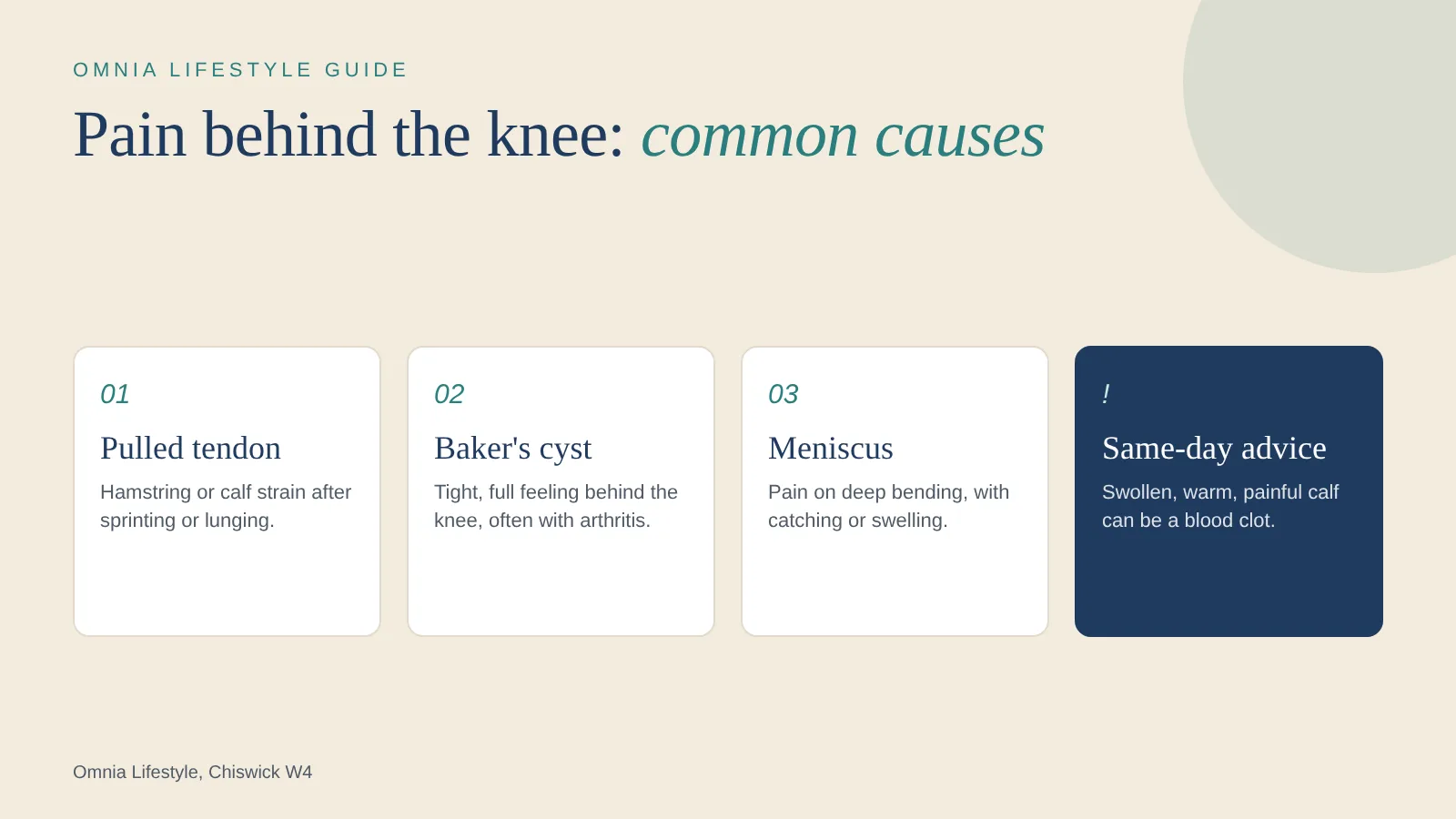
Pain behind the knee is most often caused by a strained or irritated hamstring or calf tendon, a Baker's cyst, a meniscus tear or arthritis. A pulled tendon behind the knee usually improves within a few weeks with gentle stretching and strengthening. Get same-day medical advice if your calf is also swollen, warm, red or painful, as this can be a deep vein thrombosis (DVT).
Why does the back of my knee hurt?
The back of the knee, called the popliteal area, contains the lower ends of the hamstring tendons, the upper ends of the calf muscles, the small popliteus muscle, the back of the meniscus cartilage, and the main blood vessels and nerves of the lower leg. Where the pain is, how it started and what makes it worse give the best clues.
Pulled tendon behind the knee
A pulled tendon behind the knee usually means a strain of one of the hamstring tendons, which you can feel as cords on either side of the back of the knee, or of the top of the calf muscle.
- Hamstring strain or tendinopathy: pain at the back of the knee or lower thigh, often after sprinting, kicking or a sudden lunge. It is worse when bending the knee against resistance or stretching the hamstring. See our hamstring strain exercises.
- Calf (gastrocnemius) strain: pain just below the back of the knee or in the upper calf, often after pushing off suddenly, such as in tennis or running uphill. It is worse rising onto tiptoe.
- Popliteus strain: pain deep at the back outer corner of the knee, often worse walking or running downhill.
Mild strains usually settle within two to six weeks with relative rest followed by gradual strengthening. A sudden snap with immediate severe pain, significant bruising or difficulty walking needs assessment.
Baker's cyst
A Baker's cyst is a fluid-filled swelling at the back of the knee. It usually develops because of an underlying problem in the joint, such as osteoarthritis or a meniscus tear, which produces extra fluid. It can cause:
- A soft lump or fullness behind the knee, more obvious when standing
- Tightness or aching behind the knee, especially when fully bending or straightening
- Stiffness and sometimes knee swelling
Many Baker's cysts need no specific treatment and settle as the underlying knee problem is treated. If a cyst bursts, fluid can leak into the calf, causing sudden pain, swelling and redness that looks very like a DVT. Always get this checked the same day. Read more about swollen knees.
Other causes of pain behind the knee
- Meniscus tear: a tear at the back of the knee cartilage can cause pain behind the knee when squatting or fully bending, sometimes with catching, locking or swelling.
- Osteoarthritis: an ache at the back and around the knee, with stiffness after rest. See osteoarthritis.
- Ligament injury: the posterior cruciate ligament can be injured by a fall onto a bent knee or a dashboard injury in a car accident.
- Referred pain from the back: a trapped nerve in the lower back can cause pain down the back of the thigh and knee, often with pain into the calf or foot. See sciatica.
Aching behind the knees
An ache behind both knees after a long day standing, walking or sitting with your legs straight is often linked to tight or tired hamstrings and calves, a recent increase in activity or hypermobile knees that rest pushed back. Osteoarthritis in both knees is another common cause in older adults. Varicose veins can also cause an ache, heaviness or throbbing behind the knee and in the calf, often worse at the end of the day.
Pain behind the knee when bending or straightening
Pain behind the knee when bending fully is common with a Baker's cyst or meniscus tear. Pain when straightening the knee, or a pulling feeling when bending forward with straight legs, more often points to the hamstring tendons. Our guide to knee pain when bending covers more patterns.
When to get help
Call NHS 111 or get an urgent GP appointment if you have:
- Throbbing or cramping pain in the calf or behind the knee, usually in one leg
- Swelling, warmth, or red or darker skin in the calf
- Swollen veins that are hard or sore to touch
These can be signs of a DVT. Risk is higher after surgery, a long journey, a period of immobility, pregnancy or if you take the contraceptive pill or HRT.
Call 999 if leg pain or swelling comes with breathlessness, chest pain or coughing up blood, as a clot may have travelled to the lungs.
Go to A&E or get urgent advice if you heard a snap, cannot put weight on the leg, the knee is very swollen or locked, or your foot feels numb or cold.
See a GP or physiotherapist if pain behind the knee has not improved after two weeks, keeps coming back or is stopping you exercising.
What you can do at home
- Ease off activities that provoke it, such as sprinting, hill running or deep squats, for a week or two
- Use ice wrapped in a towel for up to 20 minutes after activity for a recent strain
- Stretch gently: a light hamstring or calf stretch, held for 20 to 30 seconds without forcing, can ease tightness
- Start strengthening once the sharp pain settles: bridges, heel raises and sit to stands. Our exercises for knee pain show how
- Break up long periods of sitting or standing and avoid locking your knees back
- Try painkillers such as paracetamol or ibuprofen if suitable for you
How we help in Chiswick
At Omnia Lifestyle our HCPC-registered physiotherapists examine the knee, hamstrings, calf and lower back to find where pain behind your knee is coming from, screen for any signs that need medical review, and set a clear plan.
- Physiotherapy in Chiswick: 70-minute initial assessment and treatment for £99, follow-ups from £70. Recognised by AXA Health, Aviva, WPA and Vitality.
- Sports massage: from £65 for 30 minutes, to ease tight hamstrings and calves alongside a strengthening plan. Massage is not suitable if a blood clot is suspected.
- Home visit physiotherapy across West London from £110.
Frequently asked questions
Why does behind my knee hurt?
Most often because of a strained hamstring or calf tendon, a Baker's cyst, a meniscus tear or arthritis. Pain with a swollen, warm calf can be a blood clot and needs same-day advice.
How long does a pulled tendon behind the knee take to heal?
Mild strains usually improve within two to six weeks. More significant strains or long-standing tendon pain can take a few months with a structured strengthening programme.
Should I stretch if the back of my knee hurts?
Gentle stretching can help tight muscles, but do not stretch hard into pain in the first few days after a strain. Strengthening is usually more important for recovery.
How do I know if pain behind my knee is a blood clot?
A clot usually causes throbbing pain in one calf with swelling, warmth and red or darker skin. You cannot rule it out yourself, so call NHS 111 or see a GP the same day.
Can I walk with pain behind my knee?
If you can walk without limping and there are no warning signs, gentle walking is usually fine and helps recovery.
Pain behind the knee in Chiswick
Pain behind the knee is assessed and treated at Omnia Lifestyle, 8 to 9 Bedford Corner, The Avenue, Chiswick W4 1LZ, close to Turnham Green station, on bus routes 94, E3 and 272. Limited parking is available on request when booking.
Read more about knee pain and outer knee pain, explore physiotherapy in Chiswick, or book an assessment.
This article is general information, not medical advice. If you have any of the warning signs listed above, seek urgent medical attention.
Ready to book?
Physiotherapy


.jpg)
.jpg)