



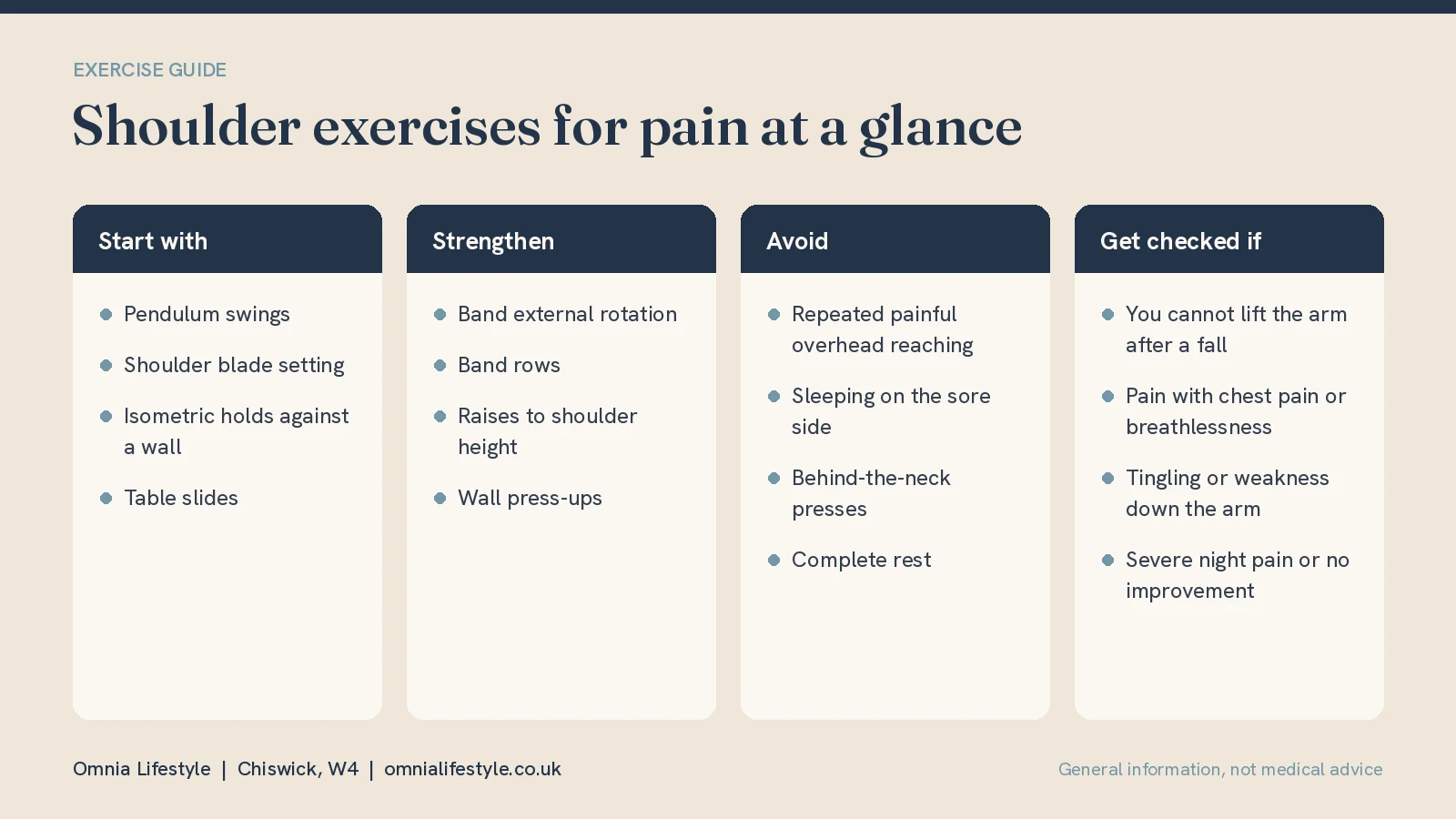


Shoulder pain is very common, and the right exercises are the most effective treatment for most of it. The shoulder is the most mobile joint in the body, which means it relies heavily on the muscles around it, especially the rotator cuff and the muscles that control the shoulder blade, to keep it stable and pain-free.
This guide sets out shoulder exercises for pain: where to start, how to build strength, what to avoid, and the signs that mean your shoulder should be assessed rather than exercised.
Why exercise helps most shoulder pain
The most common cause of shoulder pain in adults is irritation of the rotator cuff tendons, often called rotator cuff related shoulder pain or impingement. It typically causes an ache on the outside of the upper arm, pain lifting the arm out to the side or overhead, and pain lying on that side at night. It often follows an increase in overhead work, gardening, decorating, swimming or gym training.
Tendons recover by being loaded gradually. Research consistently finds that a progressive exercise programme is the first-line treatment for this type of shoulder pain, and most people improve over 6 to 12 weeks. Rest alone tends to leave the shoulder weaker and stiffer.
A guide to intensity: discomfort up to about 3 or 4 out of 10 during exercise is acceptable if it settles within 24 hours. Sharp pain, or pain that is clearly worse the next day, means you should drop back a stage.
Is it frozen shoulder instead?
Frozen shoulder behaves differently. The shoulder becomes stiff in every direction, particularly turning the arm outwards, and it stays stiff even when someone else tries to move it for you. It is most common between 40 and 60 and in people with diabetes. If this sounds like you, see our guide to frozen shoulder exercises, because the approach is different.
Shoulder exercises to start with
Pendulum swings
Lean forward with your good hand resting on a table and let the painful arm hang down relaxed. Gently sway your body so the arm swings in small circles, then forwards and backwards. Continue for 30 to 60 seconds. This eases pain and stiffness without working the muscles hard.
Shoulder blade setting
Sit or stand tall. Gently draw your shoulder blades back and down, as if tucking them into your back pockets, without arching your back. Hold for five seconds and relax. Repeat 10 times. Good shoulder blade control takes pressure off the rotator cuff.
Isometric holds against a wall
Stand side on to a wall with a folded towel between your elbow and the wall, elbow bent to 90 degrees. Gently press your elbow outward into the wall without moving, hold for 20 to 30 seconds and relax. Repeat five times. Then stand facing the wall and press the back of your wrist gently outward against a door frame to work the muscles that turn the arm out. Isometric holds are often comfortable even when movement is painful.
Table slides
Sit at a table with your hand resting on a towel. Slide your hand forward along the table, leaning your body forward to raise the arm, then return. Repeat 10 times. This restores lifting range with the arm supported.
Shoulder strengthening exercises
Introduce these once the starting exercises are comfortable, usually after one to two weeks. Aim for three sets of 10 to 15 repetitions, every other day, and increase the resistance gradually as they become easy.
Band external rotation
Stand with your elbow bent to 90 degrees and tucked against your side, with a small folded towel between your elbow and body. Hold a resistance band anchored at waist height across your body. Keeping the elbow at your side, rotate your forearm outward, then return slowly. This strengthens the rotator cuff muscles that are most often weak in shoulder pain.
Band rows
Anchor a resistance band at chest height. Holding an end in each hand, pull your elbows back past your body while squeezing your shoulder blades together, then return slowly.
Raises to shoulder height
Hold a light weight or bottle of water with your thumb pointing up. Raise your arm in front of you and slightly out to the side, about halfway between forwards and sideways, up to shoulder height, then lower slowly over three seconds. Keep the shoulder blade set and avoid shrugging.
Wall press-ups
Stand facing a wall with your hands on it at shoulder height. Bend your elbows to bring your chest towards the wall, then push back. As you push, let your shoulder blades move apart slightly at the end. Progress to a worktop and later the floor.
Returning to overhead movement
Once you can do the exercises above comfortably with some resistance, gradually add lifting overhead: first reaching to a high shelf, then light overhead presses. Build up over several weeks rather than returning straight to heavy lifting, swimming or throwing.
Everyday changes that help
- Sleep on your back or the other side, with a pillow hugged in front of you to support the sore arm.
- Keep frequently used items at chest height rather than on high shelves for a few weeks.
- Break up overhead tasks such as painting or hanging washing into short spells.
- Keep the arm moving in comfortable ranges through the day.
What to avoid, at least initially
- Repeated painful overhead reaching, lifting or throwing.
- Lying on the painful side for long periods.
- Behind-the-neck presses and pull-downs, dips and heavy upright rows in the gym.
- Complete rest or keeping the arm in a sling unless advised.
- Pushing through sharp pain to finish a set.
When to seek medical attention
Call 999 if: shoulder or arm pain comes with chest pain, breathlessness, sweating or feeling sick, particularly on the left side.
Seek urgent medical attention if:
- You cannot lift your arm after a fall or injury, or the shoulder looks deformed
- The shoulder is hot, red and swollen, or you feel feverish and unwell
See your GP or a physiotherapist if:
- Pain, tingling, numbness or weakness travels down the arm into the hand
- Pain is severe at night whatever position you are in
- You have unexplained weight loss or a history of cancer
- The shoulder is becoming stiffer in every direction
- There is no improvement after four to six weeks of exercise
What a physiotherapy assessment adds
Shoulder pain can come from the rotator cuff, the joint capsule, the joint at the top of the shoulder, or the neck, and each needs a different plan. An assessment tests movement, strength and specific structures, checks whether the neck is involved, and sets the right starting level. Hands-on treatment or acupuncture can be added to ease pain while the strengthening programme does the long-term work.
If your shoulder is stiff in every direction, see how to cure frozen shoulder quickly.
Frequently asked questions
How long do shoulder exercises take to work?
Many people notice less pain within two to four weeks, with larger improvements over 6 to 12 weeks. Tendons strengthen slowly, so consistency matters more than intensity.
Should I use heat or ice on a painful shoulder?
Either can ease pain. Ice often helps after activity or a flare, and heat helps stiffness and muscle tension. Neither replaces exercise.
Can I keep going to the gym with shoulder pain?
Usually yes, with changes. Keep training the rest of the body, swap painful overhead and wide-grip movements for pain-free alternatives, and use the strengthening exercises above.
What is the best sleeping position for shoulder pain?
Sleep on your back or on the other side, with a pillow in front of you to rest the sore arm on. Avoid sleeping with the painful arm above your head.
Do steroid injections help shoulder pain?
An injection can reduce pain in the short term and make exercise easier, but it does not strengthen the shoulder. It works best alongside an exercise programme.
Does acupuncture help shoulder pain?
Some trials report short-term pain relief for shoulder pain. It is best used alongside exercise rather than instead of it.
Shoulder pain assessment and treatment in Chiswick
Shoulder pain is assessed and treated at Omnia Lifestyle in Chiswick, W4, close to Turnham Green station, on bus routes 94, E3 and 272. Limited parking is available on request when booking. Assessment identifies the source of your pain and sets a strengthening programme at the right level.
Read more about neck and shoulder pain and frozen shoulder, see our guides to frozen shoulder exercises, neck pain exercises and tennis elbow exercises, explore physiotherapy and acupuncture, or book an assessment.
This article is general information, not medical advice. If you have any of the warning signs listed above, seek medical attention.



.jpg)
.jpg)