






Book at our Chiswick clinic
Physiotherapy
Sciatica is pain, tingling or numbness that travels from the lower back or buttock down the back of the leg, often into the foot, because a nerve in the lower back is irritated or pressed. This guide is for anyone with sciatica that is slow to ease, keeps returning or is making it hard to sit, walk, work or sleep. It explains what physiotherapy for sciatica involves, what the NHS and NICE recommend, and what to expect in Chiswick.
When to see someone: the NHS suggests getting help if sciatica has not improved after a few weeks of home treatment, is getting worse or is stopping your normal activities. Physiotherapy at Omnia is with HCPC-registered physiotherapists, no GP referral is needed, and a 70-minute first appointment with assessment and treatment is £99. Book online or call 020 4515 0000.
Quick answer
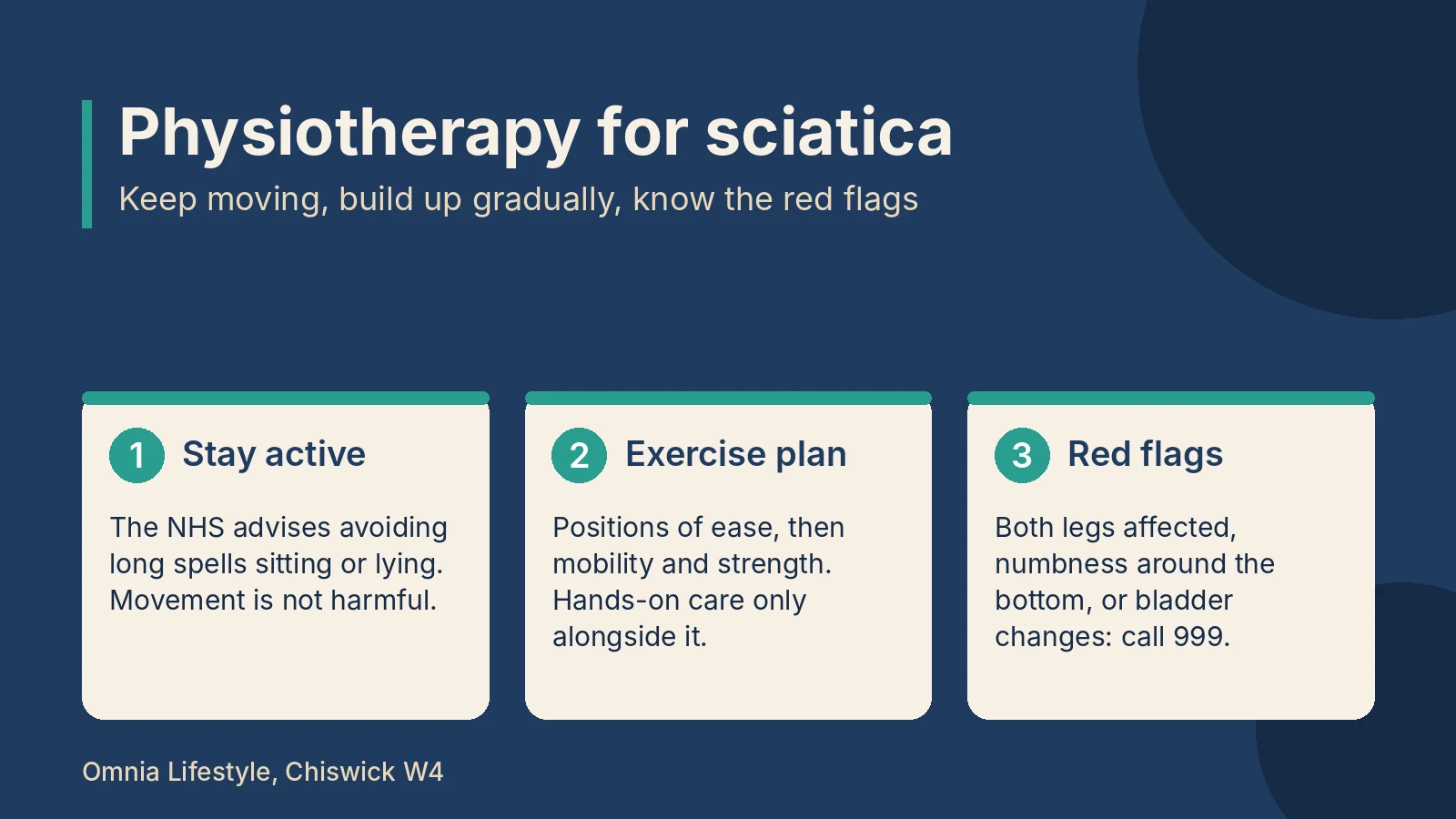
Physiotherapy for sciatica focuses on staying active, exercise and advice, with hands-on treatment as part of an exercise plan. The NHS lists physiotherapy, including exercise advice and manual therapy, among the main treatments. NICE recommends exercise and says manual therapy should only be used alongside it. Sciatica usually improves within a few weeks to a few months, and physiotherapy aims to ease pain, keep you moving and help you manage any future flare-ups. It cannot promise to speed up nerve healing for everyone.
What physiotherapy for sciatica involves
The NHS describes sciatica as usually affecting the bottom and back of one leg, often with sharp or burning pain, pins and needles, numbness or weakness. Leg pain is usually worse than back pain. A physiotherapist will:
- Assess the nerve. Check sensation, reflexes and muscle strength in the legs, and look for signs that need urgent medical review.
- Explain what is going on. Understanding that nerve pain can be intense without meaning serious damage often reduces fear and helps you stay active.
- Find positions of ease. Many people have movements or postures that settle the leg pain; these become your starting point.
- Build an exercise plan. Gentle mobility, nerve gliding where appropriate, walking, and gradually more strength work for the back, hips and legs.
- Use hands-on treatment where helpful. Soft tissue work or mobilisation can ease pain and muscle guarding, used as part of the exercise plan.
- Advise on work and daily life. Breaking up long periods of sitting, sleeping comfortably and returning to work or sport.
What NICE and the NHS say about sciatica treatment
NICE guideline NG59 covers low back pain and sciatica in people aged 16 and over. For sciatica it says:
- Self-management. Give information about sciatica and encourage people to continue normal activities.
- Exercise. Consider a group exercise programme for a specific episode or flare-up.
- Manual therapy only with exercise. Spinal manipulation, mobilisation or soft tissue techniques such as massage should only be considered as part of a package that includes exercise.
- Not recommended. Belts or corsets, foot orthotics, traction, acupuncture, ultrasound, TENS and interferential therapy are not recommended.
- Medicines. NICE advises against gabapentinoids, other antiepileptics, oral corticosteroids and benzodiazepines for sciatica, and against opioids for chronic sciatica, because of limited benefit and risk of harm.
- Surgery. Spinal decompression can be considered when non-surgical treatment has not improved pain or function and scan findings match the symptoms.
The NHS sciatica page lists exercises and stretches, painkillers and physiotherapy as the main treatments, and notes that physiotherapy is free on the NHS but waiting times can be long. A specialist may consider injections, radiofrequency denervation or surgery if pain is severe and other treatments have not helped.
What happens at your first session
Your first appointment at Omnia lasts 70 minutes, so you are assessed and treated the same day. Wear comfortable clothes that let your physiotherapist see your back and legs. Expect questions about how the pain started, what eases it, any numbness or weakness, and bladder and bowel function, because these screen for serious problems. You will leave with a clear explanation, two or three exercises or positions to use at home, and a plan for the next few weeks.
How many physio sessions for sciatica?
There is no set number. Because sciatica often improves over weeks to months, physiotherapy is often most useful as a short series of sessions spread out over that time, rather than many sessions close together. Early on, sessions focus on easing pain and keeping you moving. Later, they focus on strength, fitness and getting back to everything you want to do. Your physiotherapist should track leg pain, how far you can walk and how long you can sit, and refer you back to your GP if you are not improving or symptoms worsen. See how many physiotherapy sessions you may need.
Physiotherapy for sciatica: cost
- First appointment: 70 minutes, £99, including assessment and treatment the same day.
- Follow-up sessions: £70 for 30 minutes or £90 for 45 minutes.
- Consultation only: £50 for 30 minutes.
- Home visit physiotherapy: across West London from £110, if travelling or sitting in a car is too painful.
Physiotherapy at Omnia is recognised by AXA Health, Vitality, WPA and Aviva, although policies vary. See how much physiotherapy costs in the UK.
Physiotherapy for sciatica at home
The NHS advice for sciatica at home is simple and well supported:
- Keep up normal activities as much as you can and start gentle exercise as soon as you are able.
- Avoid sitting or lying down for long periods. Movement may hurt, but the NHS notes it is not harmful and can help you recover faster.
- Use heat packs on painful areas.
- Do regular sciatica exercises and stretches. See our sciatica exercises and the ones to avoid.
- Ask a pharmacist about painkillers. The NHS says paracetamol is unlikely to help and it is not clear how much anti-inflammatories such as ibuprofen help.
Our guide on how to relieve sciatica pain has more practical tips for bad days.
Other treatments people combine with physiotherapy
Some people ask about acupuncture or massage for sciatica. NICE does not recommend acupuncture for managing low back pain with or without sciatica, and says massage should only be used as part of a package with exercise. Some people still choose acupuncture or massage alongside physiotherapy to ease muscle tension or pain, as a personal choice. Read can acupuncture help sciatica for an honest look at the evidence.
When to seek urgent help
Go to A&E or call 999 if you:
- Have sciatica on both sides
- Have weakness or numbness in both legs that is severe or getting worse
- Have numbness around or under your genitals, or around your bottom
- Find it hard to start peeing, cannot pee, or cannot control when you pee
- Do not notice when you need to poo, or cannot control when you poo
These can be signs of cauda equina syndrome, a serious problem that needs hospital treatment as soon as possible. Do not drive yourself; ask someone to take you or call 999.
Get an urgent GP appointment or call NHS 111 if you feel hot, cold, shivery or generally unwell with your pain. See your GP if pain has not improved after a few weeks, is getting worse, or is stopping your normal activities, or if you have unexplained weight loss or have had cancer in the past.
Frequently asked questions
Does physiotherapy help sciatica pain?
For many people, yes. The NHS lists physiotherapy among the main treatments for sciatica, and NICE recommends exercise with hands-on therapy only as part of an exercise package. Physiotherapy helps you stay active, manage pain and build strength. Sciatica often improves with time anyway, so the goal is to feel more in control while that happens.
Can I get physiotherapy for sciatica on the NHS?
Yes. Physiotherapy for sciatica is available free on the NHS, and in many areas you can refer yourself to community musculoskeletal services without seeing a GP. Waiting times can be long, which is why some people choose private physiotherapy. At Omnia you can book directly without a referral.
Is physiotherapy or rest better for sciatica nerve pain?
Staying active is better for most people. The NHS advises avoiding long periods of sitting or lying down, even though moving may hurt, because movement is not harmful and can speed recovery. A physiotherapist can show you which positions and exercises ease your leg pain so you can keep moving safely.
How long does sciatica take to heal with physiotherapy?
The NHS says sciatica usually gets better in a few weeks to a few months, although it can last longer and can come back. Physiotherapy does not follow a fixed timeline, but it can help you stay active and confident through recovery. See how long sciatica lasts for a fuller timeline.
Physiotherapy for sciatica in Chiswick
Our clinic is at 8 to 9 Bedford Corner, The Avenue, Chiswick W4 1LZ, close to Turnham Green station, on bus routes 94, E3 and 272. Limited parking is available on request when booking. Physiotherapists, acupuncturists and massage therapists work under one roof, so treatments can be combined where that suits you.
Read more about sciatica, see physiotherapy for back pain, or read what a slipped disc feels like.
Book physiotherapy in Chiswick: first appointment £99, including assessment and treatment. Book online or call 020 4515 0000.
This article is general information, not medical advice. If you have any of the warning signs above, seek medical attention.
Ready to book?
Physiotherapy




.jpg)
.jpg)
