



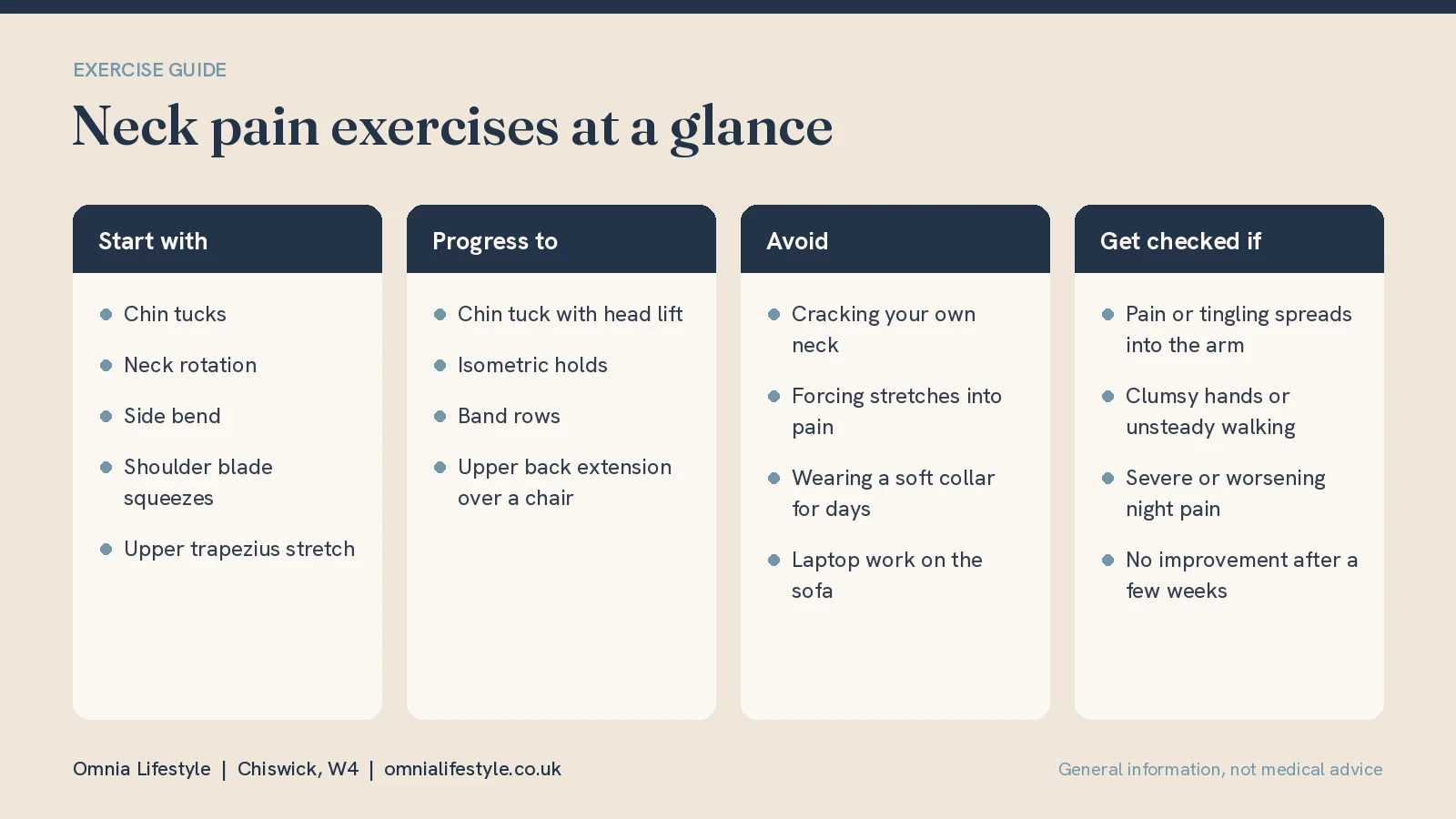


Neck pain is one of the most common reasons people see a physiotherapist. In most cases it comes from the muscles, joints and ligaments of the neck rather than anything serious, and it usually settles within a few weeks. Staying active and doing the right exercises helps it settle faster and makes it less likely to come back.
This guide covers the exercises that help, the everyday habits that keep neck pain going, what to avoid, and the warning signs that mean your neck should be assessed rather than exercised.
Why most neck pain is not serious
Clinicians call the most common type non-specific or mechanical neck pain. It typically feels stiff and sore, especially on turning the head, often with tension across the top of the shoulders, and sometimes with a headache that starts at the base of the skull. Common triggers include long periods at a desk or looking down at a phone, an awkward sleeping position, stress, and a sudden increase in activity such as decorating or a long drive.
Scans are rarely needed. Age-related changes on X-ray and MRI are very common in people who have no neck pain at all, so they often do not explain the symptoms and can cause unnecessary worry.
The two principles that matter most
Keep it moving. Gentle, regular movement within comfort helps stiff joints and guarded muscles relax. Collars and prolonged rest tend to slow recovery rather than speed it.
Build strength and endurance. The deep muscles at the front of the neck and the muscles around the shoulder blades support the head through a long day. Research consistently supports exercise for persistent neck pain, and it works best when combined with advice and, where helpful, hands-on treatment.
A useful guide to intensity: mild discomfort during exercise, up to about 3 or 4 out of 10, is acceptable if it settles within 24 hours. Pain, pins and needles or numbness that spreads into the arm is not, and means you should stop that exercise and get assessed.
Everyday changes that reduce the pain
- Raise your screen so the top of it sits at about eye level, and bring your phone up towards your eyes rather than your head down to the phone.
- Break up long sitting every 30 to 45 minutes. Stand, roll your shoulders and turn your head gently each way.
- Use one supportive pillow that keeps your neck level with the rest of your spine, and avoid sleeping on your front with your head turned to one side.
- Share the load by using a backpack or swapping sides with heavy bags.
- Notice tension. Stress commonly shows up as raised, tight shoulders. Slow breathing and letting the shoulders drop a few times a day helps.
Exercises to start with
Chin tucks
Sit tall and look straight ahead. Gently draw your chin straight back, as if making a double chin, without tipping your head up or down. Hold for five seconds and relax. Repeat 10 times, two or three times a day. This switches on the deep neck muscles that support good head position.
Neck rotation
Sitting tall, slowly turn your head to look over one shoulder as far as is comfortable. Hold for two or three seconds, return to the centre, then turn the other way. Repeat 10 times each side.
Side bend
Sitting tall, slowly tilt your ear towards your shoulder without lifting the shoulder up to meet it. Return to the centre and repeat on the other side. Repeat 10 times each side.
Shoulder blade squeezes
Sit or stand tall with your arms by your sides. Draw your shoulder blades gently back and down, hold for five seconds, and relax. Repeat 10 times. This takes load off the muscles at the top of the shoulders.
Upper trapezius stretch
Sit tall and hold the edge of the chair with your right hand. Gently tilt your head to the left until you feel a stretch along the right side of your neck. Hold for 20 to 30 seconds and repeat three times on each side. You should feel a stretch, not pain or tingling.
Exercises to progress to
Chin tuck with head lift
Lie on your back with your knees bent. Do a chin tuck, then lift your head two or three centimetres off the pillow while keeping the chin tucked. Hold for five seconds to begin with and build up to 10. Start with five repetitions and build to 10. This builds endurance in the deep neck muscles.
Isometric holds
Place your hand on your forehead and gently press your head into your hand without letting any movement happen. Hold for five to 10 seconds. Repeat with your hand on the side of your head and then the back. Use low effort, around a third of your maximum.
Band rows
Anchor a resistance band at chest height. Holding an end in each hand, pull your elbows back and squeeze your shoulder blades together, then return slowly. Build up to three sets of 10 to 12.
Upper back extension over a chair
Sit in a chair whose backrest reaches the middle of your upper back. Support your head with your hands and gently arch your upper back over the top of the backrest, then return. Repeat 10 times. A stiff upper back passes more load to the neck, so freeing it up often helps.
What to avoid, at least initially
- Repeatedly cracking or clicking your own neck. The relief is brief and it does not address the cause.
- Forcing stretches or fast neck circles into pain. Slow and controlled is better.
- Wearing a soft collar for more than a day or two unless a clinician has advised it.
- Complete rest. Keep moving within comfort.
- Long laptop sessions on the sofa or in bed with your head bent forward.
When to seek medical attention
Call 999 or go to A&E if:
- Neck pain follows a fall, a road traffic collision or a blow to the head, particularly with numbness or weakness
- You have a stiff neck with a high temperature, headache, sensitivity to light or a rash that does not fade when a glass is pressed against it
- You have a sudden, severe neck pain or headache unlike anything before, especially with dizziness, double vision, slurred speech or difficulty swallowing
See your GP or a physiotherapist promptly if:
- Pain, pins and needles, numbness or weakness spreads into an arm or hand
- You notice clumsiness in your hands, such as difficulty with buttons or writing, or your walking feels unsteady
- The pain is steadily getting worse, or is severe at night whatever position you are in
- You feel generally unwell, have unexplained weight loss or a history of cancer
- The pain has not started to improve after a few weeks
What a physiotherapy assessment adds
An assessment checks the warning signs first, then looks at which movements provoke your pain, how the joints of the neck and upper back are moving, the strength and endurance of the supporting muscles, and whether a nerve is involved. It also looks at your working set-up and daily habits. Treatment may include hands-on techniques to ease stiffness, alongside an exercise programme set at the right level and progressed as you improve.
If neck pain followed a car accident or sudden jolt, see how long whiplash lasts, and for another option alongside exercise, acupuncture for neck pain.
Frequently asked questions
How long does neck pain take to get better?
Most episodes improve noticeably within a few weeks. Pain that lasts beyond three months is described as persistent and usually responds best to a structured exercise programme rather than more rest.
Is heat or ice better for neck pain?
Heat is usually more comfortable for stiffness and muscle tension. Either can help with comfort, but neither addresses the cause on its own.
What is the best pillow for neck pain?
There is no single best pillow. Choose one that keeps your neck level with the rest of your spine in the position you usually sleep in.
Can neck pain cause headaches?
Yes. Headaches that start from the neck, known as cervicogenic headaches, are common, and neck tension often accompanies tension-type headaches too. A sudden, severe or unusual headache needs urgent medical attention.
Can I keep working at a desk?
Usually yes. Adjust your screen height, take regular movement breaks and do a few of the exercises above during the day.
Does acupuncture help neck pain?
Some trials show short-term pain relief for persistent neck pain compared with no treatment. It is generally used alongside exercise rather than instead of it.
Neck pain assessment and treatment in Chiswick
Neck pain is assessed and treated at Omnia Lifestyle in Chiswick, W4, close to Turnham Green station, on bus routes 94, E3 and 272. Limited parking is available on request when booking. Assessment identifies what is driving your pain and sets an exercise programme at a level your neck can tolerate.
Read more about neck and shoulder pain and whiplash, see our guide to frozen shoulder exercises, explore physiotherapy and acupuncture, or book an assessment.
This article is general information, not medical advice. If you have any of the warning signs listed above, seek medical attention.



.jpg)
.jpg)