



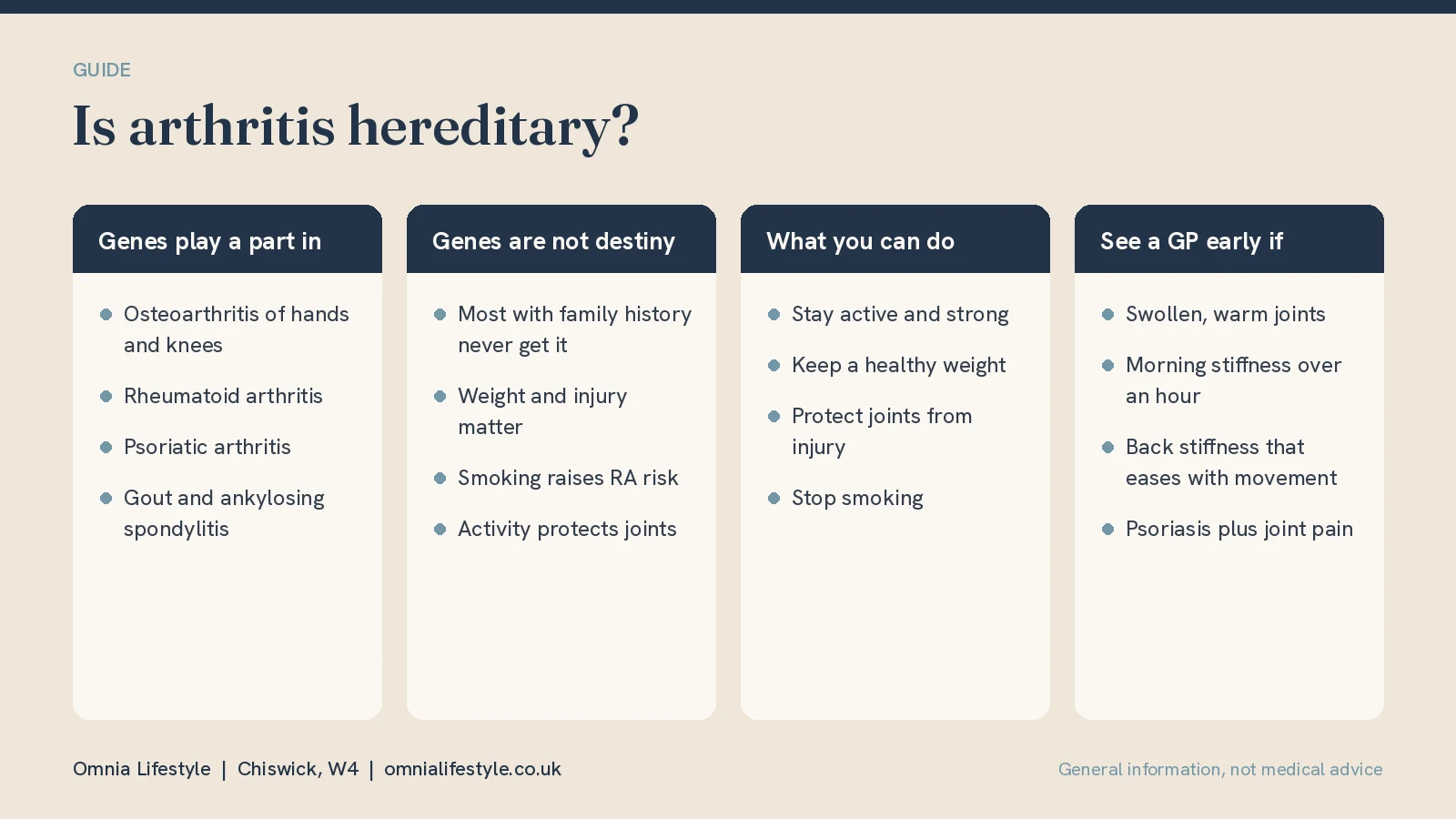


If a parent or grandparent had arthritis, it is natural to wonder whether you will get it too. The answer is that genes do play a part in several types of arthritis, but they are only part of the story. Most people with a family history never develop the condition, and there is a lot you can do to protect your joints.
This guide explains which types of arthritis run in families, how much genes matter, and what you can do to lower your risk.
Which types of arthritis run in families?
Osteoarthritis
Genes contribute to osteoarthritis, especially in the hands, hips and knees. Bony swellings at the finger joints often run in families. Age, previous joint injury, body weight and muscle strength also play major roles.
Rheumatoid arthritis
Rheumatoid arthritis has a genetic component, and having a close relative with it increases your risk. However, most people with a family history do not develop it. Smoking is one of the strongest modifiable risk factors.
Psoriatic arthritis
Psoriatic arthritis often runs in families, and people with psoriasis, or a family history of psoriasis, are at higher risk.
Ankylosing spondylitis
This type mainly affects the spine. It is strongly linked to a gene called HLA-B27, but most people who carry the gene never develop the condition.
Gout
Genes affect how well the kidneys remove uric acid, so gout often runs in families. Diet, alcohol, weight and medicines also matter.
Genes are not destiny
Inheriting a higher risk does not mean you will develop arthritis. For most types, genes interact with factors you can influence, such as weight, activity, smoking and joint injuries. Many people with a strong family history stay free of arthritis throughout their lives.
Is there a genetic test for arthritis?
Genetic tests are not used to predict most types of arthritis in healthy people. Some tests, such as HLA-B27, are used alongside symptoms and other tests when a doctor is investigating possible inflammatory arthritis, but a positive result on its own does not mean you have or will develop the condition.
What you can do to protect your joints
- Stay active: regular movement keeps joints healthy and muscles strong.
- Strengthen the muscles around your knees and hips two or three times a week.
- Keep a healthy weight to reduce load on the knees and hips.
- Protect joints from injury in sport with good technique and warm-ups.
- Stop smoking, which increases the risk of rheumatoid arthritis.
- Limit alcohol and sugary drinks if gout runs in your family.
See a GP early if
- You have swollen, warm or tender joints
- Morning stiffness lasts more than an hour
- You have back stiffness that eases with movement and worsens with rest, especially if you are under 45
- You have psoriasis and new joint pain
- A hot, red, swollen joint appears suddenly
Early treatment of inflammatory arthritis protects joints from long-term damage, so it is worth acting quickly on these signs, especially with a family history.
Frequently asked questions
If my mother had arthritis, will I get it?
Your risk may be higher, but it is far from certain. Staying active, keeping a healthy weight and protecting your joints from injury all lower the risk.
Can arthritis skip a generation?
Because several genes and lifestyle factors are involved, arthritis can appear in some family members and not others, including across generations.
Is osteoarthritis genetic or wear and tear?
Both genes and how joints are loaded play a part. It is no longer seen as simple wear and tear, and the right exercise helps rather than harms joints.
Should I tell my GP about a family history?
Yes, particularly if you develop joint symptoms. A family history helps your GP decide which tests are needed.
Arthritis assessment in Chiswick
Joint pain is assessed at Omnia Lifestyle in Chiswick, W4, close to Turnham Green station, on bus routes 94, E3 and 272. Limited parking is available on request when booking. Blood tests can be arranged where inflammation or gout needs ruling out, and results are shared with your GP.
Read more about arthritis, osteoarthritis and gout, see what arthritis feels like and what causes gout, explore physiotherapy and blood tests, or book an assessment.
This article is general information, not medical advice. If you have any of the warning signs listed above, see your GP.



.jpg)
.jpg)