


Book at our Chiswick clinic
Physiotherapy
Ankle pain can follow an obvious injury, such as rolling your ankle on a kerb, or build up gradually as an ache that is worse after walking, running or standing all day. The ankle takes your full body weight with every step, so even a small problem can affect how you move.
Most ankle problems are sprains, tendon problems or arthritis, and they usually get better with the right mix of rest, movement and strengthening. This guide explains the common causes of a painful ankle, what the location of the pain can tell you, what you can do at home and when ankle pain needs urgent attention.
Quick answer
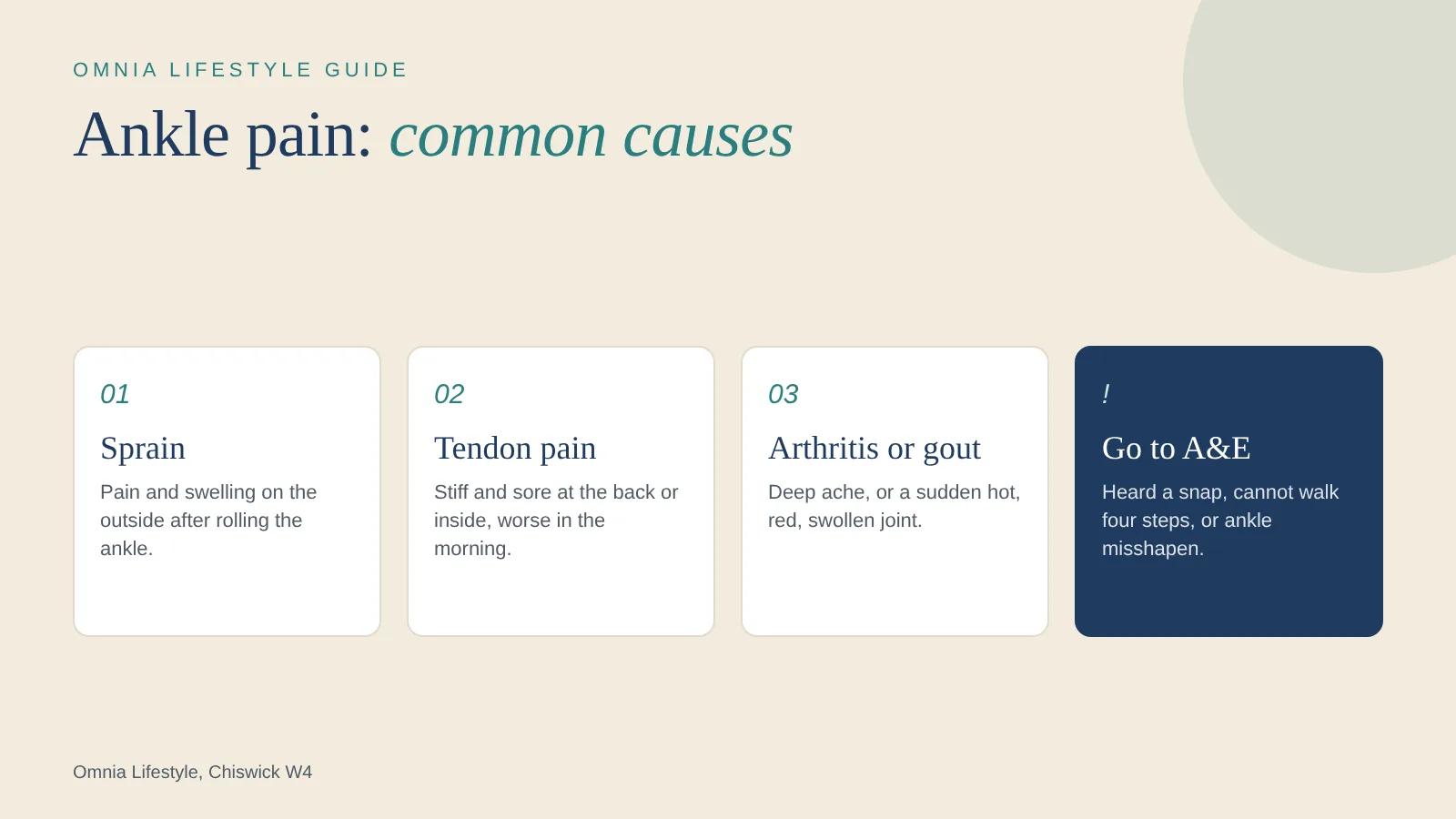
Ankle pain is most often caused by a sprain, tendon irritation such as Achilles or tibialis posterior tendinopathy, or arthritis. Pain after an injury usually improves within a few weeks with early movement and strengthening. Go to A&E if you heard a snap, cannot walk, or the ankle looks misshapen. A hot, red, swollen ankle without injury, particularly with a fever, needs same-day medical advice.
Common causes of ankle pain
Ankle pain after an injury
- Sprained ankle: the most common ankle injury, usually from rolling the foot inwards. It causes pain and swelling on the outside of the ankle, often with bruising. See our ankle sprain exercises.
- Fracture: a broken bone can look very like a bad sprain. Bone tenderness, being unable to take four steps or a misshapen ankle all need an X-ray. Read when to worry about a sprained ankle.
- Achilles tendon rupture: a sudden pain at the back of the ankle, often described as feeling like being kicked, with difficulty pushing off or standing on tiptoe. This needs urgent assessment.
Ankle pain without injury
- Tendinopathy: an overloaded tendon becomes painful and stiff, especially first thing in the morning and at the start of activity. Common sites are the Achilles at the back of the ankle, tibialis posterior on the inside and the peroneal tendons on the outside. See our Achilles tendinopathy exercises.
- Osteoarthritis: less common in the ankle than the knee, and often follows an old fracture or repeated sprains. It causes a deep ache and stiffness. See osteoarthritis.
- Gout: sudden, severe pain with a hot, red, swollen joint, often overnight. It usually affects the big toe but can affect the ankle. See what gout feels like.
- Inflammatory arthritis: such as rheumatoid or psoriatic arthritis, often with swelling and stiffness in several joints.
- Ongoing ankle instability: after a sprain that was not fully rehabilitated, the ankle may keep giving way and ache.
- Nerve problems: burning, tingling or numbness around the ankle and foot can come from a trapped nerve in the back or at the ankle, or from peripheral neuropathy.
What the location of your ankle pain can mean
- Outside of the ankle: a sprain, peroneal tendon pain or ongoing instability after an old sprain
- Inside of the ankle: tibialis posterior tendon pain, often with the arch of the foot gradually flattening, or a sprain of the inner ligaments
- Back of the ankle: Achilles tendinopathy or, after a sudden injury, an Achilles rupture
- Front of the ankle: pinching when squatting or walking uphill, often after old sprains, or arthritis
- Heel and sole: more likely plantar fasciitis than an ankle problem. See plantar fasciitis exercises
Ankle aching after walking, standing or at night
An ankle ache that comes on after a long walk or a day on your feet is often tendon overload, arthritis or flat feet, where the tibialis posterior tendon works hard to support the arch. Unsupportive shoes, a sudden increase in walking or a change of job can trigger it. If aching ankles come with swelling at the end of the day, see our guide to swollen ankles, as fluid retention has different causes.
Ankle pain that wakes you at night and is not linked to activity, or that comes with fever, weight loss or feeling unwell, should be checked by a GP.
When to worry about ankle pain
Go to A&E if:
- You heard a snap, pop or crack at the time of injury
- You cannot put weight on the foot or walk four steps
- The ankle or foot looks misshapen
- Your foot is numb, pale, blue or cold
- You felt a sudden blow-like pain at the back of the ankle and cannot stand on tiptoe
Ask for an urgent GP appointment or call NHS 111 if:
- The ankle is hot, red and swollen, or you have a high temperature or feel shivery
- You have diabetes and new pain, swelling, redness or a wound on your foot or ankle
- Pain is severe and not easing with painkillers
- A painful, swollen calf comes with the ankle pain, which may be a blood clot
See a GP or physiotherapist if: ankle pain has not improved after two weeks, the ankle keeps giving way, or pain is stopping you walking or exercising normally.
What you can do at home
- In the first few days after an injury: protect the ankle, raise it when resting and use ice wrapped in a towel for up to 20 minutes every two to three hours
- Move early: gentle ankle circles and walking as comfort allows help recovery more than complete rest
- Load gradually: heel raises, balance on one leg and walking further each week build strength
- Choose supportive shoes with a cushioned sole and avoid very flat or high-heeled shoes while sore
- Use painkillers such as paracetamol if suitable for you, and ask a pharmacist for advice
- Work on balance: standing on one leg while brushing your teeth helps prevent repeat sprains
How we help in Chiswick
At Omnia Lifestyle our HCPC-registered physiotherapists assess your ankle, foot and the way you walk, check for any signs that need an X-ray or GP review, and explain what is causing the pain.
- Physiotherapy in Chiswick: 70-minute initial assessment and treatment for £99, follow-ups from £70. Treatment combines hands-on therapy with a progressive strength, balance and return-to-sport plan. Recognised by AXA Health, Aviva, WPA and Vitality.
- Sports massage: from £65 for 30 minutes, for tight calf muscles that often go with Achilles and ankle problems.
- Home visit physiotherapy across West London from £110, if walking to the clinic is difficult.
Our gait analysis guide explains how looking at the way you walk and run can help with recurring ankle problems.
Frequently asked questions
Why does my ankle hurt when I have not injured it?
The most common reasons are tendon overload, arthritis, flat feet and gout. Pain that started after a change in activity or footwear is usually tendon related.
How long does ankle pain take to go away?
A mild sprain often improves within two to six weeks, though full strength can take longer. Tendon problems usually take several weeks to a few months with exercise.
Should I walk on a painful ankle?
If you can walk without a limp and there are no warning signs, gentle walking usually helps. If you cannot take four steps, get it checked for a fracture.
Can ankle pain come from the back?
Yes. A trapped nerve in the lower back can cause pain, tingling or numbness around the ankle and foot, usually with back or leg symptoms. See sciatica.
Should I use heat or ice on a sore ankle?
Ice is usually better in the first few days after an injury. For a stiff, long-standing ache, warmth can feel more comfortable.
Ankle pain treatment in Chiswick
Ankle pain is assessed and treated at Omnia Lifestyle, 8 to 9 Bedford Corner, The Avenue, Chiswick W4 1LZ, close to Turnham Green station, on bus routes 94, E3 and 272. Limited parking is available on request when booking.
Read more about sprains and strains and ankle sprain exercises, explore physiotherapy in Chiswick, or book an assessment.
This article is general information, not medical advice. If you have any of the warning signs listed above, seek urgent medical attention.
Ready to book?
Physiotherapy



.jpg)
.jpg)