




Lying awake when you badly want to sleep is frustrating and exhausting, and the more you try to force sleep, the harder it usually becomes. Most people have nights like this from time to time. When it happens often, there is usually a clear set of causes, and most of them can be changed.
This guide explains the most common reasons you cannot sleep, what to do on the night, the changes that help over the following weeks, and when poor sleep needs a GP.
Quick answer
The most common reasons for not being able to sleep are stress and a racing mind, an irregular routine, caffeine later in the day, alcohol, screens and light in the evening, a bedroom that is too warm or noisy, and worry about sleep itself. Health problems such as pain, menopause symptoms, low mood, sleep apnoea and some medicines also play a part. If you cannot sleep, get up after about 20 minutes, do something quiet in dim light and go back to bed when sleepy. If poor sleep happens at least three nights a week for three months, speak to your GP about insomnia treatment.
Common reasons you cannot sleep
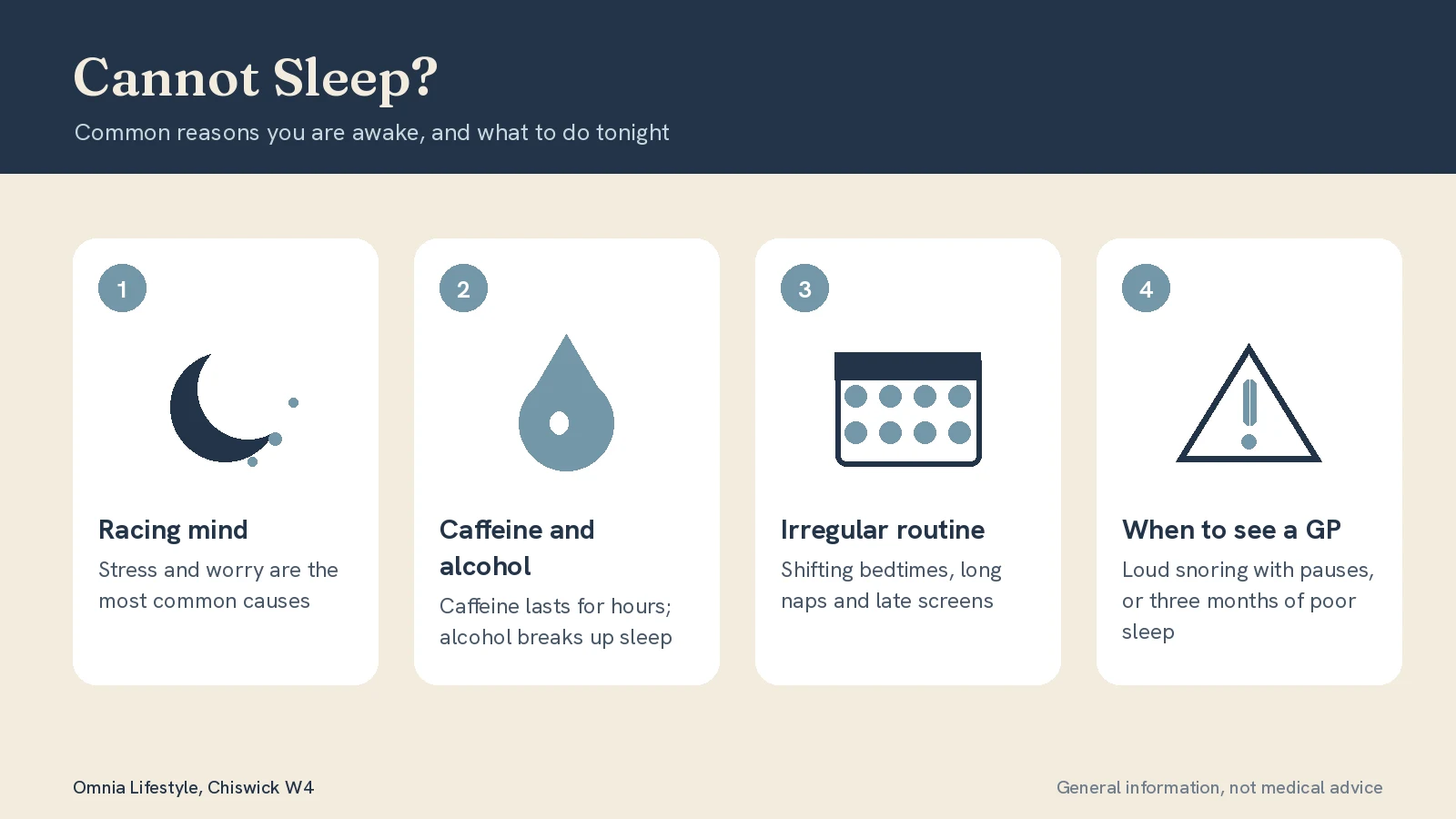
- Stress and a racing mind. Worry raises alertness, making it hard to switch off.
- Worry about sleep itself. After a few bad nights, the bed can become linked with frustration rather than rest, which keeps the problem going.
- An irregular routine. Changing bedtimes and wake times, long lie-ins and late naps confuse your body clock.
- Caffeine. Its effects last for many hours, so an afternoon coffee can still be working at bedtime.
- Alcohol. It may help you fall asleep, but it breaks up sleep later in the night.
- Screens and bright light in the evening, and stimulating activity close to bedtime
- Your bedroom. Heat, noise and light all disturb sleep.
- Pain, from back, joint or other conditions
- Hormonal changes, such as night sweats in the perimenopause and menopause, and pregnancy
- Low mood and anxiety, which commonly cause early waking or difficulty falling asleep
- Medicines, including some antidepressants, steroids, beta blockers and decongestants
- Sleep conditions, such as sleep apnoea and restless legs syndrome
- Shift work and jet lag
What to do tonight
- If you have been awake for about 20 minutes, get up and do something quiet and calm in dim light, such as reading a book
- Go back to bed only when you feel sleepy
- Turn the clock away; checking the time increases alertness
- Try slow breathing, breathing out for longer than you breathe in
- Avoid your phone, which adds light and stimulation
- Keep the room cool, dark and quiet
Changes that help over the next few weeks
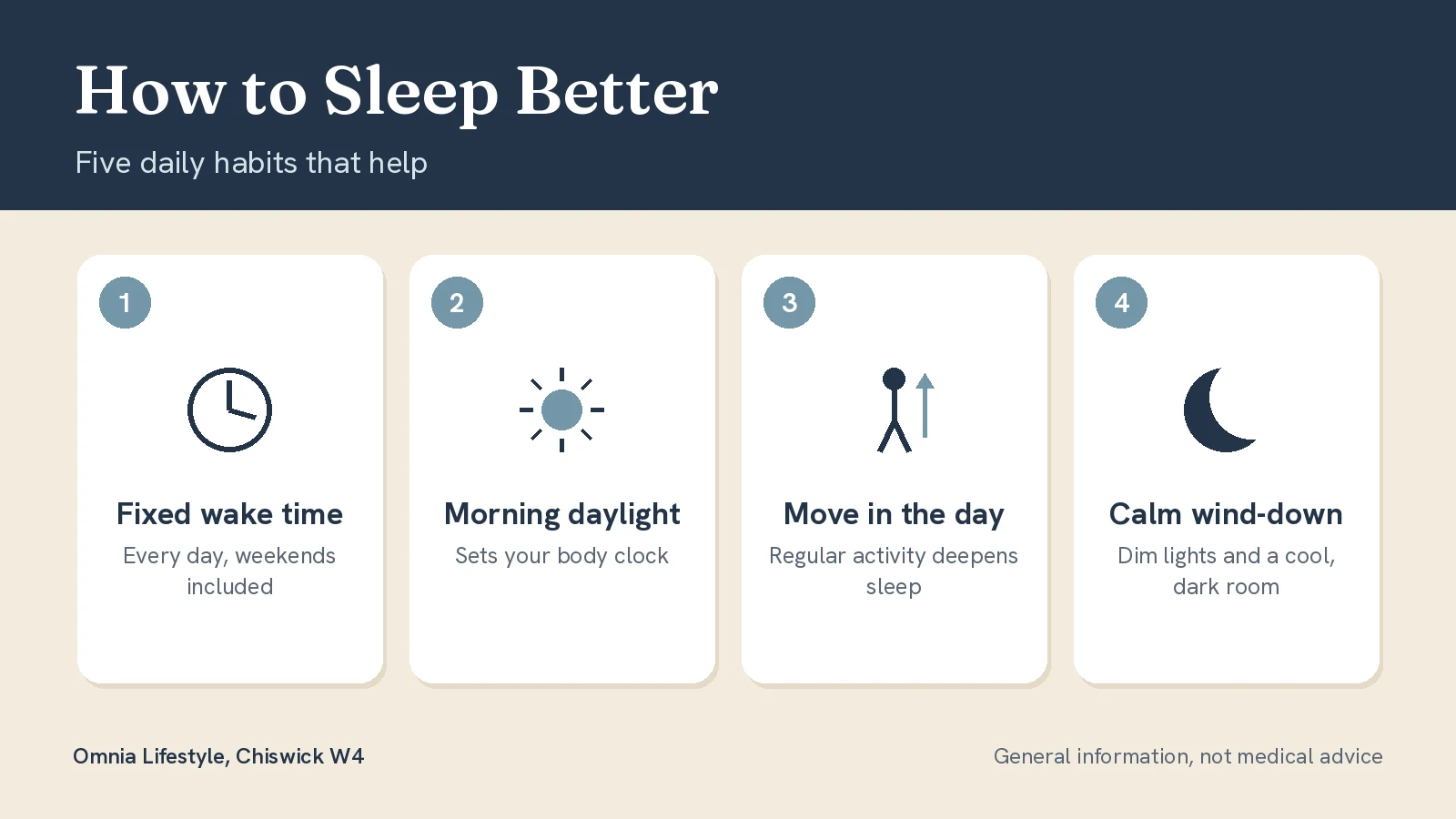
- Keep the same wake-up time every day, including weekends, even after a poor night
- Get daylight in the morning to set your body clock
- Avoid long or late naps
- Have caffeine before midday only
- Keep alcohol low, especially in the evening
- Be active during the day, but avoid vigorous exercise late at night
- Build a wind-down routine for the last hour before bed
- Deal with worries earlier in the evening, for example by writing them down with a plan for the next day
- Use your bed only for sleep and intimacy, not for work or scrolling
For more ideas, see our five daily habits for better sleep.
When poor sleep becomes insomnia
Difficulty sleeping at least three nights a week for three months or more, with daytime effects, is called chronic insomnia. NICE recommends cognitive behavioural therapy for insomnia (CBT-I) as the first treatment. It retrains your sleep pattern over several weeks and its benefits last, and a digital version is available through the NHS in some areas. Sleeping tablets are only recommended for a few nights in a crisis, because they lose effect and can cause dependence.
When to seek medical help
See your GP if:
- Poor sleep has lasted three months or more, or is affecting your daily life
- You snore loudly and someone has noticed pauses in your breathing
- You feel very sleepy during the day or have fallen asleep while driving
- You have an uncomfortable urge to move your legs in the evening
- Low mood or anxiety is part of the picture
- You think a medicine may be affecting your sleep. Do not stop it without advice
If poor sleep comes with very low mood or thoughts of harming yourself, please speak to someone straight away: contact your GP or NHS 111, call Samaritans free on 116 123, or call 999 if you are in immediate danger.
Frequently asked questions
Is it bad to lie in bed awake?
Lying awake for long periods can link the bed with being awake. Getting up after about 20 minutes and returning when sleepy usually works better.
Should I take melatonin?
In the UK, melatonin is available on prescription only and is mainly used short term for adults aged 55 and over, or for specific sleep problems. Speak to your GP before taking any sleep aid.
How much sleep do I need?
Most adults need between seven and nine hours, but needs vary. Feeling refreshed during the day is a better guide than an exact number.
Does reading before bed help?
Reading a paper book in dim light can be a helpful part of a wind-down routine. Screens are more stimulating and best avoided in the last hour.
Sleep support in Chiswick
Support for poor sleep is available at Omnia Lifestyle in Chiswick, W4, close to Turnham Green station, on bus routes 94, E3 and 272. Limited parking is available on request when booking. We look at your routine, stress and health, may ask you to keep a sleep diary, and refer to your GP where needed.
Read more about poor sleep and insomnia, see why am I so tired all the time? and Shirodhara for better sleep, explore acupuncture, Ayurveda and clinical psychology, or book an appointment.
This article is general information, not medical advice. If you have any of the warning signs listed above, seek medical attention.


.jpg)
.jpg)