


Book at our Chiswick clinic
Acupuncture
Acupuncture charts covered in lines and dots can look mysterious, but there is a clear system behind them. Each acupuncture point has a name, a number and a precise location, and practitioners choose a combination of points for each person and problem. Knowing a little about how points work makes it easier to understand what happens in a session and why your acupuncturist may place needles in your hand or foot to treat a headache.
This guide explains what acupuncture points are, how many there are, how practitioners find them, the best-known points on the hands, legs and back, which points are avoided in pregnancy, how acupressure differs from acupuncture, and what the evidence says.
Quick answer
Acupuncture points are specific spots on the body where fine needles are inserted. Traditional Chinese medicine describes 361 main points along 14 channels, or meridians, plus extra points and tender points. Each has a name and code, such as LI4 on the hand or ST36 below the knee. Many lie close to nerves, blood vessels or muscle trigger points, which may explain some of their effects. Practitioners choose points based on your symptoms and diagnosis, and often combine local points with distant ones on the hands and feet.
What are acupuncture points?
In traditional Chinese medicine (TCM), acupuncture points are places on the body where the flow of qi, or vital energy, can be influenced. They sit along channels called meridians, each linked with an organ system. Needling a point is believed to help restore balance in that channel.
Western medical acupuncture explains the same points in terms of anatomy. Many traditional points lie where nerves pass close to the surface, at muscle motor points, over trigger points or between tendons and bones. Stimulating these areas sends signals to the spinal cord and brain that may change how pain is felt and release natural pain-relieving chemicals such as endorphins. Our guide to what acupuncture is and how it works explains both views in more detail.
How many acupuncture points are there?
The international standard on point locations published by the WHO lists 361 classical acupuncture points. They sit on 14 channels: 12 main channels, each running down one side of the body and mirrored on the other, plus two midline channels on the front and back. On top of these are:
- Extra points: well-known points that sit outside the main channels, such as Yintang between the eyebrows.
- Ashi points: tender spots that are needled because they hurt when pressed, similar to trigger points.
- Ear points: a map of points on the outer ear used in auricular acupuncture.
How acupuncture points are named
Each point has a Chinese name and a code made of the channel's initials and a number. For example, LI4 is the fourth point on the Large Intestine channel, and PC8 is the eighth point on the Pericardium channel. Common channel codes include LU (Lung), LI (Large Intestine), ST (Stomach), SP (Spleen), HT (Heart), SI (Small Intestine), BL (Bladder), KI (Kidney), PC (Pericardium), SJ or TE (Triple Energiser), GB (Gallbladder), LR (Liver), GV (Governor Vessel) and CV (Conception Vessel).
How practitioners find acupuncture points
Points are located using bony landmarks, creases and muscles, and a proportional measure called the cun, roughly the width of your own thumb. Four finger-widths, for example, equal three cun. Practitioners also feel for small hollows or tender spots, because the exact location varies slightly from person to person.
Hand acupuncture points
Points on the hands and wrists are among the most frequently used, often to treat problems elsewhere in the body.
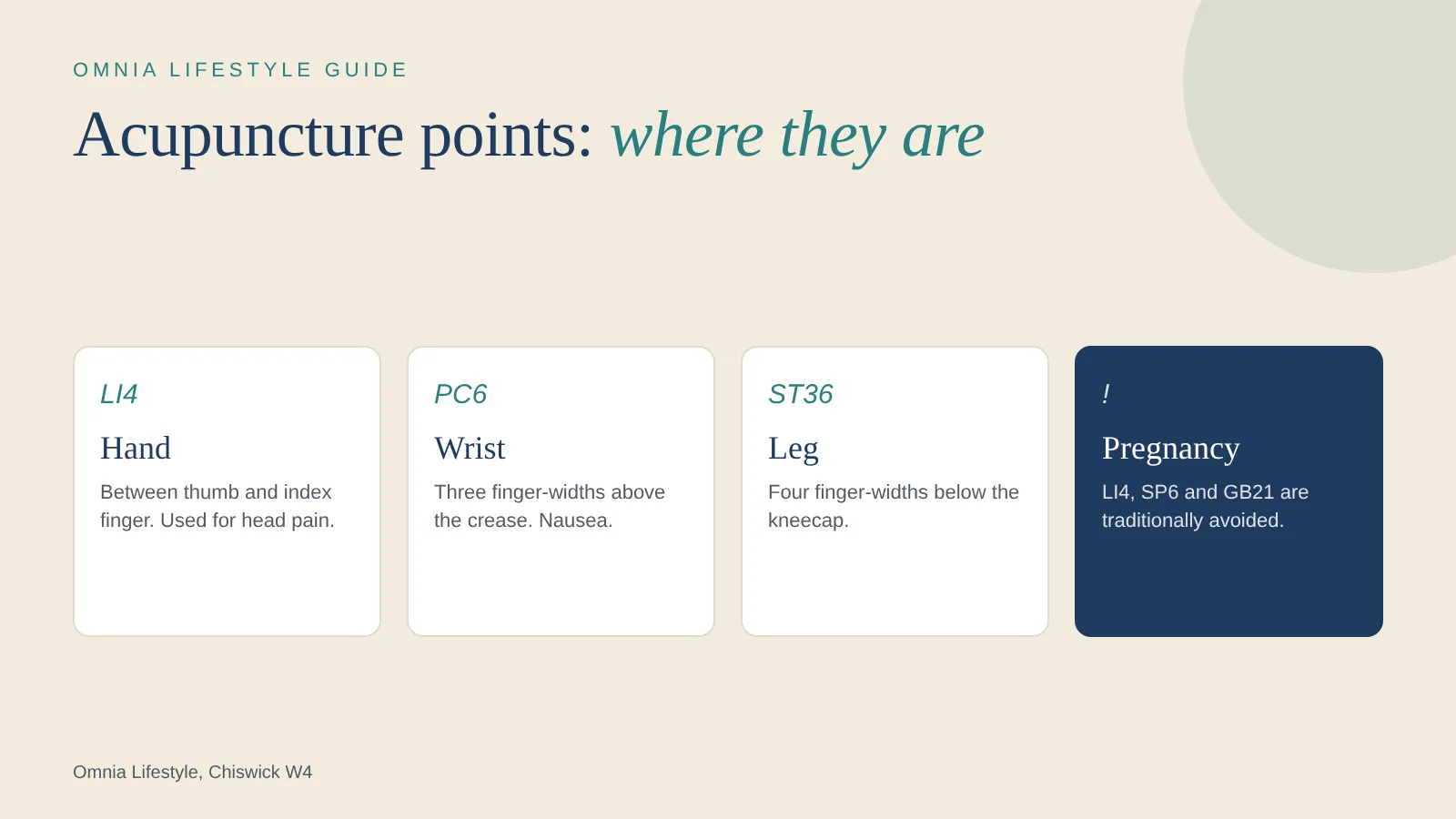
- LI4 (Hegu): on the back of the hand, in the fleshy area between the thumb and index finger. One of the most widely used points, traditionally for headaches, facial pain, toothache and general pain relief. It is traditionally avoided in pregnancy.
- PC8 (Laogong): in the centre of the palm, where the tip of your middle finger rests when you make a loose fist. Traditionally used to calm the mind and clear heat, and a focus point in qigong practice.
- PC6 (Neiguan): on the inner forearm, about three finger-widths above the wrist crease, between the two central tendons. Best known for nausea and sickness, and the point targeted by travel sickness wristbands.
- HT7 (Shenmen): on the wrist crease, on the little-finger side. Commonly used for anxiety, restlessness and poor sleep.
- SI3 (Houxi): on the outer edge of the hand, just below the little finger knuckle. Traditionally used for a stiff neck and back.
Acupuncture points on the legs and feet
- ST36 (Zusanli): four finger-widths below the kneecap, one finger-width to the outside of the shin bone. Traditionally used for digestion, fatigue and general wellbeing.
- SP6 (Sanyinjiao): on the inner lower leg, four finger-widths above the inner ankle bone, just behind the shin bone. Widely used for period pain, women's health and sleep. Traditionally avoided in pregnancy.
- LR3 (Taichong): on the top of the foot, in the hollow between the big toe and second toe bones. Used for stress, irritability and headaches, and often paired with LI4.
- GB34 (Yanglingquan): on the outside of the lower leg, just below and in front of the head of the fibula. Traditionally used for muscle and tendon problems, including knee pain.
- KI3 (Taixi): on the inner ankle, between the ankle bone and the Achilles tendon.
Acupuncture points on the back
The back has many points. The Bladder channel runs in two lines down either side of the spine and includes the back-shu points, each traditionally linked with an organ. Another row of points, the Huatuojiaji points, sits close to the spine at each level and is often used for back pain.
- BL23 (Shenshu): in the lower back, at waist level, about two finger-widths either side of the spine. Commonly used for low back pain.
- BL40 (Weizhong): in the centre of the crease behind the knee. A classic distant point for back pain.
- GB21 (Jianjing): on the top of the shoulder, midway between the neck and the tip of the shoulder. Used for neck and shoulder tension. It is needled shallowly because the top of the lung lies beneath, and it is avoided in pregnancy.
- GB20 (Fengchi): in the hollows at the base of the skull. Widely used for headaches and neck pain.
Read more in acupuncture for back pain and acupuncture for neck pain.
Acupuncture points for sciatica
For sciatic pain, practitioners often combine points in the lower back with points along the path of the pain, such as GB30 (Huantiao) in the buttock, BL40 behind the knee, BL57 (Chengshan) in the calf and GB34 on the outer leg. See acupuncture for a slipped disc and sciatica.
Head, face and ear points
- Yintang: between the eyebrows, used for calming and sleep.
- GV20 (Baihui): at the top of the head, used for calming the mind and for headaches.
- Ear Shenmen: in the upper part of the ear, one of the most used ear points for stress and relaxation.
Points used for women's health
For period pain, endometriosis-related pain and fertility support, practitioners commonly select points such as SP6, LR3, CV4 (Guanyuan) on the lower abdomen and ST29 (Guilai) nearby. The choice is always individual, and acupuncture is used alongside medical care rather than instead of it. Read more about endometriosis and fertility acupuncture in London.
Acupuncture points avoided in pregnancy
Traditionally, practitioners avoid strong stimulation of LI4, SP6, BL60 (Kunlun) and BL67 (Zhiyin), GB21 and points on the lower abdomen and lower back during pregnancy unless there is a specific reason. Always tell your acupuncturist if you are or might be pregnant. See acupuncture when pregnant.
Acupressure vs acupuncture: pressure points
Acupressure uses firm finger or thumb pressure on the same points instead of needles. It is a simple self-care technique you can try at home, for example pressing PC6 on the inner wrist for nausea or LI4 for a tension headache (not in pregnancy). Some research supports pressure on PC6 for nausea, but for most other uses the evidence for acupressure is limited. At Omnia, acupuncture is always given with fine, sterile, single-use needles, and acupressure is something you might do yourself between sessions.
Do acupuncture points really exist?
No unique anatomical structure has been found at acupuncture points, and research on whether exact point location matters is mixed. Trials comparing real acupuncture with sham acupuncture often find that both help, with real acupuncture giving a modest extra benefit for some types of long-term pain. NICE recommends acupuncture as an option for chronic primary pain and for preventing chronic tension-type headache and migraine. See does acupuncture work for a summary of the evidence.
Is acupuncture safe?
Acupuncture is very safe when carried out by a trained, registered practitioner using single-use sterile needles. Mild bruising, brief soreness or feeling light-headed are the most common side effects. Never try to needle points on yourself.
Tell your acupuncturist if you:
- Are pregnant or trying to conceive
- Take blood thinners or have a bleeding disorder
- Have a pacemaker or another implanted device
- Have epilepsy, diabetes or a weakened immune system
- Feel anxious about needles or have fainted before
Call 999 or go to A&E if you develop sudden breathlessness or chest pain after needling on the chest, shoulders or upper back, which can very rarely be a sign of a punctured lung. See your GP if a needle site becomes red, hot, swollen or painful. More detail is in acupuncture side effects.
How we help in Chiswick
At Omnia Lifestyle, acupuncture is provided by Dr Jialin Zhu (British Acupuncture Council), Dr Youzhong Wu and Dr Shu Fen Zhang (Association of Traditional Chinese Medicine). Your practitioner takes a full history, examines you and chooses points for your symptoms, explaining what they are doing as they go.
- Acupuncture in Chiswick: traditional acupuncture is £80 for 60 minutes, and a 30-minute TCM consultation is £50.
- Acupuncture with Tui Na massage: 90 minutes, £135. Read about Tui Na massage.
- Fertility acupuncture: 60 minutes, £90.
Evening appointments are available, and itemised receipts can be provided for Aviva, AXA Health, Vitality, WPA and Simplyhealth. See what not to do after acupuncture or book a session.
Frequently asked questions
What is the most important acupuncture point?
There is no single most important point, but LI4 on the hand and ST36 below the knee are among the most widely used. Points are always chosen as a combination for the individual.
Which acupuncture points help anxiety?
Points commonly used for anxiety and stress include HT7 on the wrist, PC6 on the forearm, Yintang between the eyebrows and LR3 on the foot. Evidence for acupuncture in anxiety is promising but more limited than for pain.
Why does an acupuncturist use points far from the pain?
In TCM, channels connect distant parts of the body, so points on the hands and feet are used for problems in the head, neck or back. Western explanations point to the way the nervous system processes pain signals.
Does needling some points hurt more than others?
Points on the hands and feet can feel more noticeable than those on fleshy areas. Most people feel a brief prick, then a dull ache or tingling. See does acupuncture hurt.
Can I press acupuncture points myself?
Yes, gentle acupressure is safe for most people and can be calming. Avoid LI4 and SP6 if you are pregnant, and do not press on broken skin, varicose veins or swelling.
Acupuncture at Omnia Lifestyle
If you would like to understand which points could help your symptoms, our acupuncturists will talk you through your plan before any needles are used. Omnia Lifestyle is at 8 to 9 Bedford Corner, The Avenue, Chiswick W4 1LZ, close to Turnham Green station, on bus routes 94, E3 and 272. Limited parking is available on request when booking.
This article is general information, not medical advice. If you have any of the warning signs listed above, seek medical attention.
Ready to book?
Acupuncture


.jpg)
.jpg)