



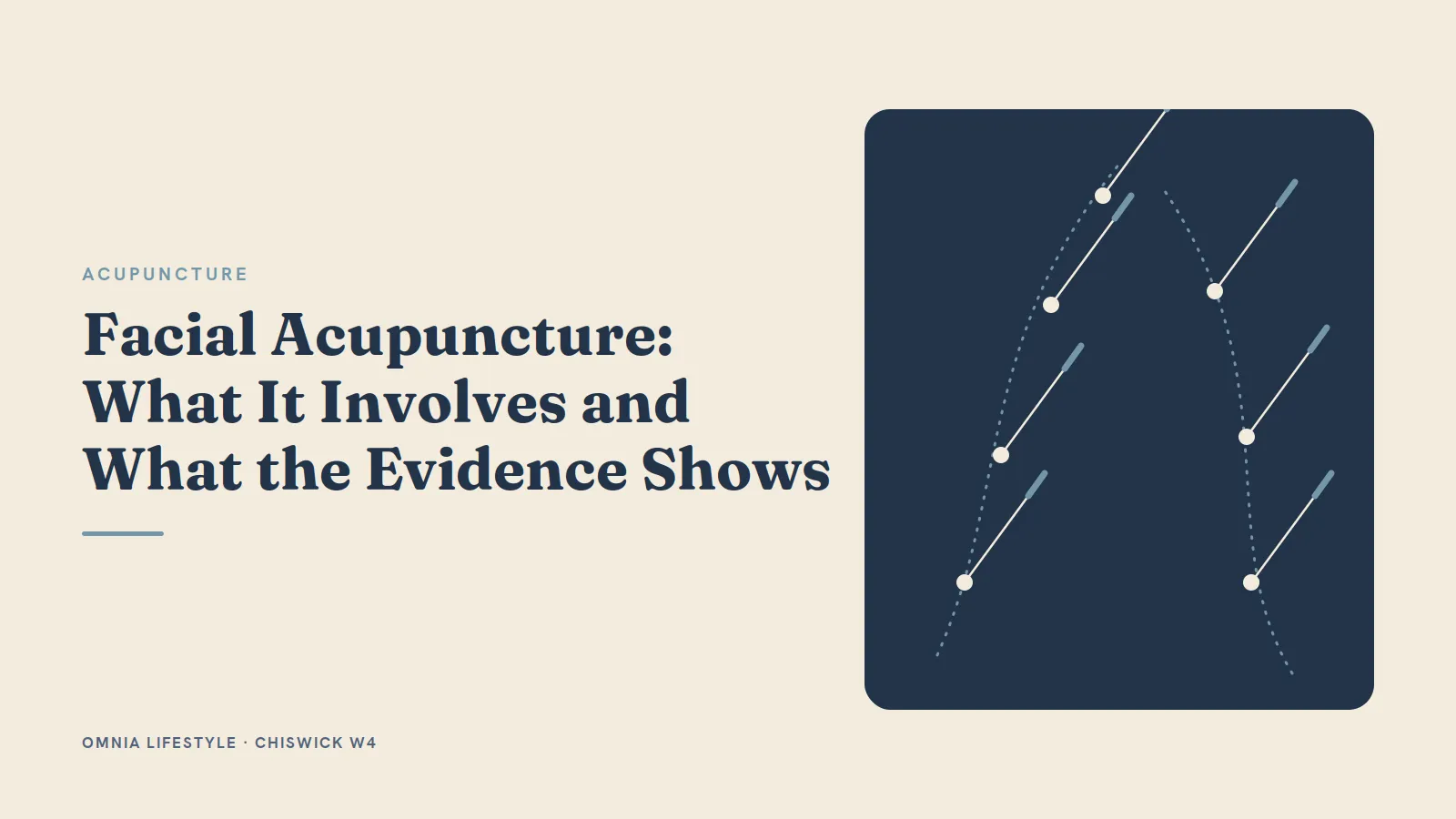


Facial acupuncture, sometimes called cosmetic acupuncture or facial rejuvenation acupuncture, involves inserting very fine needles into points on the face, alongside points elsewhere on the body. It has grown quickly in popularity as an alternative to injectable treatments.
This guide covers what it involves, what the evidence does and does not show, and how to judge whether it is worth your money.
What happens during a session
A session normally begins with a consultation covering your general health, skin, sleep, digestion and stress. In traditional practice the face is not treated in isolation, so points on the arms, legs or torso are usually included alongside facial points.
The needles used on the face are extremely fine, considerably finer than those used on the body. Between 20 and 60 may be inserted depending on the practitioner and the plan. They are typically retained for 20 to 30 minutes while you rest.
Many practitioners combine needling with facial massage, gua sha, or jade rolling. Some incorporate microneedling or LED light, though these are distinct treatments that happen to be offered alongside.
Sessions usually last 60 to 90 minutes including consultation and aftercare.
What the evidence shows
Here is where an honest answer matters, because facial acupuncture is marketed with a great deal of confidence relative to what has actually been demonstrated.
The research base is small, and the quality is generally low. Most published studies involve few participants, lack credible control groups, and rely on subjective before-and-after assessment rather than blinded objective measurement. Several were conducted without any comparison group at all.
Some small studies have reported improvements in participant-rated facial appearance and skin elasticity. These are genuine findings, but small uncontrolled studies of a cosmetic treatment are exactly the setting where expectation effects are strongest, and they should not be read as proof.
What can be said fairly: some people report they like how their face looks and feels afterwards, and report a temporary sense of lift, reduced puffiness and better skin tone. Local effects on circulation in the treated area are plausible.
What cannot be said: that facial acupuncture is a proven treatment for wrinkles, that it produces results comparable to injectables, or that any effect is lasting. Anyone presenting it that way is going beyond the evidence, and in the UK, beyond what advertising rules permit.
Why some people prefer it anyway
Even accounting for the weak evidence, there are reasons people choose it:
- It is not injectable. For people who do not want botulinum toxin or fillers, but do want to do something, this occupies a middle ground.
- It is genuinely relaxing. Most people find the session restful, and the effects on stress and sleep are among the more consistently reported outcomes.
- It is treated as whole-body. Practitioners typically ask about sleep, digestion and stress, which some people find more satisfying than a purely cosmetic transaction.
- Reduced puffiness. Facial fluid retention often responds visibly, and this is one of the more immediately noticeable effects.
How many sessions, and how long do effects last?
Practitioners commonly recommend a course of six to ten weekly sessions, followed by occasional maintenance. This is a significant time and cost commitment, and worth thinking about clearly before starting.
Any visible effect is temporary. There is no evidence of permanent structural change. If a clinic implies otherwise, treat that as a reason to look elsewhere.
Side effects and who should avoid it
The main side effect is bruising. The face is highly vascular, and small bruises are relatively common, particularly around the eyes. They usually fade within a week, but if you have an event coming up, allow a clear margin.
Other possible effects include brief redness, mild tenderness and occasional lightheadedness.
Facial acupuncture is generally not suitable, or requires specific advice, if you:
- Take anticoagulant medication or have a bleeding disorder
- Are pregnant, in which case point selection must be adapted
- Have an active skin infection, cold sore outbreak or inflamed acne in the area
- Have had recent facial surgery or injectables, where timing should be discussed with the practitioner who performed them
- Bruise very easily or scar abnormally
- Have uncontrolled migraine that is triggered by facial stimulation
Questions worth asking before you book
- What training do you have specifically in facial acupuncture?
- What results is it reasonable for me to expect, and what is not realistic?
- How likely is bruising, and how long should I allow before an event?
- What is the total cost of the recommended course?
- What would make you advise against treating me?
A practitioner who answers the second question with appropriate caution is more trustworthy than one who promises a transformation.
Frequently asked questions
Does facial acupuncture hurt?
Facial needles are very fine and most insertions are barely felt, though some points, particularly around the forehead, can be briefly sharp.
Is it a replacement for Botox?
No. They work by entirely different mechanisms, and the evidence bases are not comparable. Botulinum toxin has extensive clinical evidence for reducing dynamic lines. Facial acupuncture does not.
Can I have it alongside injectables?
Often, but timing matters, and you should discuss it with whoever administered the injectables before booking.
When will I see a difference?
Reduced puffiness may be visible immediately. Anything else, if it occurs, tends to be reported gradually over a course rather than after one session.
Is it safe?
When performed by a properly trained practitioner using sterile single-use needles, it is considered low-risk, with bruising the most common issue.
Acupuncture at our Chiswick clinic
We offer acupuncture at Omnia Lifestyle in Chiswick, W4, close to Turnham Green station, on bus routes 94, E3 and 272. Limited parking is available on request when booking. Every course begins with a consultation, and we will be straightforward with you about what acupuncture can and cannot reasonably achieve.
Learn more about acupuncture, or book a consultation.
This article is general information, not medical advice. Facial acupuncture is a cosmetic treatment with a limited evidence base and is not a medical treatment for any skin condition.



.jpg)
.jpg)