


Book at our Chiswick clinic
Acupuncture
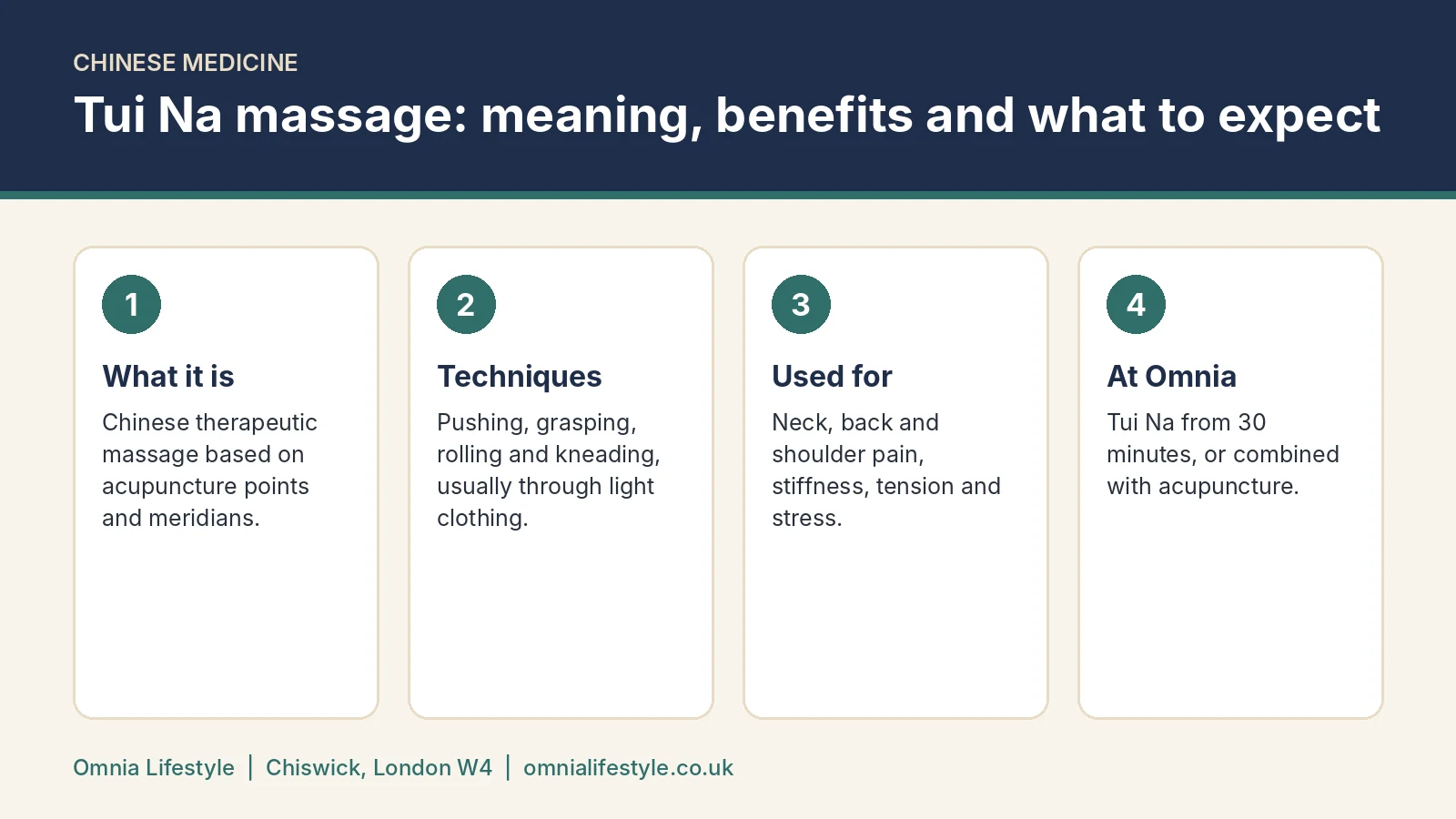
Tui Na is the therapeutic massage of Traditional Chinese Medicine. It has been used in China for more than 2,000 years and is still practised in Chinese hospitals today alongside acupuncture and herbal medicine. Tui Na feels quite different from a relaxing spa massage: it is firm, focused and usually given through light clothing, with the therapist working on specific muscles, joints and acupuncture points.
This guide explains what Tui Na massage means, the techniques used, the benefits and what the research shows, what happens in a session and who should avoid it.
Quick answer
Tui Na (pronounced twee-nah) is a Chinese therapeutic massage that combines pushing, grasping, rolling, kneading and pressing techniques along the body's meridians and acupuncture points. It is mainly used for neck, shoulder and back pain, stiffness, muscle tension and stress. Research suggests it may help neck pain, lower back pain and knee osteoarthritis, although most studies are small. A session usually lasts 30 to 60 minutes, and it is often combined with acupuncture.
Tui Na massage meaning
The name comes from two of its main techniques. Tui means to push and na means to grasp or lift. Together they describe a hands-on therapy that works both the soft tissue and the flow of qi (energy) through the meridians, according to Chinese medicine theory. In modern terms, Tui Na works on muscles, fascia and joints to ease tension, improve movement and calm the nervous system.
What is Tui Na massage therapy?
Tui Na massage therapy is part of the wider system of Traditional Chinese Medicine (TCM). Your practitioner first assesses you, often looking at your posture, movement, tongue and pulse, and then chooses techniques and points to suit your pattern. It is not a general relaxation massage: it is targeted treatment for a particular problem, such as a stiff neck or a sore lower back.
Tui Na techniques
- Tui (pushing): firm strokes along muscles and meridians.
- Na (grasping): lifting and squeezing muscles, often across the shoulders and neck.
- Gun fa (rolling): a rhythmic rolling movement with the back of the hand over large muscles.
- An (pressing): sustained thumb or palm pressure on acupuncture points, similar to acupressure.
- Rou (kneading): circular kneading to loosen tight tissue.
- Mobilisation: gentle stretching and joint movements to improve range of motion.
Most Tui Na is given through loose, light clothing without oil, although a herbal liniment may sometimes be used on the skin.
Tui Na massage benefits
- Neck and shoulder pain: releases tight upper trapezius and neck muscles and improves movement.
- Back pain: works on the muscles of the upper and lower back and the hips.
- Stiff joints: mobilisation techniques can ease stiffness in the shoulders, hips and knees.
- Muscle tension and knots: see knots in shoulders.
- Stress and sleep: many people find Tui Na deeply calming and sleep better afterwards.
- Headaches: work on the neck and the base of the skull can ease tension-type headaches.
What does the evidence say?
Tui Na has been studied mostly in China. Systematic reviews suggest it may reduce pain and improve function in chronic neck pain, lower back pain and knee osteoarthritis, often when compared with no treatment or with other standard therapies. However, many trials are small and of mixed quality, so the evidence is promising rather than conclusive. Tui Na works best as part of a plan that also includes exercise and good daily habits. Read about acupuncture for back pain for how Chinese medicine fits with exercise-based care.
Tui Na vs other massage
- Tui Na vs Swedish massage: Swedish massage uses oil and long, flowing strokes mainly for relaxation. Tui Na is firmer, more targeted and usually done clothed.
- Tui Na vs acupressure: acupressure focuses on pressing points. Tui Na includes point pressure but also works whole muscles and joints.
- Tui Na vs shiatsu: shiatsu is a Japanese therapy that developed partly from Chinese massage. It is often given on a floor mat with slower, sustained pressure.
- Tui Na vs deep tissue massage: both can be firm. Deep tissue massage uses oil and slow strokes into deeper muscle layers, while Tui Na is guided by TCM diagnosis. See deep tissue massage.
What to expect in a Tui Na session
- Consultation. Your practitioner asks about your symptoms, health and medicines, and may check your tongue and pulse.
- Positioning. You lie or sit on a treatment couch in light, comfortable clothing.
- Treatment. The practitioner uses a mix of techniques on the area of concern and related points. Pressure is firm but should never be more than you are comfortable with.
- Afterwards. You may feel relaxed, lighter or a little tender. Mild soreness for a day or so is normal. Drink water and avoid strenuous exercise for the rest of the day.
A course of three to six sessions is common for a long-standing problem, reviewed as you go.
Tui Na and acupuncture together
Tui Na is often combined with acupuncture in the same appointment. Massage loosens the muscles first, then fine needles are placed and left to work while you rest. Many people with neck, shoulder or back pain find this combination more effective than either alone. Cupping may also be added where it helps. See acupuncture in Chiswick and what not to do after acupuncture.
Who should avoid Tui Na massage?
Tui Na is safe for most people when given by a trained practitioner. Tell your practitioner, and they may avoid or adapt treatment, if you have:
- a recent fracture, sprain or injury
- broken skin, burns, rashes or skin infection in the area
- a known or suspected blood clot (DVT)
- osteoporosis or fragile bones
- a bleeding disorder, or you take blood-thinning medicine
- pregnancy, as some points are avoided
- cancer or a fever
When to see a doctor instead
- Call 999 for chest pain, sudden weakness, slurred speech or a sudden, severe headache.
- Get same-day medical advice for back pain with numbness around the bottom or genitals, or new bladder or bowel problems.
- See your GP for pain after a fall or injury, pain with fever or weight loss, or pain that is getting steadily worse.
Frequently asked questions
Is Tui Na massage painful?
Tui Na is firmer than a relaxing massage and some areas may feel tender, but it should not be painful. Your practitioner adjusts the pressure for you.
Do I need to undress for Tui Na?
Usually not. Tui Na is normally given through loose, light clothing.
How often should I have Tui Na?
For a specific problem, weekly sessions for three to six weeks are common. For general wellbeing, once a month is enough for many people.
Is Tui Na the same as Chinese massage?
Yes. Tui Na is the traditional therapeutic massage of Chinese medicine and is often simply called Chinese massage.
Can Tui Na help sleep?
Many people sleep better after Tui Na because it relaxes tight muscles and calms the nervous system. See acupuncture for insomnia.
Tui Na massage near me in Chiswick
Tui Na is given by our Traditional Chinese Medicine doctors at Omnia Lifestyle, 8 to 9 Bedford Corner, The Avenue, Chiswick W4 1LZ, close to Turnham Green station, on bus routes 94, E3 and 272. Limited parking is available on request when booking.
- Tui Na massage, 30 minutes: £65
- Tui Na massage, 60 minutes: £85
- Acupuncture and Tui Na, 90 minutes: £135
Explore acupuncture and Chinese medicine, Chinese herbal medicine and manual therapy in London, or book an appointment.
This article is general information, not medical advice. If you have any of the warning signs listed above, seek medical attention.
Ready to book?
Acupuncture


.jpg)
.jpg)