


Book at our Chiswick clinic
Acupuncture
Acupuncture is one of the oldest forms of medicine still in everyday use. Today it is offered in specialist clinics and is also used in some NHS GP practices, pain clinics and physiotherapy services. Yet many people are unsure what it actually is, how a few fine needles could make a difference, or what a session feels like.
This guide explains what acupuncture means, how acupuncture works from both the modern Western and the traditional Chinese medicine viewpoints, what happens in a session, what the needles feel like, how to choose a safe practitioner and who should check with a doctor first.
Quick answer
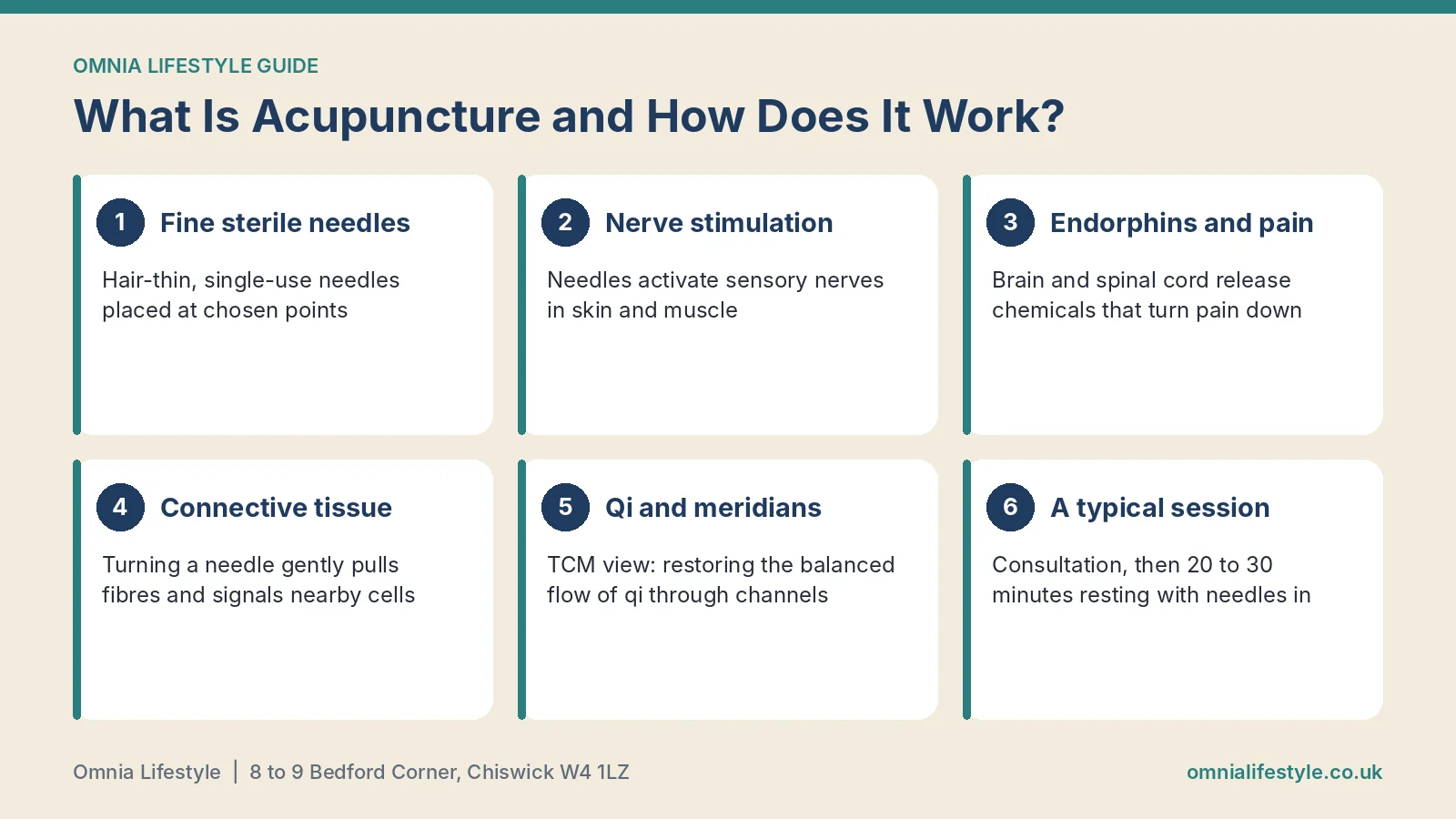
Acupuncture is a treatment in which very fine, sterile needles are inserted into specific points on the body. In Western terms, the needles stimulate nerves in the skin and muscle, prompting the brain and spinal cord to release endorphins and other natural chemicals that change how pain is felt, and they also act on the surrounding connective tissue. Traditional Chinese medicine explains it as restoring the flow of qi through channels called meridians. NICE recommends it as an option for some long-term pain and for preventing headaches and migraine.
What is acupuncture? Meaning and definition
The word acupuncture comes from the Latin acus, meaning needle, and punctura, meaning pricking. A simple acupuncture definition is:
Acupuncture is the insertion of thin, solid needles into specific points on the body to relieve pain or ease other symptoms.
A few things set it apart from other treatments that use needles:
- Nothing is injected. Acupuncture needles are solid, not hollow, and carry no medicine.
- The needles are very fine, much thinner than the needles used for injections or blood tests.
- The points are chosen carefully, based on your symptoms, an examination and, in the traditional approach, a pattern diagnosis.
Acupuncture developed in China over two thousand years ago. Today there are two main approaches: traditional Chinese acupuncture, based on the ideas of Chinese medicine, and Western medical acupuncture, which explains the same treatment in terms of anatomy and the nervous system. Many practitioners draw on both.
How does acupuncture work?
There are two ways of explaining how acupuncture works. They use different language, but in the treatment room they often lead to similar choices of points.
The Western view: nerves, endorphins and pain signalling
Research into acupuncture and how it works has focused mainly on the nervous system:
- Nerve stimulation: each needle stimulates sensory nerves in the skin and the muscle beneath it.
- Endorphins and other chemicals: these signals travel to the spinal cord and brain, which respond by releasing endorphins, the body's own painkillers, along with serotonin and other chemical messengers.
- Pain signalling: the incoming signals can dampen pain messages in the spinal cord and switch on pathways in the brain that turn pain down. Brain imaging studies show changes in areas involved in processing pain.
- Local effects: blood flow around the needle increases, and muscle that has been guarding a painful area often relaxes.
Expectation and the calm setting of a session also play a part, as they do with many treatments. This is one reason studies comparing real acupuncture with sham (pretend) acupuncture often find smaller differences than studies comparing acupuncture with usual care.
Connective tissue and the interstitium
Researchers have also looked at connective tissue, the web of fibres that wraps and links muscles and organs. When a practitioner gently turns a needle, the fibres around it wind onto the needle, creating a slight grip. This mechanical pull is thought to send signals to nearby cells.
In 2018, anatomists described a network of fluid-filled spaces running through connective tissue across the body, which they called the interstitium. Some researchers have suggested this may help explain how effects travel along routes similar to meridians. This is an idea under investigation rather than an established fact. You can read more about the interstitium and the meridian map.
The traditional Chinese medicine view: qi and meridians
In traditional Chinese medicine (TCM), health depends on the smooth flow of qi, often translated as vital energy, and on a balance between the opposing forces of yin and yang.
- Qi is described as flowing through a network of channels called meridians. There are twelve main meridians, each linked with an organ system.
- Acupuncture points lie along these meridians.
- Pain and illness are understood as a blockage, deficiency or imbalance in the flow of qi.
- The practitioner makes a diagnosis using your history, your pulse and the appearance of your tongue, then chooses points to restore balance.
Qi and meridians are traditional ways of describing the body rather than structures that can be seen under a microscope. Even so, the TCM framework remains the basis of how many acupuncturists plan treatment.
How does acupuncture help?
In practice, people most often notice that acupuncture:
- Eases pain, particularly some types of long-term pain
- Reduces how often headaches and migraines happen when used as a course of treatment
- Relaxes tight muscles around a painful area
- Helps them feel calmer, with many people feeling deeply relaxed during and after a session
The strongest evidence is for pain and headache. It is used for many other problems too, with varying levels of evidence. Rather than list them all here, see what acupuncture is good for and the conditions it helps.
What happens in an acupuncture session
- Consultation: your practitioner asks about your symptoms, medical history, medicines, sleep, digestion and goals. In the TCM tradition, they may also check your pulse and look at your tongue.
- Examination: they may check how you move and where you are tender.
- Needling: you lie comfortably on a treatment couch. The practitioner cleans the skin if needed and places the needles. The number varies with your treatment plan.
- Rest: the needles usually stay in for around 20 to 30 minutes. The practitioner may turn some of them gently. Many people doze off.
- Removal and aftercare: the needles are removed and disposed of, and you are given advice for the rest of the day.
Acupuncture is usually given as a course, often once a week. A good practitioner will tell you how many sessions are likely to be needed and review your progress after the first few.
What do acupuncture needles feel like?
Acupuncture needles are about as thin as a hair. Most people are surprised by how little they feel.
- On insertion: you may feel a brief pinch or nothing at all.
- Once in place: a dull ache, heaviness, tingling or warmth around the needle is common. In TCM this sensation is called de qi and is seen as a sign the point is active.
- Sharp or burning pain is not normal. Tell your practitioner, who can adjust or remove the needle.
Afterwards you may notice a small bruise, a spot of blood, tiredness or light-headedness, and occasionally a short-lived flare of symptoms before they improve. Read more about whether acupuncture hurts and which side effects are normal.
Types of acupuncture
- Traditional Chinese acupuncture: points chosen using a TCM diagnosis.
- Western medical acupuncture: used by some doctors and physiotherapists, with points chosen on the basis of anatomy and the nervous system.
- Dry needling: a related technique that targets tight bands in muscle. See dry needling versus acupuncture.
- Electroacupuncture: a small, gentle electrical current is passed between pairs of needles, sometimes used for stubborn pain.
- Ear (auricular) acupuncture: fine needles placed in points on the outer ear.
You may also see laser acupuncture or needle-free acupuncture advertised. These use light or pressure rather than needles and are not offered at Omnia, where all acupuncture uses fine sterile needles.
Is acupuncture safe? Warning signs and who should check first
Acupuncture is very safe when it is carried out by a trained practitioner, and serious problems are rare.
Choosing a safe practitioner
- Licensed and qualified: acupuncturists in the UK generally need to be licensed or registered with their local council, unless they are exempt as a regulated health professional or member of certain professional bodies. Many belong to a professional body such as the British Acupuncture Council or the Association of Traditional Chinese Medicine and Acupuncture UK.
- Single-use sterile needles: needles should come in sealed packs, be used once and then placed in a sharps bin.
- A proper consultation: your practitioner should ask about your health and medicines before treating you.
Who should check first
- Pregnancy: acupuncture is used in pregnancy, but some points are avoided. Tell your practitioner and midwife.
- Bleeding disorders or blood thinners: if you have a condition such as haemophilia or take anticoagulant medicine, talk to your GP before having acupuncture.
- Pacemakers: if electroacupuncture is being considered, tell your practitioner, as the electrical current can interfere with pacemakers and other implanted devices.
- Needle phobia or fainting: tell your practitioner. They can start with fewer needles, treat you lying down and stop whenever you ask.
- Metal allergy or skin infection: needles should not be placed where the skin is infected, and a metal allergy should be mentioned.
When to get medical help
- Call 999 if you have sudden chest pain or severe breathlessness after treatment, or someone faints and does not come round quickly
- See a GP promptly if a needle site becomes red, hot, swollen or painful, or you develop a fever
- See your GP first about any new, unexplained or worsening symptoms, so the cause is checked before you start acupuncture
How an acupuncturist plans your treatment
A good acupuncturist treats you as a whole person rather than following a fixed recipe. They will usually:
- Take a full history and agree clear, realistic goals with you
- Choose points for your presentation, combining the TCM diagnosis with what the examination shows
- Start gently if you are new to acupuncture or nervous of needles
- Add related techniques, such as cupping or Tui Na massage, only where they serve the plan
- Review progress after a few sessions and tell you honestly if acupuncture is not helping
- Work alongside your GP, physiotherapist or other care rather than replacing it
Frequently asked questions
What is acupuncture good for?
The strongest evidence is for some types of long-term pain and for preventing tension-type headaches and migraine. It is also used for stress, sleep and other problems, where the evidence is more mixed.
What is acupuncture recommended for?
NICE recommends acupuncture as an option for chronic primary pain and for preventing chronic tension-type headache and migraine. It is used for these within some NHS services.
What is the theory behind acupuncture?
Traditional Chinese medicine says acupuncture restores the balanced flow of qi through the meridians. Western research explains it through nerve stimulation, the release of endorphins, changes in pain signalling and effects on connective tissue.
What does acupuncture clinic mean?
An acupuncture clinic is a practice where qualified acupuncturists assess and treat people using acupuncture, often alongside related therapies such as cupping or Chinese herbal medicine. A good clinic uses single-use sterile needles and starts with a proper consultation.
Acupuncture in Chiswick
Acupuncture is offered at Omnia Lifestyle, 8 to 9 Bedford Corner, The Avenue, Chiswick W4 1LZ, close to Turnham Green station, on bus routes 94, E3 and 272. Limited parking is available on request when booking. Treatment is provided by Dr Jialin Zhu (BAcC), Dr Youzhong Wu and Dr Shu Fen Zhang (ATCM) using single-use sterile needles, and a 60-minute session is £80.
Read more about what the evidence says about acupuncture, acupuncture costs in the UK and what not to do after acupuncture, explore acupuncture at Omnia, or book a session.
This article is general information, not medical advice. If you have any of the warning signs listed above, seek medical attention.
Ready to book?
Acupuncture



.jpg)
.jpg)