






Book at our Chiswick clinic
Acupuncture
Knee pain is one of the most common reasons people look into acupuncture, whether it comes from osteoarthritis, an old sports injury or a sore knee that never quite settled. This guide is for adults weighing up acupuncture for knee pain who want an honest picture of the evidence, including where NICE does not recommend it, before deciding whether to book.
When to see someone: if knee pain is stopping you walking, using the stairs or sleeping well, it is worth having it assessed. Acupuncture at Omnia starts with an assessment, and a 60-minute session is £80. Our acupuncturists work alongside our physiotherapists, so we can point you towards exercise-based care where that suits your knee better. Book online or call 020 4515 0000.
Quick answer
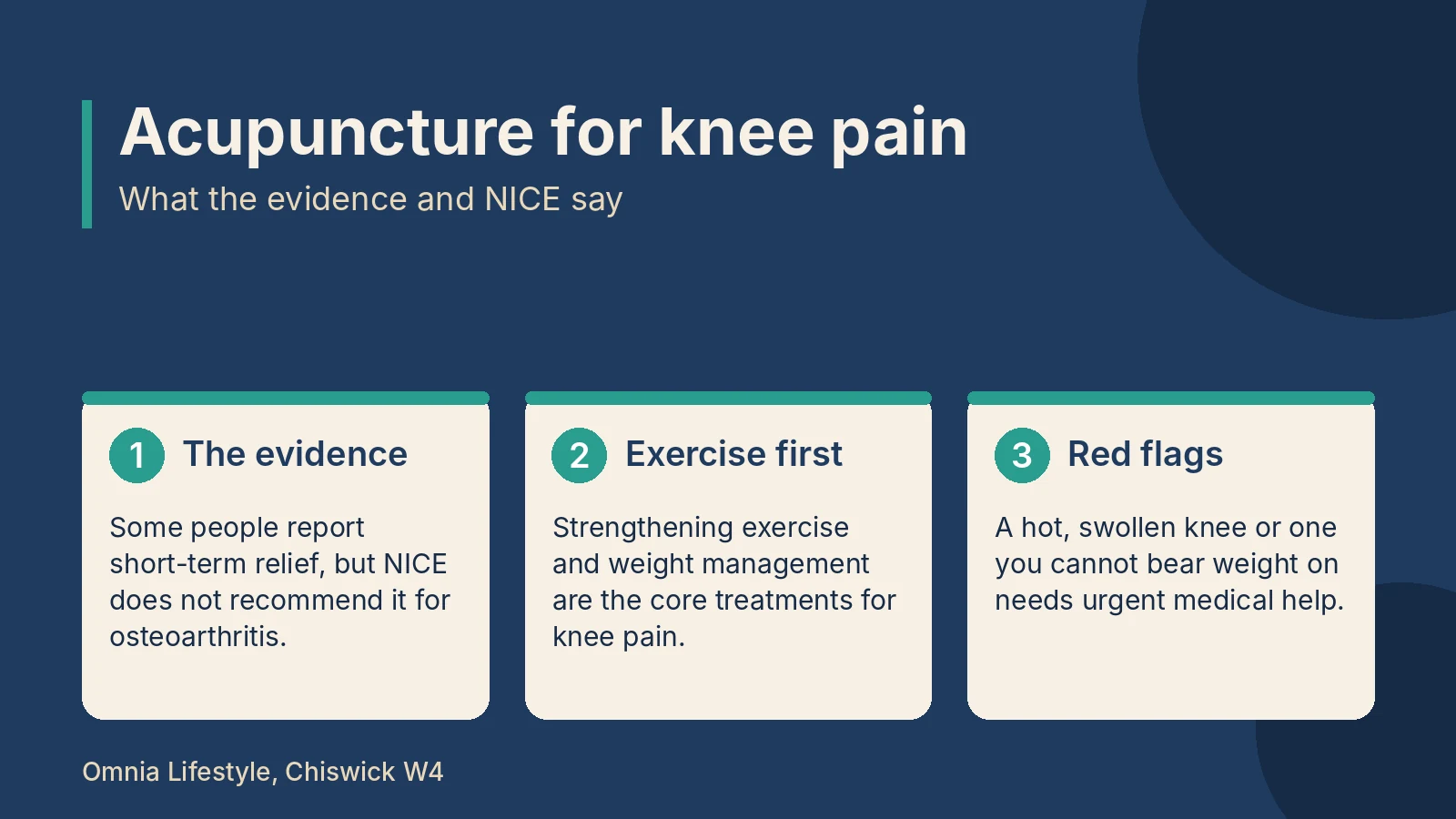
Acupuncture may ease knee pain for some people in the short term, but the evidence is mixed, and NICE does not recommend it for osteoarthritis, a common cause of long-term knee pain in adults. NICE guidance says do not offer acupuncture or dry needling to manage osteoarthritis, and puts strengthening exercise and weight management first. If you still choose acupuncture, use it alongside an exercise plan and review progress by the third session. A 60-minute session at Omnia in Chiswick is £80.
Does acupuncture help knee pain? What the evidence shows
Most research on acupuncture for knee pain has been done in people with knee osteoarthritis. Some trials report less pain and better function compared with no treatment or usual care. When real acupuncture is compared with sham acupuncture, where needles are placed away from traditional points or do not pierce the skin, the difference is usually small. That suggests a good part of the relief people feel comes from the treatment experience as a whole, such as rest, attention and expectation, rather than from the specific points chosen.
For other causes of knee pain, such as tendon pain, a meniscus tear or pain around the kneecap, there is much less good-quality research, so it is not possible to say that acupuncture helps. Reviews and personal stories online vary widely: some people describe real relief, while others notice nothing. The fairest way to approach it is as a short trial with a clear review point, not an open-ended course.
What NICE says about acupuncture for knee osteoarthritis
- Osteoarthritis (NICE NG226). NICE states: "Do not offer acupuncture or dry needling to manage osteoarthritis." This covers knee osteoarthritis at every stage, including knees described as "bone on bone".
- What NICE recommends instead. Therapeutic exercise tailored to you, such as local muscle strengthening and general aerobic fitness, for everyone with osteoarthritis, plus support with weight loss for people living with overweight. NICE explains that any weight loss is likely to help, and that losing 10% of body weight is likely to be better than 5%.
- Chronic primary pain (NICE NG193). NICE says a single course of acupuncture can be considered for chronic primary pain, meaning pain lasting more than three months with no clear underlying condition. Knee pain caused by osteoarthritis is not in this group, but some long-standing knee pain without a clear cause may be.
The NHS takes a similar line: its osteoarthritis treatment pages note that some people try acupuncture, but that there is a lack of evidence for it. We would rather tell you this plainly than promise more than the evidence supports. If you have knee osteoarthritis and still want to try acupuncture as a personal choice, it should sit alongside exercise, never replace it.
Acupuncture for knee pain, swelling and meniscus problems
Knee pain has many causes, and the right treatment depends on which one you have. A knee that swells after a twist, locks or gives way may have a ligament or meniscus injury that needs a proper examination, and acupuncture cannot repair torn tissue. Swelling with heat and redness can be bursitis, gout or infection, which need medical assessment first. Our guides to a swollen knee and pain behind the knee explain the common causes.
Where acupuncture is used for these problems, the aim is pain relief alongside rehabilitation, for example to make strengthening exercises more comfortable while a tendon or meniscus settles. A physiotherapist can confirm what is going on and build the exercise plan. See physiotherapy for knee pain for what that involves.
What happens at an acupuncture session for knee pain
- Assessment. Your practitioner asks how the pain started, what makes it worse, which medicines you take and about your general health, and checks for anything that needs your GP first.
- Needling. Fine, sterile, single-use needles are placed around the knee and at points further down the leg, then left for around 20 to 30 minutes while you rest. Most people feel a dull ache or tingle rather than sharp pain.
- Points. Commonly used acupuncture points for knee pain sit either side of the kneecap, below the knee on the shin and outer leg, and on the inner leg. Some practitioners add electro-acupuncture, which passes a gentle current between needles. There is no good evidence that any particular set of points works better than another.
- Plan. You leave with simple movement advice and a date to review progress.
Worried about needles? Read does acupuncture hurt and acupuncture side effects.
How many sessions will you need?
Most people try one session a week, and at Omnia we review progress at the third visit. Before you start, note two or three things that matter to you, such as how far you can walk, how the stairs feel or how often pain wakes you, then compare them at the review. If nothing meaningful has changed by then, it is better to stop and put your time into exercise and other treatments than to carry on by default.
Acupuncture for knee pain: cost
At Omnia Lifestyle in Chiswick, a 60-minute acupuncture session is £80, with the assessment included. Prices vary between clinics across the UK. Because NICE does not recommend acupuncture for osteoarthritis, you are unlikely to be offered it on the NHS for knee arthritis, so most people who choose it pay privately; see acupuncture on the NHS. Our acupuncturists are registered with the British Acupuncture Council or the Association of Traditional Chinese Medicine.
What else helps knee pain
- Strengthening exercise. This is the core treatment for knee osteoarthritis. NICE advises that joint pain may increase when you start, and that sticking with a plan over the long term brings the most benefit. See exercises for knee pain.
- Weight management. NICE says weight loss improves pain, physical function and quality of life for people with osteoarthritis who are living with overweight.
- Pain relief. For knee osteoarthritis, NICE suggests trying medicines applied to the skin first, such as anti-inflammatory gels, before tablets. Ask a pharmacist or your GP what is safe for you. Steroid injections can help, but NICE notes they only give short-term relief of around 2 to 10 weeks.
- Physiotherapy. A physiotherapist can assess your knee and build a programme that progresses. NICE only supports hands-on manual therapy alongside exercise, not on its own.
- Easing a flare. The NHS suggests an ice pack wrapped in a tea towel for up to 20 minutes every 2 to 3 hours, and putting as little weight as possible on the knee while it settles.
For more detail on each option, read how to treat osteoarthritis.
Who should take extra care
- If you take blood-thinning medicine or bleed easily, as the NHS notes acupuncture may not be safe for you.
- If you have a skin infection, broken skin or a skin condition around the knee.
- If your knee is hot, red and swollen, which should be checked by a doctor before any treatment.
- If you are pregnant, as some points are avoided, so always tell your practitioner.
- If you have a pacemaker, as electro-acupuncture is avoided.
- If you have had a knee replacement, tell your practitioner and follow your surgical team's advice; the area of a recent operation is avoided.
When to seek urgent help
Call NHS 111 or get urgent medical help if:
- Your knee is very painful, or you cannot move it or put any weight on it
- Your knee is badly swollen or has changed shape
- Your knee locks, gives way or clicks painfully
- You have a very high temperature, or feel hot, cold or shivery, with redness or heat around the knee
A hot, swollen joint with fever can be a sign of infection inside the joint, which needs urgent medical assessment. See your GP if knee pain has not improved within a few weeks.
Frequently asked questions
Is acupuncture good for knee arthritis?
NICE does not recommend acupuncture or dry needling for osteoarthritis, including knee arthritis, and the NHS notes a lack of evidence that it works. Some people still report short-term relief. If you choose to try it, treat it as an addition to strengthening exercise and weight management, which have the strongest evidence, and review by the third session.
Does acupuncture help a bone on bone knee?
Acupuncture cannot rebuild cartilage or change what an X-ray shows. With advanced knee osteoarthritis, exercise, weight management, pain relief and, for some people, a referral to discuss surgery are the main options. Some people use acupuncture for comfort, but NICE does not recommend it, so it should never delay a medical review of a severely painful knee.
What are the main acupuncture points for knee pain?
Practitioners often use points either side of the kneecap, points below the knee on the shin and outer leg, and points on the inner leg, sometimes with electro-acupuncture. Point choice depends on where your pain is and your assessment. There is no strong evidence that one set of points gives better knee pain relief than another.
How quickly does acupuncture work for knee pain?
Some people feel easier straight after a session, often because they have rested and relaxed. Any lasting change, if it comes, usually shows over a few weekly sessions. At Omnia we review progress at the third visit, and if your walking, stairs or sleep have not improved, we will suggest stopping or changing approach.
Can acupuncture help after a knee replacement?
Physiotherapy and a structured exercise programme are the main recovery treatments after knee replacement. Some people ask about acupuncture for lingering pain later on, but there is little good evidence for it. Always check with your surgical team first, and tell your practitioner about the operation so the area around the new joint is avoided.
Acupuncture for knee pain in Chiswick
Our clinic is at 8 to 9 Bedford Corner, The Avenue, Chiswick W4 1LZ, close to Turnham Green station, on bus routes 94, E3 and 272. Limited parking is available on request when booking. Because our acupuncturists and physiotherapists work under one roof, we can combine acupuncture with an exercise plan where that suits you.
Read more about knee pain and osteoarthritis, see our guide to the stages of osteoarthritis, or explore acupuncture at Omnia.
Book acupuncture in Chiswick: 60-minute sessions £80. Book online or call 020 4515 0000.
This article is general information, not medical advice. If you have any of the warning signs above, seek medical attention.
Ready to book?
Acupuncture



.jpg)
.jpg)
