






Book at our Chiswick clinic
Acupuncture
Irritable bowel syndrome (IBS) causes stomach cramps, bloating, diarrhoea or constipation, and it often flares with stress. This guide is for adults with diagnosed IBS who have seen acupuncture suggested online and want a straight answer on the evidence, what NICE says and what helps most, before deciding whether acupuncture has any place in their plan.
When to see someone: if you have not yet been diagnosed, start with your GP, as IBS symptoms can overlap with other conditions. If you have a diagnosis and want to try acupuncture at Omnia for stress or symptom support alongside your usual care, a 60-minute session with assessment is £80. Book online or call 020 4515 0000.
Quick answer
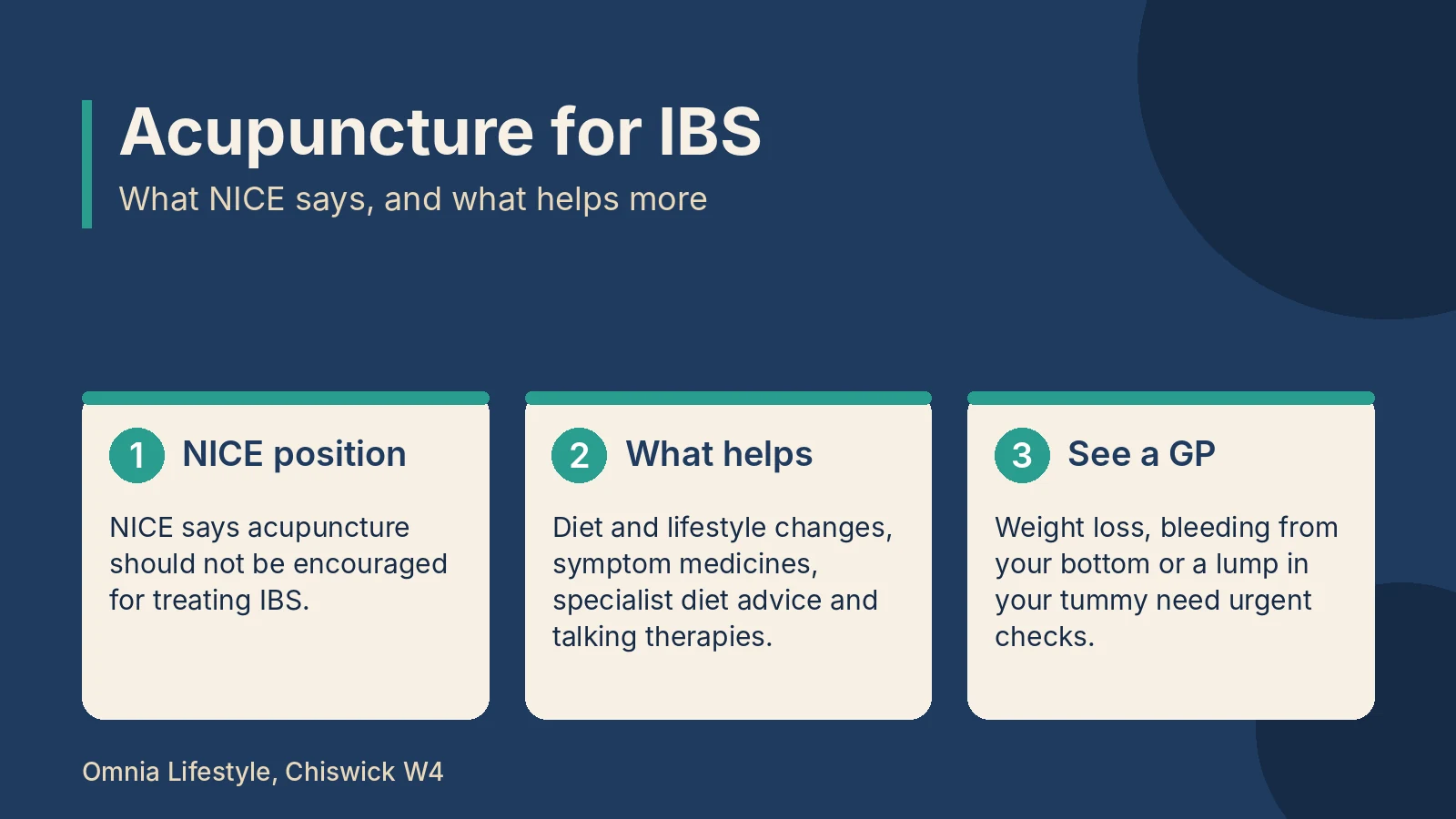
NICE does not support acupuncture for IBS. Its IBS guideline (CG61) states that the use of acupuncture should not be encouraged for the treatment of IBS. The treatments with support are diet and lifestyle changes, medicines for specific symptoms, specialist dietary advice such as a low FODMAP diet, and psychological therapies for IBS that persists. Some people still choose acupuncture as a personal choice for stress and relaxation. If you do, use it alongside proper IBS care, never instead of it.
Does acupuncture help IBS? What the evidence shows
Research on acupuncture for IBS has produced mixed results. Some trials report people feeling better after a course, but when real acupuncture is compared with sham acupuncture, the difference is small or absent. That suggests much of the improvement people notice comes from the treatment experience as a whole, such as time to rest, attention and expectation, rather than from needling specific points. Many studies are also small, short or at risk of bias.
This fits with how IBS works. Symptoms often rise and fall on their own, and they are closely linked with stress, sleep and routine. Anything that helps you relax may help you feel better for a while, which is different from treating IBS itself.
What NICE says about acupuncture for IBS
- Acupuncture (NICE CG61). "The use of acupuncture should not be encouraged for the treatment of IBS." NICE says the same about reflexology.
- Diet and lifestyle. NICE advises regular meals without skipping or long gaps, at least 8 cups of fluid a day, no more than 3 cups of tea or coffee, less alcohol and fizzy drinks, and no more than 3 portions of fresh fruit a day. Fibre should be reviewed, usually reduced, and insoluble fibre such as bran discouraged.
- Further dietary help. If symptoms continue, NICE recommends advice on approaches such as a low FODMAP diet, given only by a healthcare professional with expertise in diet.
- Medicines. Antispasmodics for cramps, laxatives for constipation and loperamide for diarrhoea, adjusted to your symptoms.
- Psychological therapies. Referral for cognitive behavioural therapy (CBT), hypnotherapy or psychological therapy should be considered for IBS that has not responded to medicines after 12 months.
We think it is right to say this plainly. If a clinic tells you acupuncture will fix IBS, that claim goes beyond the evidence.
Acupuncture for IBS and anxiety: where it might fit
IBS and anxiety often feed each other: worry can bring on symptoms, and unpredictable symptoms create more worry. The NHS advises people with IBS to try to find ways to relax. Some people find acupuncture sessions deeply calming, and choose it as one of their ways to unwind, in the same way others choose yoga or massage.
If that is your reason for trying acupuncture, it is a reasonable personal choice, as long as you understand that the evidence does not show it treats IBS, and you keep up the diet, lifestyle and medical care that do. If anxiety is a big part of the picture, talking therapies have stronger evidence. See can acupuncture help anxiety, how to cope with anxiety and how stress affects your body.
IBS with diarrhoea or constipation (IBS-D and IBS-C)
People often search for acupuncture for IBS with diarrhoea or IBS with constipation. Research does not show that acupuncture reliably helps either type. The NHS suggests asking a pharmacist about loperamide for diarrhoea, and about laxatives such as Fybogel for constipation, along with drinking plenty of water. For bloating, cramps and wind, the NHS suggests eating oats regularly, avoiding the sweetener sorbitol and asking a pharmacist about medicines such as peppermint oil. Our article on feeling bloated or puffy covers other common causes of bloating.
What happens if you choose an acupuncture session
- Assessment. Your practitioner asks about your diagnosis, symptoms, diet, sleep, stress and medicines, and checks for any warning signs that need your GP first.
- Needling. Fine, sterile, single-use needles are placed, often on the lower legs, forearms and abdomen, and left for around 20 to 30 minutes while you rest. Most people feel a dull ache or tingle rather than sharp pain.
- Review. At Omnia we review at the third visit. Keep a simple symptom diary so you can judge honestly whether sessions are helping you cope.
How many sessions, and what does it cost?
There is no evidence-based course of acupuncture for IBS, so be cautious of any clinic that asks you to commit to a large package. If you choose to try it, a few weekly sessions with a review at the third visit is a sensible limit. If you are not noticeably calmer or coping better by then, it is better to stop. At Omnia Lifestyle in Chiswick a 60-minute session is £80, with the assessment included. See how much acupuncture costs in the UK.
What helps IBS most
- Keep a food and symptom diary to spot what triggers your IBS, as the NHS recommends.
- Eat regularly and slowly, and cut back on fatty, spicy or processed foods.
- Get plenty of exercise, which the NHS lists among the things that help.
- Try probiotics for a month if you want to, and stop if they make no difference.
- Ask about specialist dietary advice, such as a low FODMAP diet with a dietitian, if symptoms continue.
- Ask your GP about psychological therapies if IBS has not settled with other treatments.
When to see a doctor
Ask for an urgent GP appointment or call NHS 111 if:
- You have lost a lot of weight for no reason
- You are bleeding from your bottom or have bloody diarrhoea
- You find a hard lump or swelling in your tummy
- You are short of breath, notice your heartbeat (palpitations) and your skin is paler than usual
See your GP if you think you might have IBS and have had symptoms for more than 4 weeks. If new warning signs like these appear while you are being treated for IBS, NICE advises they should prompt further checks, so tell your GP.
Frequently asked questions
Can acupuncture help IBS symptoms?
Some people say they feel better after acupuncture, but trials comparing it with sham acupuncture show little or no extra benefit, and NICE advises that acupuncture should not be encouraged for treating IBS. The treatments with support are diet and lifestyle changes, medicines for specific symptoms, specialist dietary advice and, for persistent IBS, psychological therapies.
Can acupuncture cure IBS?
No. There is no evidence that acupuncture cures IBS, and the NHS describes IBS as usually a lifelong condition that lifestyle changes and medicine can help. Be wary of any clinic that promises otherwise. If you try acupuncture, treat it as a way to relax and cope with stress, alongside the care your GP recommends.
Can you have acupuncture for IBS and anxiety?
Yes, you can choose acupuncture for relaxation if you have IBS and anxiety, and many people find sessions calming. It should not replace proven support. Talking therapies such as CBT have stronger evidence for anxiety, and NICE suggests considering CBT, hypnotherapy or psychological therapy for IBS that has not responded to medicines.
Are there acupuncture points for IBS pain?
Practitioners often use points on the lower legs, forearms and abdomen for digestive symptoms. However, there is no good evidence that particular points relieve IBS pain better than sham needling. For cramps, the NHS suggests asking a pharmacist about medicines such as Buscopan or peppermint oil, and NICE supports antispasmodics taken as needed.
Acupuncture for IBS in Chiswick
Our clinic is at 8 to 9 Bedford Corner, The Avenue, Chiswick W4 1LZ, close to Turnham Green station, on bus routes 94, E3 and 272. Limited parking is available on request when booking. We will be straightforward about what acupuncture can and cannot offer for IBS, and we will suggest your GP first if anything in your history needs checking.
Read more about stress and anxiety, see does acupuncture actually work, or explore acupuncture at Omnia.
Book acupuncture in Chiswick: 60-minute sessions £80. Book online or call 020 4515 0000.
This article is general information, not medical advice. If you have any of the warning signs above, seek medical attention.
Ready to book?
Acupuncture


.jpg)
.jpg)
