






Book at our Chiswick clinic
Acupuncture
Tension-type headaches are the most common kind of headache: a dull, pressing ache on both sides of the head, often with tight neck and shoulder muscles. This guide is for adults with frequent or long-running tension headaches who want to know whether acupuncture for headaches is worth trying, what NICE says and what a course involves.
When to see someone: if headaches come several times a week or you are relying on painkillers to get through, it is worth a proper review. Acupuncture at Omnia starts with an assessment of your headache pattern, and a 60-minute session is £80. Book online or call 020 4515 0000.
Quick answer
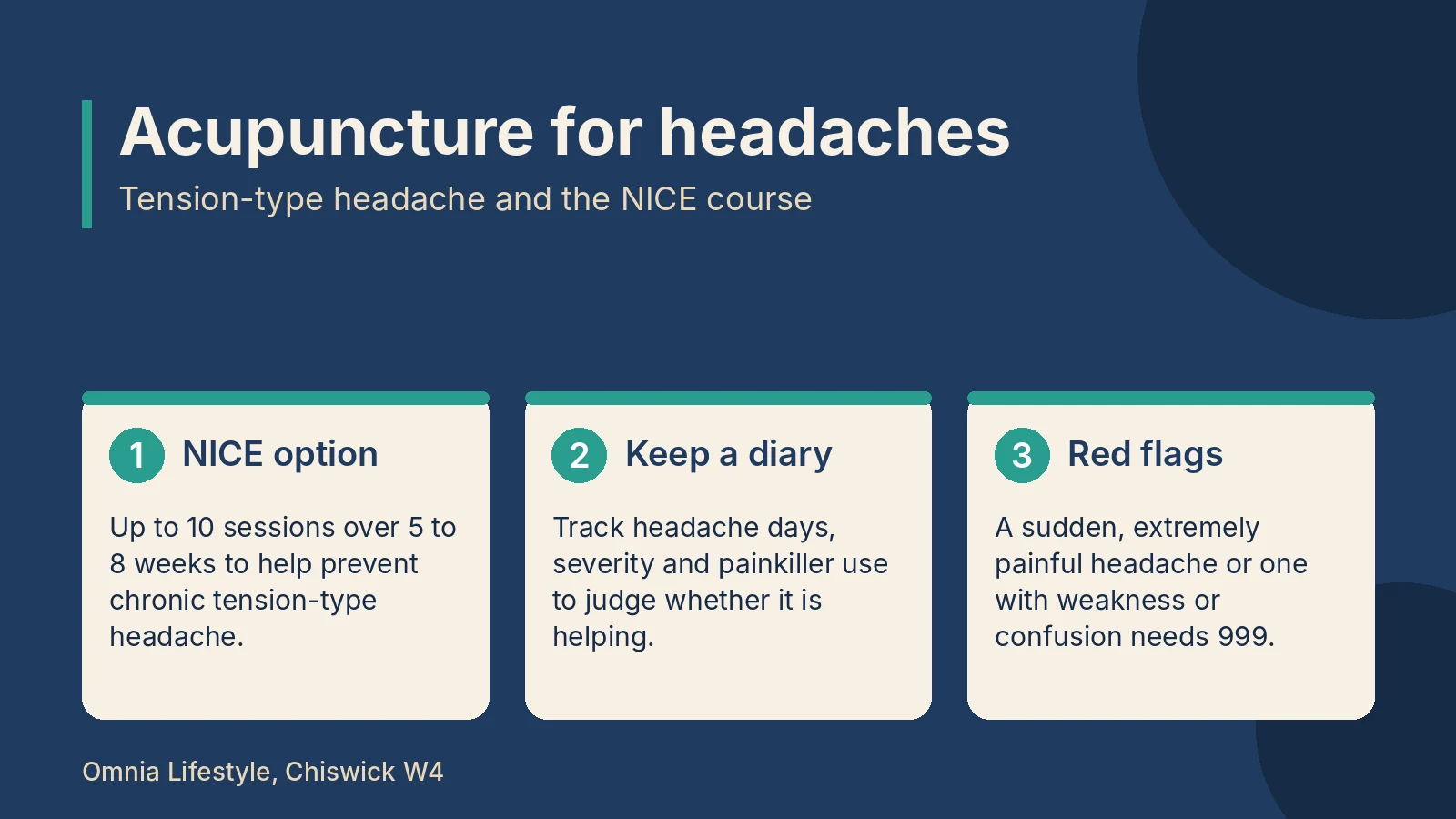
Acupuncture is one of the few complementary treatments NICE includes for headaches. NICE headache guidance (CG150) says to consider a course of up to 10 sessions over 5 to 8 weeks to help prevent chronic tension-type headache, meaning headaches on 15 or more days a month for more than three months. It is a preventive course rather than a quick fix during a headache, and results vary between people. At Omnia in Chiswick a 60-minute session is £80.
Does acupuncture help headaches? What the evidence shows
Research reviews of acupuncture for frequent tension-type headache report fewer headache days for many people compared with usual care alone. When real acupuncture is compared with sham acupuncture, the extra benefit is smaller, which suggests part of the effect comes from the treatment experience as a whole. Even so, the evidence was strong enough for NICE to include acupuncture as a preventive option for chronic tension-type headache.
The evidence is mainly about frequent, long-running tension headaches. For an occasional tension headache, simple painkillers, rest and the self-help steps below are usually enough. For other headache types, such as sinus or cluster headaches, there is not enough good research to recommend acupuncture.
What NICE says about acupuncture for tension headaches
- Chronic tension-type headache (NICE CG150). "Consider a course of up to 10 sessions of acupuncture over 5 to 8 weeks for the prophylactic treatment of chronic tension-type headache." Prophylactic means preventive.
- Definitions. NICE describes chronic tension-type headaches as occurring on 15 or more days a month for more than three months. Episodic tension-type headaches occur on fewer than 15 days a month.
- Treating a headache when it happens. NICE suggests aspirin, paracetamol or an anti-inflammatory painkiller, and says opioids should not be offered for tension-type headache.
- Keeping a diary. If a headache diary is used, NICE suggests recording headaches for at least 8 weeks, including how often they happen, how long they last, how bad they are, what medicines you take and possible triggers.
Acupuncture for headaches and migraines: which is which?
Tension-type headache usually feels like pressure or a tight band on both sides of the head, face or neck, and does not usually stop you carrying on with your day. Migraine is often a throbbing pain on one side, with feeling sick, or sensitivity to light and noise, and it can be disabling. NICE also lists acupuncture for migraine prevention, in different circumstances. If your headaches sound more like migraine, read our separate guide to acupuncture for migraines.
Acupuncture for headaches and neck pain
Many people with tension-type headaches also have tight muscles at the base of the skull, across the neck and over the tops of the shoulders, especially after long hours at a desk or a stressful week. The NHS lists stress and sleep problems among the common causes of tension headaches. Acupuncture sessions often include points in these muscles, and many people find the session itself calming. A pillow that supports your neck, regular movement breaks and posture exercises help too. See acupuncture for neck pain and neck pain exercises.
What happens at a session
- Assessment. Your practitioner asks about your headache pattern, triggers, sleep, stress, painkiller use and general health, and checks for warning signs that need a doctor first.
- Needling. Fine, sterile, single-use needles are placed and left for around 20 to 30 minutes while you rest. Commonly used points sit at the base of the skull, on the temples, across the tops of the shoulders and on the hand between the thumb and index finger.
- Review. Progress is checked against your headache diary at each visit.
Most people feel a dull ache or tingle rather than sharp pain. See does acupuncture hurt and acupuncture side effects.
How many sessions will you need, and what does it cost?
The NICE course for chronic tension-type headache is up to 10 sessions over 5 to 8 weeks. At Omnia we review progress at the third visit using your diary. If headache days, severity or painkiller use are coming down, it makes sense to complete the course and then space sessions out. If nothing has changed by the review, it is reasonable to stop and look at other options with your GP.
At Omnia Lifestyle in Chiswick, a 60-minute acupuncture session is £80, with the assessment included. Many people review progress and space sessions out before reaching the full NICE course of 10. NHS access to acupuncture for headaches varies by area; see acupuncture on the NHS. Our acupuncturists are registered with the British Acupuncture Council or the Association of Traditional Chinese Medicine.
What you can do at home
- Relax and move. The NHS suggests relaxing activities such as exercise, yoga and massage.
- Look at sleep and caffeine. Regular sleep and cutting back on caffeine can reduce tension headaches.
- Ease neck tension. A low, firm pillow and heat or cold packs can help if your neck is part of the problem.
- Watch painkiller use. NICE warns that taking paracetamol, aspirin or anti-inflammatory painkillers on 15 or more days a month, or triptans, opioids or combination painkillers on 10 or more days a month, for three months or more can cause medication overuse headache.
For more, read how to relieve a tension headache, what causes headaches and how long headaches last.
Who should take extra care
- If you take blood-thinning medicine or bleed easily, as the NHS notes acupuncture may not be safe for you.
- If you are pregnant, as some points are avoided; the NHS says paracetamol is the first choice painkiller in pregnancy.
- If you have a skin infection or a skin condition where needles would go.
- If you have a pacemaker, as electro-acupuncture is avoided.
When to seek urgent help
Call 999 or go to A&E if a headache comes with any of these:
- It came on suddenly and is extremely painful
- Numbness or weakness in the body or face, or difficulty speaking, walking, balancing or remembering things
- A seizure, drowsiness, confusion or loss of vision
- A very high temperature, a stiff neck, bright light hurting your eyes, or a rash that does not fade when a glass is rolled over it
- A head injury within the last 3 months
Ask for an urgent GP appointment or call NHS 111 if a headache comes with vision problems, vomiting, jaw pain when eating or a tender scalp, or is triggered by coughing, sneezing, bending or exercise. See your GP if you get headaches several times a week or they are severe.
Frequently asked questions
Does acupuncture help tension headaches?
For frequent, long-running tension headaches, acupuncture can reduce how often headaches happen for many people, and NICE suggests considering a course of up to 10 sessions over 5 to 8 weeks for chronic tension-type headache. Results vary, so keep a headache diary and review progress after a few sessions to see whether it is working for you.
Can acupuncture help stress headaches?
Stress is one of the common causes of tension-type headache, and many people find acupuncture sessions relaxing. The NICE recommendation covers chronic tension-type headache, which includes many stress-related headaches. Pairing acupuncture with better sleep, regular exercise and ways to manage stress tends to help more than any single treatment on its own.
What are the acupuncture points for tension headaches?
Commonly used points include those at the base of the skull, the temples, the tops of the shoulders and the hand between the thumb and index finger. Practitioners choose points based on where your headaches sit and how tense your neck and shoulders are. Some people press the hand point themselves at home, but evidence for self-acupressure is limited.
Can acupuncture stop a headache once it has started?
Acupuncture is mainly used to prevent headaches over a course of sessions. Some people feel easier if they have a session during a milder headache, but it is not a substitute for simple pain relief when you need it. NICE suggests aspirin, paracetamol or an anti-inflammatory painkiller for treating a tension-type headache.
Is acupuncture safe for headaches in pregnancy?
Acupuncture can be used in pregnancy by an experienced practitioner who avoids certain points, so always say you are pregnant. Tell your midwife or GP about new or severe headaches in pregnancy before booking, as some need urgent checks, especially later in pregnancy. Read our page on acupuncture in pregnancy.
Acupuncture for headaches in Chiswick
Our clinic is at 8 to 9 Bedford Corner, The Avenue, Chiswick W4 1LZ, close to Turnham Green station, on bus routes 94, E3 and 272. Limited parking is available on request when booking. If neck and shoulder tension is part of your headaches, our acupuncturists and physiotherapists can work together on your plan.
Read more about headaches and migraines, see our guide to acupuncture for migraines, or explore acupuncture at Omnia.
Book acupuncture in Chiswick: 60-minute sessions £80. Book online or call 020 4515 0000.
This article is general information, not medical advice. If you have any of the warning signs above, seek medical attention.
Ready to book?
Acupuncture




.jpg)
.jpg)
