

Book at our Chiswick clinic
LPG Endermologie
Cellulite is one of the most common skin concerns, and one of the most over-sold. Creams, wraps and gadgets promise to get rid of it, but most do little. The honest picture is that cellulite can be improved, sometimes noticeably, but not permanently removed, and any treatment that works needs maintenance.
This guide explains what cellulite is, what genuinely helps, what does not, and how to judge results realistically.
Quick answer
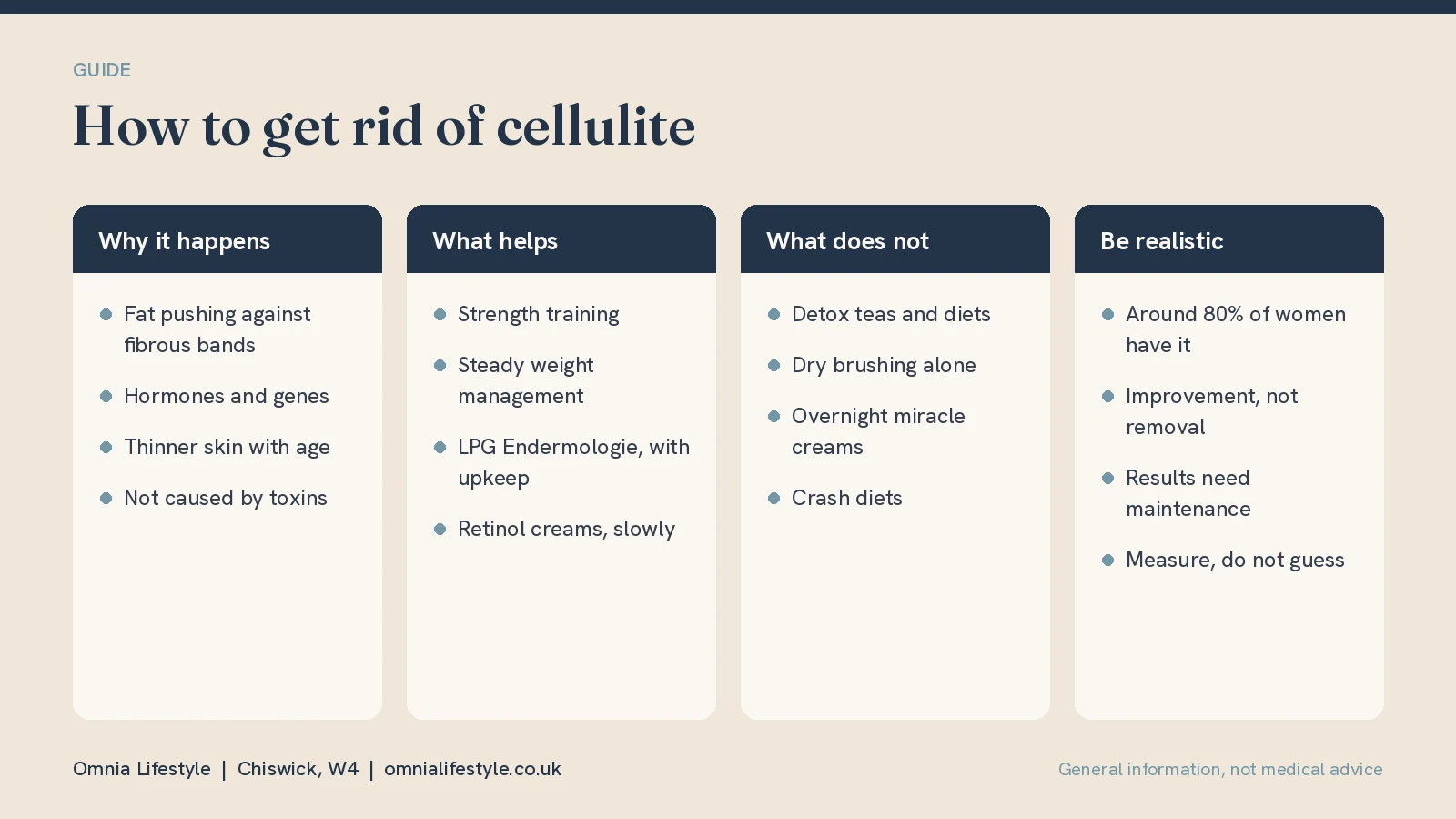
You cannot get rid of cellulite permanently, but you can make it much less noticeable. The approaches with the best support are strength training for the legs and glutes, steady weight management, reducing fluid retention, retinol creams used for several months and a course of LPG Endermologie followed by maintenance sessions. Detox teas, wraps and quick-fix creams do not remove cellulite.
What cellulite is
Under the skin, fat sits in small chambers separated by fibrous bands that connect the skin to the deeper tissue. When the fat chambers push upwards and the bands pull down, the surface takes on a dimpled, uneven look. It is most common on the thighs, hips and buttocks.
Around eight or nine in ten women develop some cellulite after puberty, compared with far fewer men, because of differences in how these fibrous bands are arranged and in hormones. It is normal, it is not a medical problem, and it is not caused by toxins. For a fuller explanation of why it develops, see what causes cellulite.
Grades of cellulite, from mild to severe
Clinicians often grade cellulite by when it can be seen:
- Mild: the skin looks smooth standing and lying down, and dimpling only shows when you pinch it.
- Moderate: dimpling is visible when you stand but disappears when you lie down.
- Severe: dimpling and lumps are visible standing and lying down.
Severe cellulite is still harmless. But if the fat on your legs is painful, bruises easily and stops sharply at the ankles, it may be lipoedema, a medical condition that needs a different approach. Our guide to lipoedema vs lymphoedema explains how lipoedema is recognised.
What makes cellulite more visible
- Genes and hormones, particularly oestrogen
- Thinner, less firm skin as collagen declines with age
- Fluid retention, which makes dimpling more obvious
- Weight gain, although slim people also have cellulite
- Low muscle tone in the thighs and buttocks
What genuinely helps
Strength training
Building the muscles of the thighs and buttocks firms the area beneath the skin, which can make the surface look smoother. Squats, lunges, bridges and step-ups two or three times a week are a good foundation.
Steady weight management
For people carrying excess weight, gradual weight loss often improves the appearance of cellulite. Crash dieting can make skin looser and cellulite more noticeable, so steady change works better.
LPG Endermologie
LPG Endermologie uses a motorised head with rollers and controlled suction to mobilise the skin and the tissue beneath it. Studies report improvements in skin smoothness and firmness over a course of sessions. Results are real but gradual, typically assessed after around ten to fifteen sessions, and they fade without maintenance. Our guide to whether LPG Endermologie works for cellulite sets out the research in detail.
Retinol creams
Creams containing retinol may slightly thicken the skin and improve appearance with consistent use over around six months. Caffeine creams can tighten skin temporarily, but the effect is short-lived.
Reducing fluid retention
Regular movement, less salt and compression or lymphatic drainage where fluid is a factor can make cellulite less noticeable, although the underlying structure stays the same. At Omnia, Body Ballancer compression therapy starts from £45 for 30 minutes and is often combined with LPG where fluid retention makes dimpling worse.
What does not work
- Detox teas, diets and wraps. Cellulite is not caused by toxins.
- Dry brushing on its own. It may feel invigorating, but there is no good evidence it reduces cellulite.
- Overnight miracle creams. Any visible change is usually temporary swelling or hydration.
- Drinking extra water beyond normal hydration.
How to get rid of cellulite on your legs and thighs
The thighs are where most people notice cellulite, often described as "cottage cheese" or "orange peel" skin on the legs. Cottage cheese legs are simply cellulite, so the same approach applies. The most effective combination is strength training for the legs and glutes, steady weight management if relevant, and, if you want a treatment, a course of LPG Endermologie with maintenance sessions. A self-tan can also make dimpling less noticeable in the short term.
For the legs specifically, the most useful exercises are squats, lunges, glute bridges, step-ups and hip thrusts, two or three times a week, plus regular walking to keep fluid moving. Give any approach at least eight to twelve weeks before judging it.
Cellulite on the bum, stomach and arms
Bum and hips: the glutes respond well to strength training, so bridges, hip thrusts and lunges usually make the biggest visible difference here. LPG Endermologie can be used on the buttocks and hips as well as the thighs.
Stomach: cellulite on the stomach often becomes more visible after weight change or pregnancy, when the skin is looser. Steady weight management, core and full-body strength work and skin-firming treatment help more than targeted stomach exercises alone.
Upper arms: less common, but it happens. Resistance work for the arms and shoulders firms the area underneath.
How to judge results honestly
Lighting, posture and time of day change how cellulite looks more than most treatments do. Compare photos taken in the same light, position and time of day, and use measurements where possible. At Omnia we use Styku 3D body scanning to track circumference and shape over a course.
Frequently asked questions
Can you get rid of cellulite completely?
No treatment removes cellulite permanently. The realistic aim is a smoother, firmer appearance that is maintained over time.
Does exercise get rid of cellulite?
Exercise, especially strength training, can improve the appearance by firming the muscle beneath the skin, but it does not remove the fibrous bands that cause dimpling.
Can you get cellulite on your face?
Not in the usual sense. Cellulite forms where fat sits in fibrous chambers under the skin, mainly on the thighs, hips, buttocks and stomach. An uneven or puffy look on the face is more often due to fluid retention, enlarged pores, sun damage or the natural loss of collagen with age. Puffiness can be eased with facial lymphatic drainage; texture and sun damage are best discussed with a skin specialist.
Why do thin people have cellulite?
Cellulite depends on skin structure, hormones and genes, not just body fat, so slim people can have it too.
How many LPG sessions do I need for cellulite?
A typical course is ten to fifteen sessions, often twice a week at first, followed by maintenance every few weeks.
Cellulite treatment in Chiswick
Omnia Lifestyle offers LPG Endermologie on the Cellu M6 Infinity, with Styku 3D scanning to measure progress, at 8 to 9 Bedford Corner, The Avenue, Chiswick W4 1LZ, close to Turnham Green station, on bus routes 94, E3 and 272. Limited parking is available on request when booking. You can start with a £99 Discovery Session, including consultation, tissue assessment and a full 60-minute treatment, with follow-up sessions from £70.
Read more about cellulite, explore LPG Endermologie in London and compression therapy, or book online.
This article is general information, not medical advice.
Ready to book?
LPG Endermologie