


Book at our Chiswick clinic
Tai Chi & Qi Gong
Tai chi walking is a slow, deliberate way of walking that borrows the stepping, posture and breathing of tai chi. Instead of striding out, you place each foot with care, shift your weight fully from one leg to the other and move in time with your breath. It is a surprisingly good way to train balance, leg strength and focus, and you can do it in a hallway.
This guide explains what tai chi walking is, how to do it step by step, how to practise indoors or seated, the benefits, and when to check with your GP first.
Quick answer
Tai chi walking is a slow, mindful walking exercise based on tai chi. You stand tall with soft knees, place one heel forward without putting weight on it, then gradually roll your weight onto that foot before lifting the back foot. Each step takes several seconds and is linked to calm breathing. It builds balance, leg strength and body awareness, and suits beginners and seniors because it is low impact. Practise for five to ten minutes a day, beside a wall or chair for support.
What is tai chi walking?
Tai chi walking takes one of the core skills of tai chi, moving your weight from one leg to the other with control, and turns it into a walking practice. In a tai chi class it is often used as a warm-up, or practised on its own as a balance exercise. Its key features are:
- A slow pace: one step can take three to five seconds, or longer.
- The empty step: you place the foot first and only then transfer weight onto it, so you never fall into the step.
- Upright posture: head lifted, shoulders relaxed, knees soft.
- Even breathing: slow, relaxed breaths, often one breath for each step.
- Attention: your focus stays on your feet, your weight and your breath.
The name is also used online for tai chi indoor walking plans and videos, which usually combine tai chi-style arm movements with marching on the spot. These are closer to a low-impact cardio workout than to traditional tai chi.
Chi walking vs tai chi walking
The names sound alike, and thai chi walking is a common misspelling of both, but they differ. Tai chi walking is a slow practice for balance and control over a short distance. Chi walking is a separate method that applies tai chi ideas about posture and relaxation to ordinary walking at a normal or brisk pace, usually outdoors.
How to do tai chi walking for beginners, step by step
Wear flat, flexible shoes, or practise in socks on a non-slip floor. Choose a clear space a few metres long, ideally beside a wall, worktop or sturdy chair you can touch for support. If you are completely new to tai chi, our tai chi exercises for beginners cover the standing posture and weight shifts that make walking easier.
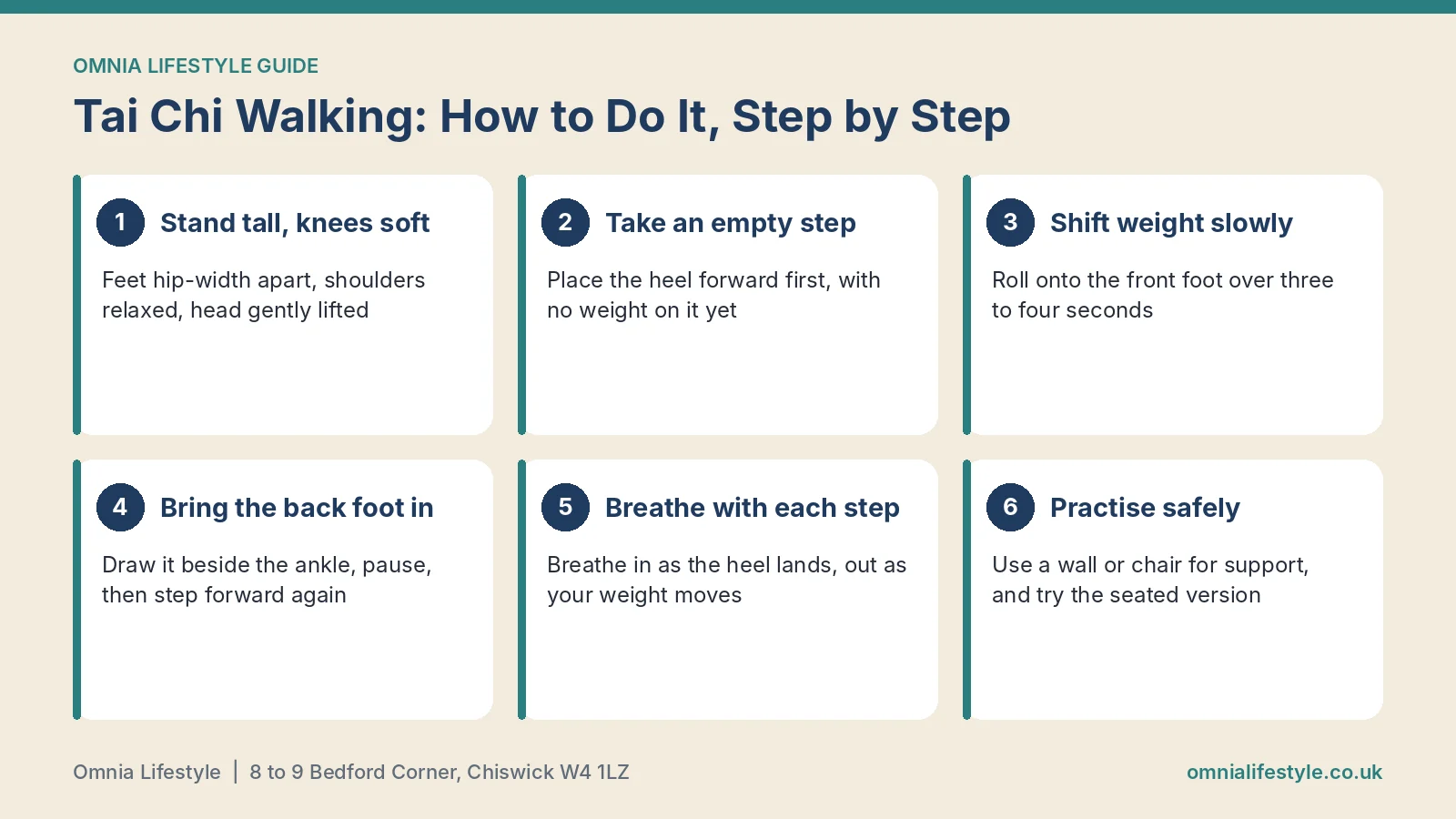
1. Find your standing posture
Stand with your feet hip-width apart, toes forwards. Soften your knees, let your shoulders drop and imagine a thread gently lifting the crown of your head. Take three slow breaths.
2. Sink onto one leg
Shift your weight slowly onto your left leg until your right foot feels light. Keep your hips level and your left knee soft, in line with your toes.
3. Take an empty step
Lift your right foot a little and place the heel down in front of you, about half a normal stride, keeping your feet hip-width apart. Do not put any weight on it yet. If you could not easily lift that foot back up, the step is too long.
4. Roll your weight forward
Slowly lower the sole of your right foot to the floor and shift your weight forward onto it, counting to three or four. Your back leg gradually empties as your front leg fills.
5. Bring the back foot through
When your weight is fully on your right leg, lift your left foot, draw it in gently beside your right ankle, pause for a moment, then place the left heel forward for the next empty step.
6. Add the breath
Once the footwork feels steady, breathe in as you place the heel and breathe out as you shift your weight forward. Keep the breath soft and never hold it.
7. Turn and repeat
At the end of your space, turn slowly with small steps, then walk back. Start with five minutes and build towards ten to fifteen minutes as your balance improves.
Common mistakes: leaning forward, locking your knees, taking long steps, rushing the weight shift and holding your breath.
Tai chi indoor walking: a 10-minute routine
Tai chi indoor walking is ideal when it is cold, wet or dark outside, and you need only a hallway or a cleared stretch of floor. Try this simple routine:
- Two minutes: standing posture and slow breathing
- Two minutes: weight shifts side to side, then forward and back, with your feet still
- Four minutes: tai chi walking forwards and back along your space
- One minute: gentle marching on the spot with relaxed arm swings
- One minute: standing still, hands on your belly, breathing slowly
To add arm movements, let your arms float up as you breathe in and sink as you breathe out. The movements in our qigong exercises for beginners also pair well with walking practice.
Tai chi walking for seniors
Tai chi walking suits older adults well. It is low impact and trains the skills that help prevent falls: standing on one leg, controlling weight shifts and sensing where your feet are. The NHS recommends that older adults do activities to improve strength, balance and flexibility on at least two days a week, and tai chi is one of the examples it gives.
To practise safely:
- Walk alongside a kitchen worktop or wall and keep a hand on it at first
- Keep a sturdy chair nearby so you can rest
- Take shorter steps, and slow down rather than speed up if you feel unsteady
- Clear rugs, cables and clutter from your path
- Wear supportive shoes rather than slippers
- Stop and sit down if you feel dizzy
If standing practice is not possible, a seated version still works the legs and breath. Sit tall towards the front of a sturdy chair, then slowly place one heel forward, roll through the foot and lift the toes, alternating sides in time with your breathing. For more on staying steady, see whether tai chi helps with balance and falls.
Tai chi walking benefits: does tai chi walking work?
There is little research on tai chi walking on its own, but it uses the same principles as tai chi, which has been studied widely and is linked with better balance and fewer falls in older adults. Possible benefits include:
- Better balance: from repeatedly standing on one leg with control
- Stronger legs: slow movements keep the thigh, hip and ankle muscles working
- Improved posture and body awareness
- Calmer breathing and focus, which many people find relaxing
- Gentle movement for stiff joints, with little impact on knees and hips
- Confidence on your feet after illness or a period of inactivity
It works best when it is regular: a few minutes most days does more than an occasional long session. See it as balance and strength practice alongside other activity, such as brisk walking, rather than a replacement for it.
Is tai chi walking good for weight loss?
Not on its own. Traditional tai chi walking is slow, so it uses fewer calories than brisk walking, swimming or cycling. Plans sold as tai chi walking for weight loss are usually faster low-impact cardio sessions. Weight loss depends mainly on your overall diet and activity, but tai chi walking can make movement easier to start and other exercise feel safer. Be wary of any plan that promises rapid results.
When to check with a GP before starting
Tai chi walking is safe for most people, but speak to your GP before you start if you:
- Have had a fall in the last year, or are worried about falling
- Get dizzy or light-headed, or feel faint, especially when standing up or turning
- Have had recent surgery, particularly on a hip, knee, ankle, back or eyes
- Have a heart condition, such as angina, heart failure or an irregular heartbeat, or blood pressure that is not well controlled
- Have been told to limit how much weight you put through one leg
- Have a condition that affects balance or feeling in your feet, such as a previous stroke, Parkinson's disease or diabetic neuropathy
Stop and call 999 if you have:
- Chest pain or tightness that does not ease with rest
- Sudden, severe breathlessness
- A drooping face, weakness or numbness on one side, or slurred speech
Go to A&E after a fall if you:
- Hit your head and feel drowsy, confused or sick
- Have severe pain or cannot put weight on a leg
See your GP if:
- You feel more unsteady than usual or have started falling more often
- Dizziness keeps coming back
- Joint pain gets worse with practice rather than easing
How a teacher or clinician can help
Learning with a teacher means someone can watch your posture, adjust your step length and offer a seated option on days your legs are tired. If balance problems, joint pain or a recent injury make walking difficult, a physiotherapist can assess what is limiting you, such as weak hip muscles, stiff ankles or an inner ear problem, and set exercises to address it alongside your tai chi practice.
Free tai chi walking videos and printable plans can be a good start, but a video cannot see you. Choose one that explains posture and safety clearly, offers a seated version and moves slowly enough for you to control each step, and consider a few classes to get the basics right.
Frequently asked questions
What is tai chi walking for seniors?
It is the same slow, controlled stepping practice, adapted with shorter steps, a wall or chair for support and a seated option. It is a gentle way for older adults to train balance and leg strength.
Does tai chi walking work?
For balance, steadiness and confidence, regular practice can help, because it trains the same skills as tai chi. It is not a quick route to weight loss or fitness on its own.
Is tai chi walking legit?
Traditional tai chi walking is a genuine part of tai chi practice. Some online programmes use the name for general low-impact workouts, so judge each one on its teaching and its claims.
What is tai chi indoor walking?
It is tai chi walking practised in a hallway or living room, often combined with stepping on the spot and gentle arm movements. It needs no equipment and suits any weather.
Are there tai chi walking classes near me?
If you live in West London, our tai chi and qigong classes in Chiswick teach the stepping, posture and breathing used in tai chi walking, with beginners welcome at any time.
Tai chi classes in Chiswick
Tai chi and qigong group classes run at Omnia Lifestyle, 8 to 9 Bedford Corner, The Avenue, Chiswick W4 1LZ, close to Turnham Green station, on bus routes 94, E3 and 272. Limited parking is available on request when booking. Classes are £15 a class, every movement has a seated option and beginners can join at any point, so you can learn the foundations of tai chi walking with a teacher watching.
Read more about balance exercises for seniors and whether tai chi is good for older adults, try our step-by-step tai chi moves, see how much tai chi classes cost in London, or book a class.
This article is general information, not medical advice. If you have any of the warning signs listed above, seek medical attention.
Ready to book?
Tai Chi & Qi Gong


.jpg)
.jpg)