




Tai chi has a public image problem. Most people picture a park at dawn, slow arm circles, something closer to a hobby than a treatment. Pleasant, certainly. Medicine, probably not.
That picture is now hard to defend. In August 2026, the British Journal of Sports Medicine published the largest evidence synthesis yet assembled on traditional Chinese exercise for musculoskeletal disorders: an umbrella review of 92 meta-analyses, drawing on 1,744 randomised controlled trials and 547 separate outcome associations.
This article explains what the review found, where the evidence is genuinely strong, how much practice appears to be needed, and what the research still cannot tell us.
What an umbrella review actually is
An umbrella review sits at the top of the evidence hierarchy. It runs no new trials. Instead it gathers every credible synthesis on a question, re-analyses the underlying data, and grades how much confidence each individual finding deserves.
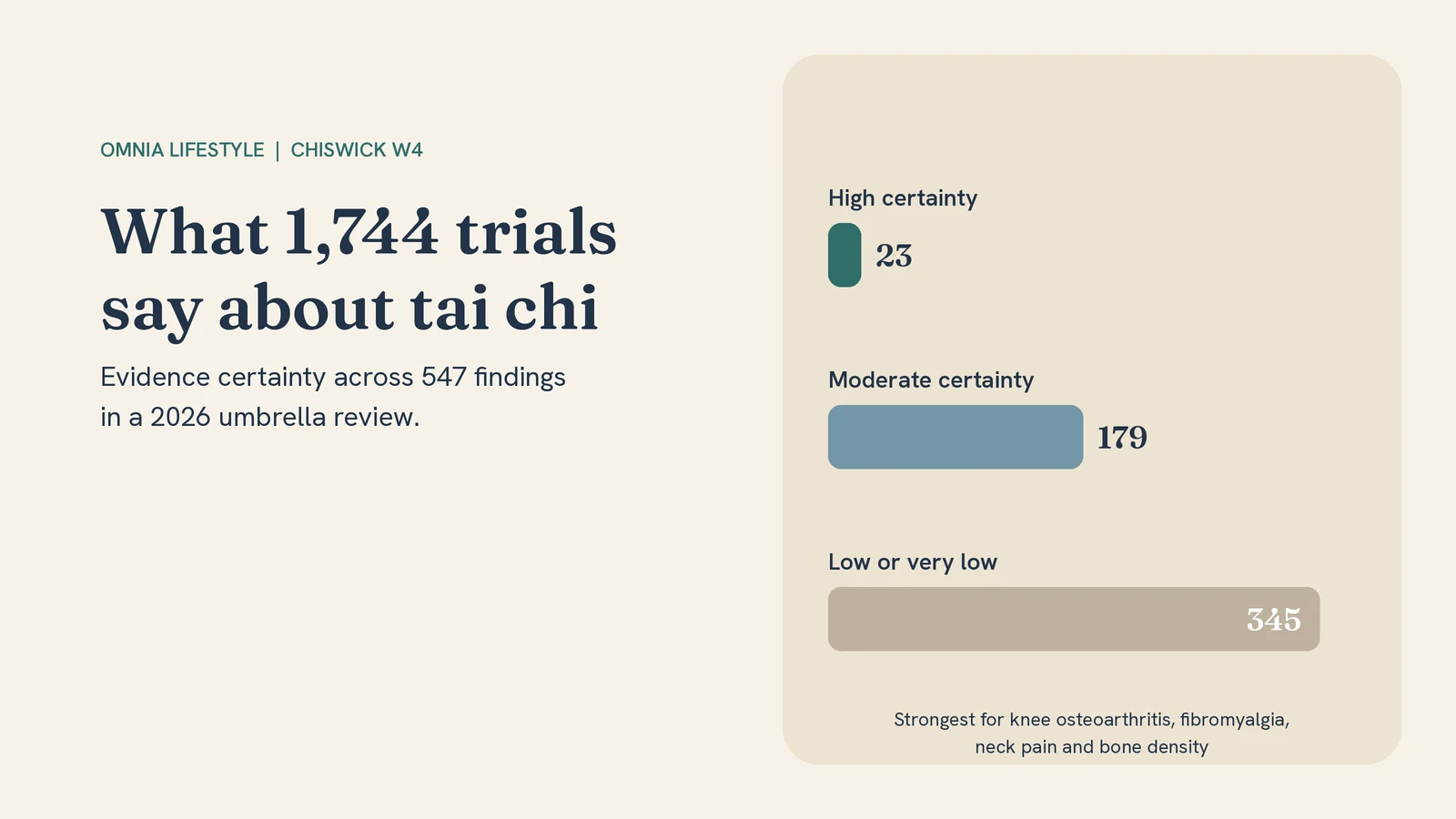
The authors used GRADE, the framework that informs clinical guidelines, to rate all 547 associations. Twenty-three reached high certainty. A further 179 reached moderate certainty. That is a meaningful result, because high-certainty evidence is uncommon anywhere in exercise medicine.
Where the evidence is strongest
Knee osteoarthritis
Traditional Chinese exercise improved physical function on the WOMAC scale with a large effect (standardised mean difference of 0.85), and improved mental health scores on the SF-36 alongside it. Tai chi specifically improved function, pain and stiffness. This is the single best-evidenced application in the review.
Fibromyalgia
Sleep quality improved, with a parallel reduction in pain, both at high certainty. Sleep is one of the hardest outcomes to shift in fibromyalgia and one of the most consequential for daily life, since poor sleep tends to amplify pain the following day.
Neck pain
Mental health outcomes improved with high certainty. Pain relief was sustained at follow-up rather than fading once the programme finished, which matters for a condition that so often recurs.
Osteopenia and osteoporosis
Tai chi increased bone mineral density at weight-bearing sites, including the femoral neck and the lumbar spine in postmenopausal women. The absolute changes were modest, in the region of 0.02 to 0.04 g/cm². That is what bone remodelling looks like over a realistic timeframe, and it is a gain in a population where the usual trajectory is loss.
Chronic musculoskeletal pain generally
Tai chi reduced pain compared with no exercise, at high certainty, with a moderate to large effect across mixed musculoskeletal conditions.
Why it works
The proposed mechanism is not mysterious, and it is not one mechanism.
Slow, weighted, continuously shifting movement trains lower-limb strength, balance and proprioception through neuromuscular adaptation. Load applied through the skeleton stimulates bone. The breath regulation and sustained attention that come with the practice engage the autonomic nervous system, and the review points to evidence that this modulates stress response and inflammatory signalling.
Three effects, one practice. That is why the outcomes cluster across physical, psychological and skeletal domains at the same time, which conventional exercise programmes rarely achieve in a single intervention.
How much, and how often
The most practical finding concerns dose, and it cuts both ways.
Larger gains were associated with sustained programmes: longer than six months, at least three sessions per week, and 150 minutes or more per week. That is the profile of a habit rather than a course of treatment.
Shorter and lighter prescriptions were not wasted, though. Programmes of three months or less, at one to two sessions per week or under 150 minutes weekly, still produced statistically significant effects for knee osteoarthritis. Something useful happens early, which matters for anyone deciding whether it is worth starting.
The sensible reading is that a low entry threshold earns early relief and builds the habit, while the longer arc is where functional recovery, bone density and psychological benefit accumulate. Stopping at twelve weeks tends to give back what was gained.
What the evidence does not show
High-certainty evidence accounted for 4.2 per cent of the associations examined. Low and very low certainty accounted for 63 per cent. The confident claims above are real, and they are a minority of what was studied.
Heterogeneity was substantial across many findings, driven by differences in participants, protocols and outcome measures. Many of the underlying trials were small and followed patients only briefly. The review could not break results down by disease severity, sex or ethnicity, because the original meta-analyses did not report that data. The authors are direct about what is needed next: large multicentre trials with long follow-up, and head-to-head comparisons between tai chi, baduanjin, qigong and the other modalities, which have not yet been reliably ranked against one another.
So the accurate summary is narrow and useful. For knee osteoarthritis, fibromyalgia, neck pain and bone density in osteopenia, traditional Chinese exercise is supported by evidence strong enough to inform clinical guidelines. Beyond those, the picture is promising and unfinished.
Frequently asked questions
Is tai chi suitable if I already have knee pain?
Generally yes, and knee osteoarthritis is where the evidence is strongest. Movements are low impact and can be adapted for range and weight-bearing tolerance. If pain is severe or the diagnosis is unclear, assessment first is sensible.
How is tai chi different from qi gong?
Both are traditional Chinese movement practices combining movement, breath and attention. Tai chi involves longer sequences of continuous, flowing forms, while qi gong tends toward shorter, repeated movements. The review examined both, along with baduanjin, yijinjing and others.
Do I need to be fit or flexible to start?
No. The practices are low impact and scale to the individual, which is part of why they have been studied so extensively in older adults and in people with chronic conditions.
How soon might I notice a difference?
The research suggests measurable benefit within three months even at lower frequencies, with larger gains accumulating over six months and beyond.
Can it replace physiotherapy or medication?
It is best understood as a complement rather than a replacement. The review positions traditional Chinese exercise as an addition to standard management that can support self-management between appointments. Any change to prescribed medication should be discussed with your doctor.
Tai chi and qi gong in Chiswick
Tai chi and qi gong sessions are offered at Omnia Lifestyle in Chiswick, W4, close to Turnham Green station, on bus routes 94, E3 and 272. Sessions are guided and suitable regardless of experience, and can be combined with assessment-led treatment where there is an existing condition or injury.
Read more about tai chi and qi gong, explore acupuncture and physiotherapy, or book an assessment.
Source: Chen W-X, Li Y-Z, Kang L-D, et al. Efficacy and evidence certainty of traditional Chinese exercises for musculoskeletal disorders: an umbrella review of meta-analyses. British Journal of Sports Medicine, published online 17 August 2026. doi:10.1136/bjsports-2026-111792.
This article is general information, not medical advice. If you have persistent pain, seek assessment from a qualified clinician.


.jpg)
.jpg)