





Facial lymphatic drainage is a gentle massage technique that moves excess fluid out of the face and towards the lymph nodes in the neck. Done properly it reduces puffiness around the eyes, cheeks and jawline, often within minutes. Done too firmly, or in the wrong order, it does very little.
This guide explains how to do facial lymphatic drainage step by step, what to realistically expect before and after, how tools such as gua sha compare with your hands, and when professional treatment is worth it.
Quick answer
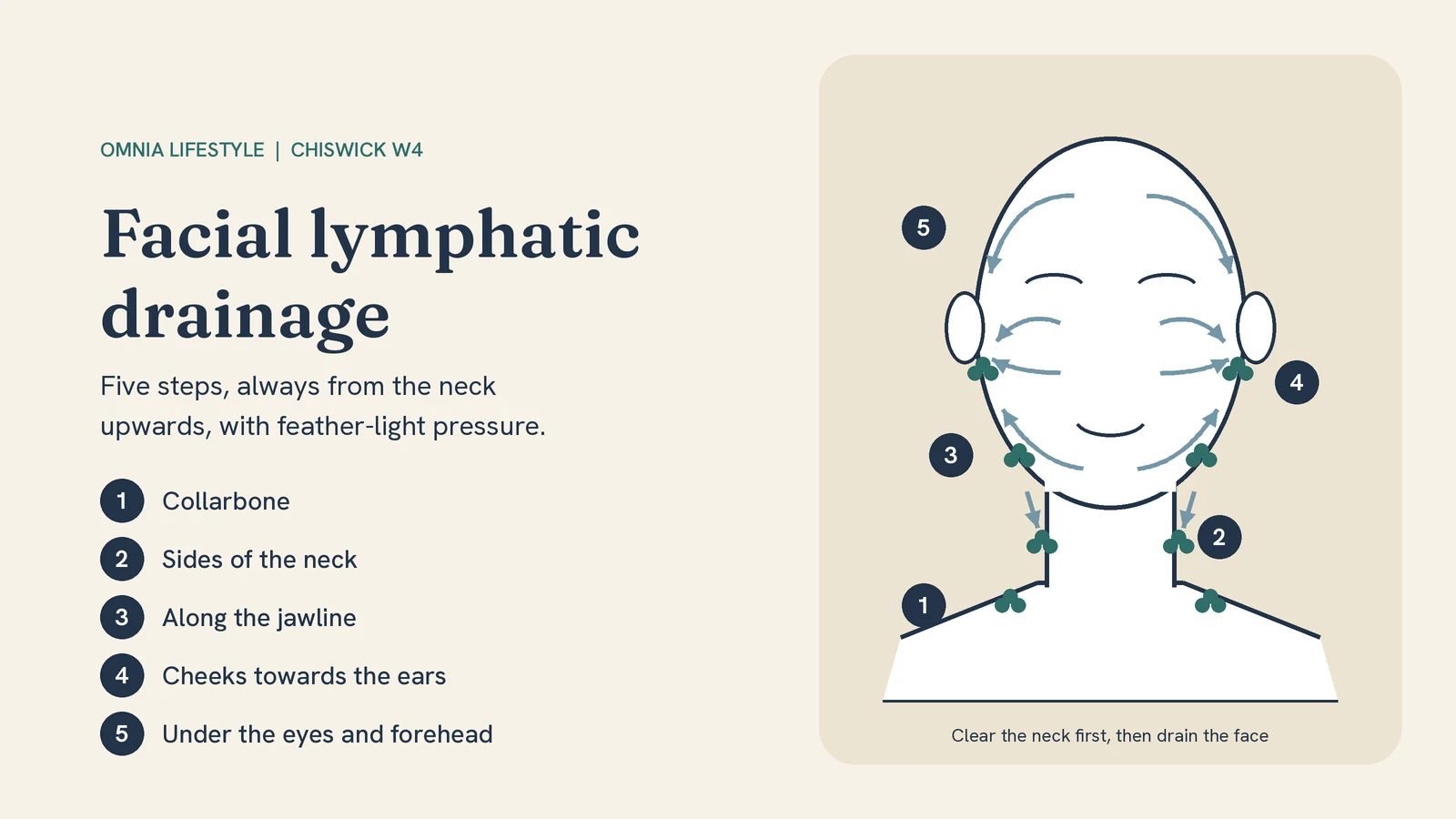
To do lymphatic drainage on your face, start at the collarbone and neck to clear the drainage points, then use feather-light strokes from the centre of the face outwards towards the ears and down the neck. Work in this order: collarbone, sides of the neck, jawline, cheeks, under the eyes and forehead. Five minutes each morning is enough to reduce overnight puffiness for most people.
Where fluid drains from the face
Lymph from the face does not drain randomly. It flows towards small groups of nodes in front of and behind the ears, under the jaw and chin, and down the sides of the neck, before emptying into the large vessels just above the collarbone. That is why every effective routine starts at the bottom and works upwards: if the neck and collarbone are congested, fluid from the face has nowhere to go.
How to do facial lymphatic drainage, step by step
Before you start: wash your hands, apply a few drops of facial oil or a light moisturiser so your fingers glide, and sit upright with your shoulders relaxed. Use the flat pads of your fingers, not the tips, and keep the pressure light enough that it would not leave a mark. The lymph vessels you are working on sit just under the skin.
1. Collarbone
Place your fingertips in the hollows just above each collarbone. Gently stretch the skin downwards and inwards, then release. Repeat ten times. This opens the point where lymph from the whole head drains back into the bloodstream.
2. Sides of the neck
Place your flat hands on each side of the neck, just below the ears. Stroke slowly downwards towards the collarbone. Repeat ten times.
3. Along the jawline
Starting at the centre of the chin, glide your fingers along the jawline towards the angle of the jaw under each ear, then down the side of the neck. Repeat five to ten times.
4. Cheeks towards the ears
From beside the nose, sweep lightly across the cheekbones towards the front of the ears, then down the neck. Repeat five to ten times. This is where most of the visible change in puffiness comes from.
5. Under the eyes and forehead
With your ring finger, the lightest finger, tap or glide very gently from the inner corner of the eye along the under-eye area towards the temple. Then sweep from the centre of the forehead outwards to the temples and down in front of the ears. Repeat five times each. Finish by repeating step 2 to clear the neck again.
Using gua sha, rollers and other tools
A gua sha stone or facial roller works on the same principle as your hands: light pressure, outward and downward strokes, neck first. Tools feel cooling and some people find them easier to use consistently, but there is no evidence that they drain more fluid than fingers. Keep the tool almost flat against the skin and avoid dragging. Electric and vibrating lymphatic devices are covered in our guide to lymphatic drainage machines.
Facial lymphatic drainage before and after: what to expect
- Straight away: less puffiness under the eyes and along the jaw, particularly first thing in the morning. The face often looks more defined for several hours.
- After two to four weeks of daily practice: morning puffiness tends to be less pronounced and settles faster.
- What it will not do: it does not remove fat, lift loose skin or erase wrinkles. A "double chin" that is mostly fluid can look smaller; one that is fat will not change.
Be wary of dramatic before-and-after photos online. Morning versus evening, lighting, head angle and a single salty meal can change the face more than the massage itself. For a fuller picture across the body, see lymphatic drainage before and after.
Why the face gets puffy
Common causes include lying flat overnight, salty food, alcohol, poor sleep, hormonal changes across the menstrual cycle, allergies and sinus congestion. Facial lymphatic drainage helps with all of these. Puffiness that is persistent, worsening, on one side only, or comes with swelling elsewhere in the body can reflect a thyroid, kidney or heart problem, or an allergic reaction, and should be checked by your GP.
When professional facial lymphatic drainage helps
Self-massage suits everyday puffiness. A trained therapist adds value after facial or dental surgery, for persistent swelling, and where you want a longer, deeper treatment as part of a wider plan. At Omnia, manual lymphatic drainage for the face and neck is delivered by therapists trained in post-surgical lymphatic care, with sessions from £65. After surgery, timing is agreed with your surgeon.
Omnia is the only clinic in London offering manual lymphatic drainage, Body Ballancer compression therapy and LPG Endermologie on the Cellu M6 Infinity under one roof, so facial work can sit within a wider lymphatic or skin programme where that helps. Our comparison of MLD, compression and LPG explains the differences.
Who should not do facial lymphatic drainage
- Anyone with an active skin infection, dental abscess or infected sinuses
- Unexplained swollen lymph nodes in the neck, which need medical assessment first
- Active, untreated cancer in the head or neck
- In the days after injectable treatments, unless your practitioner agrees
Frequently asked questions
How often should I do facial lymphatic drainage?
Daily, for about five minutes, ideally in the morning when puffiness is greatest. Consistency matters far more than duration.
How long do the results last?
The reduction in puffiness usually lasts several hours. Regular practice combined with good sleep, lower salt and less alcohol makes the effect more noticeable over time.
Can I do lymphatic drainage on my own face?
Yes. The steps above are designed for self-massage. A professional session is worth considering after surgery or for persistent swelling.
Should it hurt or leave marks?
No. If you see redness or feel discomfort, the pressure is too firm. Lymph vessels respond to gentle skin stretch, not deep pressure.
Does it help sinus congestion?
Some people find it eases the feeling of pressure, but it does not treat sinus infection. See your GP if congestion lasts more than a couple of weeks or comes with fever.
Facial lymphatic drainage in Chiswick
We offer manual lymphatic drainage for the face and body at Omnia Lifestyle, 8-9 Bedford Corner, The Avenue, Chiswick, London W4 1LZ, a short walk from Turnham Green station and on bus routes 94, E3 and 272. Limited parking is available on request when booking.
Learn more about lymphatic drainage massage in London, try our full-body lymphatic drainage exercises, see how much lymphatic drainage costs, or book online.
This article is general information, not medical advice. If facial swelling is sudden, one-sided or comes with breathing difficulty, seek urgent medical care.


.jpg)
.jpg)