



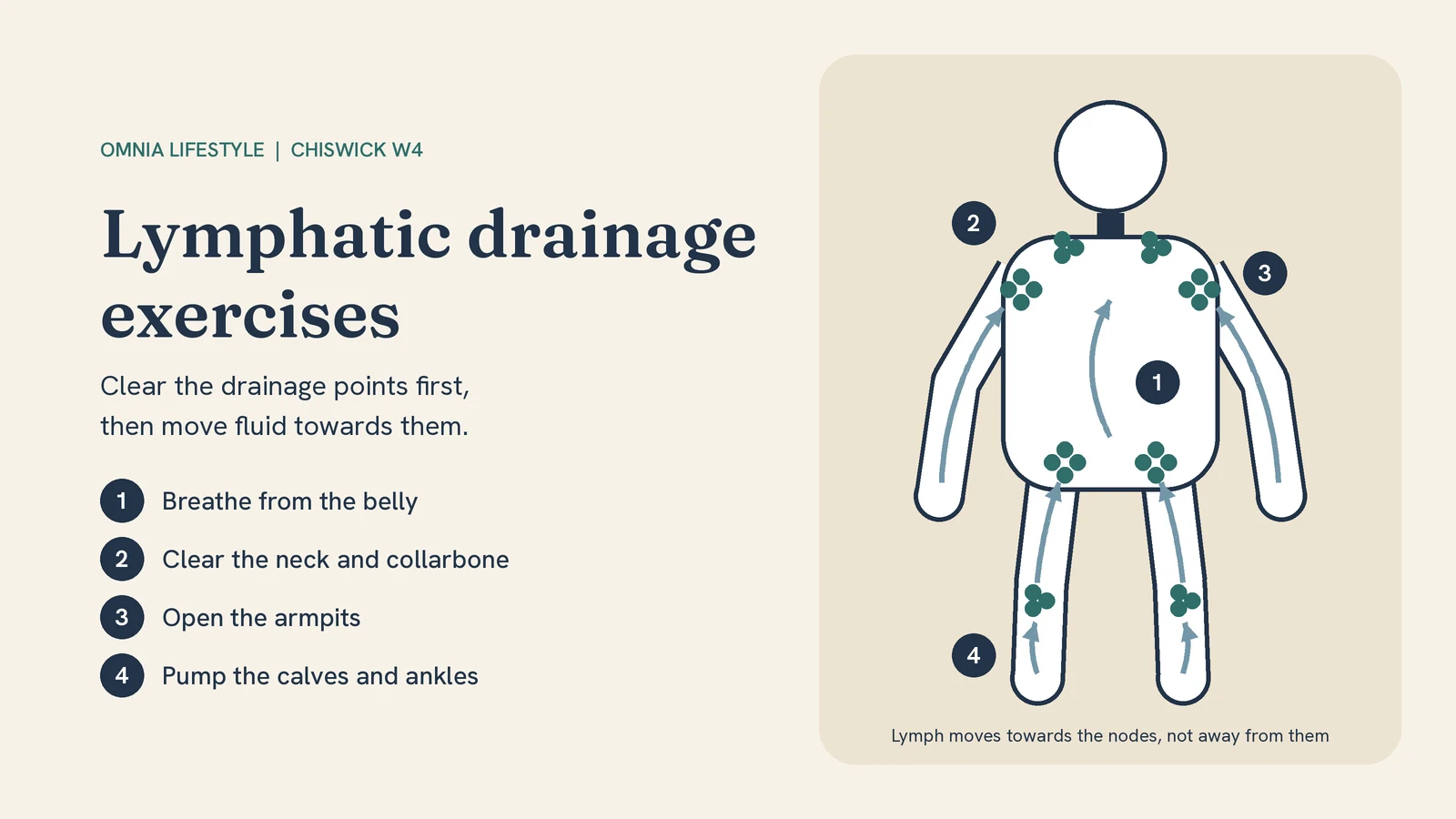


Your lymphatic system moves fluid out of the tissues and back into the bloodstream, but unlike your circulation it has no heart to pump it. It relies on muscle movement, breathing and gentle pressure on the skin. That is why simple, regular exercise is one of the most effective ways to support lymphatic drainage at home, and why swelling so often builds after long periods of sitting, standing or travelling.
This guide sets out eight lymphatic drainage exercises you can do in about ten minutes, the order to do them in, a short routine for the legs, and when home exercise is not enough.
Quick answer
The most useful lymphatic drainage exercises are deep belly breathing, gentle neck and collarbone clearing, shoulder rolls, arm pumps, ankle pumps and walking. Do them in order from the trunk outwards, so the main drainage points are cleared before you encourage fluid towards them. Five to ten minutes once or twice a day is enough for most people with mild fluid retention or heavy legs.
How exercise moves lymph
Lymph travels through thin-walled vessels just under the skin and deeper channels alongside the muscles. It moves forward in three main ways:
- The muscle pump. When a muscle contracts, it squeezes the lymph vessels around it, and one-way valves stop the fluid slipping back. Your calf muscles are the most important pump for the legs.
- Breathing. Deep breathing changes the pressure inside your chest and abdomen, which draws lymph up through the thoracic duct, the main vessel that returns lymph to the bloodstream.
- Gentle skin stretch. Light, slow movement of the skin stimulates the superficial vessels. This is the principle behind manual lymphatic drainage, and it is why firm pressure is not needed.
The rule: clear first, then drain
Lymph drains towards clusters of nodes in the neck, armpits and groin, and from there back towards the collarbone. If you push fluid down a limb before those points are open, it has nowhere to go. So every routine starts at the centre of the body and works outwards: breathing first, then the neck and collarbone, then the armpits and groin, and only then the arms and legs.
8 lymphatic drainage exercises
1. Deep belly breathing
Sit or lie comfortably with one hand on your stomach. Breathe in slowly through your nose so your hand rises, pause briefly, then breathe out slowly through your mouth so your hand falls. Repeat five to ten times. This is the single most important exercise, because it drives lymph through the trunk.
2. Neck and collarbone clearing
Place your fingertips flat in the hollow just above each collarbone. Using very light pressure, just enough to move the skin, stretch the skin gently downwards and inwards, then release. Repeat ten times. Follow with five slow head turns to each side.
3. Shoulder rolls
Sitting or standing tall, roll both shoulders slowly up, back and down. Repeat ten times. The movement works the muscles around the armpit nodes and the upper chest.
4. Open the armpits
Raise one arm and rest the hand on your head. With the flat of the other hand, make slow, light scooping movements into the armpit, as if gently pushing water upwards into it. Repeat ten times on each side.
5. Arm pumps
Raise both arms above your head. Slowly make a tight fist, then open your hands wide. Repeat ten to fifteen times, then lower your arms slowly. Raising the arms uses gravity to help fluid drain from the hands and forearms.
6. Knee raises and pelvic tilts
Lie on your back with your knees bent. Gently flatten your lower back into the floor by tilting your pelvis, then release. Repeat ten times. Then bring one knee towards your chest and lower it, alternating sides, ten times each. This works the deep abdominal lymph channels and the nodes in the groin.
7. Ankle pumps with legs raised
Lie with your legs raised on a cushion or against a wall. Point your toes away from you, then pull them back towards you. Repeat twenty times, then circle each ankle ten times in each direction. This is the most effective exercise for swollen ankles and heavy legs, because it works the calf pump with gravity on your side.
8. Walking or marching on the spot
Finish with five to ten minutes of walking, or marching on the spot while lifting your knees. Add ten slow calf raises at the end. Walking is the most natural lymphatic exercise there is, and short walks every hour matter more than one long walk if you sit for work.
A ten-minute daily routine
- Belly breathing, ten breaths
- Collarbone clearing, ten on each side, then head turns
- Shoulder rolls, ten
- Armpit scoops, ten on each side
- Arm pumps, fifteen
- Pelvic tilts and knee raises, ten each
- Ankle pumps and circles with legs raised
- Five minutes of walking, then ten calf raises
Once in the morning and once in the evening suits most people. On long flights or train journeys, the breathing, ankle pumps and calf raises can all be done seated.
Lymphatic drainage for the legs
Heavy legs and swollen ankles are the most common reason people look for these exercises. After the breathing and collarbone steps, work on the legs in this order:
- Groin. With a flat hand, make slow, light strokes into the crease at the top of the thigh, ten times each side.
- Thigh. Starting just above the knee, stroke lightly upwards towards the groin, ten times.
- Behind the knee. Gently pump the soft hollow behind the knee with flat fingers, ten times.
- Lower leg. Stroke lightly from the ankle up towards the knee, ten times.
- Ankle pumps. Finish with twenty ankle pumps, legs raised.
The pressure should be light enough that it would not leave a mark. For more ideas, see our answer on how to improve lymphatic drainage in your legs.
What about rebounding and dry brushing?
Bouncing on a mini trampoline works the calf pump in the same way as walking and is a reasonable option if you enjoy it and your joints tolerate it, but there is no good evidence that it is better than walking. Dry brushing feels pleasant and stimulates the skin, but claims that it detoxes the body are not supported. Neither is necessary.
How quickly will you notice a difference?
Many people notice lighter legs and less puffiness within a day or two of doing the routine regularly. Fluid retention that builds through the day often improves quickly. Swelling with a medical cause needs the cause addressed, and exercise alone will not resolve it.
Check with a clinician first if you have
- Swelling in one leg only, especially with pain, warmth or redness, which can be a sign of a blood clot and needs same-day medical assessment
- Heart failure, kidney disease or liver disease
- An active infection or cellulitis in the area
- Lymphoedema, particularly after cancer treatment, where exercises should be part of a plan agreed with your lymphoedema service
- Recent surgery, where your surgeon should agree the timing
Sudden swelling with breathlessness or chest pain is a medical emergency. Call 999.
When exercises are not enough
Exercise supports drainage day to day, but it cannot always shift established fluid, post-surgical swelling or the heaviness that comes back every evening. That is where hands-on and machine-assisted treatment helps:
- Manual lymphatic drainage is the hands-on version of the principles above, delivered by a trained therapist who can work around scars and swelling. Sessions at Omnia start from £65.
- Body Ballancer compression therapy moves fluid with a wave of pressure from the feet towards the trunk while you rest. Sessions start from £45.
- LPG Endermologie on the Cellu M6 Infinity combines lymphatic support with skin and texture work, starting with a £99 Discovery Session.
Omnia is the only clinic in London offering manual lymphatic drainage, Body Ballancer compression therapy and LPG Endermologie on the Cellu M6 Infinity under one roof, so your therapist can combine all three in one plan. Our comparison of MLD, compression and LPG explains which suits which goal, and our guide to lymphatic drainage machines covers the devices in more detail.
Frequently asked questions
What is the best exercise for lymphatic drainage?
Deep belly breathing combined with walking. Breathing drives lymph through the trunk and walking works the calf pump, which together move more fluid than any single targeted exercise.
How often should I do lymphatic drainage exercises?
Once or twice a day for five to ten minutes. Consistency matters more than intensity.
Can exercises replace lymphatic drainage massage?
For mild, occasional fluid retention they often can. For lymphoedema, post-surgical swelling or persistent heaviness, exercise works best alongside treatment rather than instead of it. See whether lymphatic drainage works for what the evidence shows.
Should I drink more water?
Staying normally hydrated helps, but drinking large amounts of extra water does not flush the lymphatic system.
Lymphatic drainage in Chiswick
We offer manual lymphatic drainage, Body Ballancer compression therapy and LPG Endermologie at Omnia Lifestyle, 8-9 Bedford Corner, The Avenue, Chiswick, London W4 1LZ, a short walk from Turnham Green station and on bus routes 94, E3 and 272. Limited parking is available on request when booking.
Learn more about lymphatic drainage massage in London, see how much lymphatic drainage costs, or book online.
This article is general information, not medical advice. If you have a medical condition, unexplained swelling or swelling in one limb, speak to your GP before starting.


.jpg)
.jpg)