Book at our Chiswick clinic
Manual Lymphatic Drainage
Swollen feet, ankles and legs are one of the most common discomforts of pregnancy, especially in the last few months and towards the end of the day. For most women the swelling is normal and harmless, but it can be heavy, tight and uncomfortable, and many look for gentle ways to ease it.
This guide explains why swelling happens in pregnancy, whether lymphatic drainage massage is safe, what it can help with, what you can do at home, and the warning signs that mean you should contact your midwife straight away.
Pregnancy swelling and drainage: the essentials
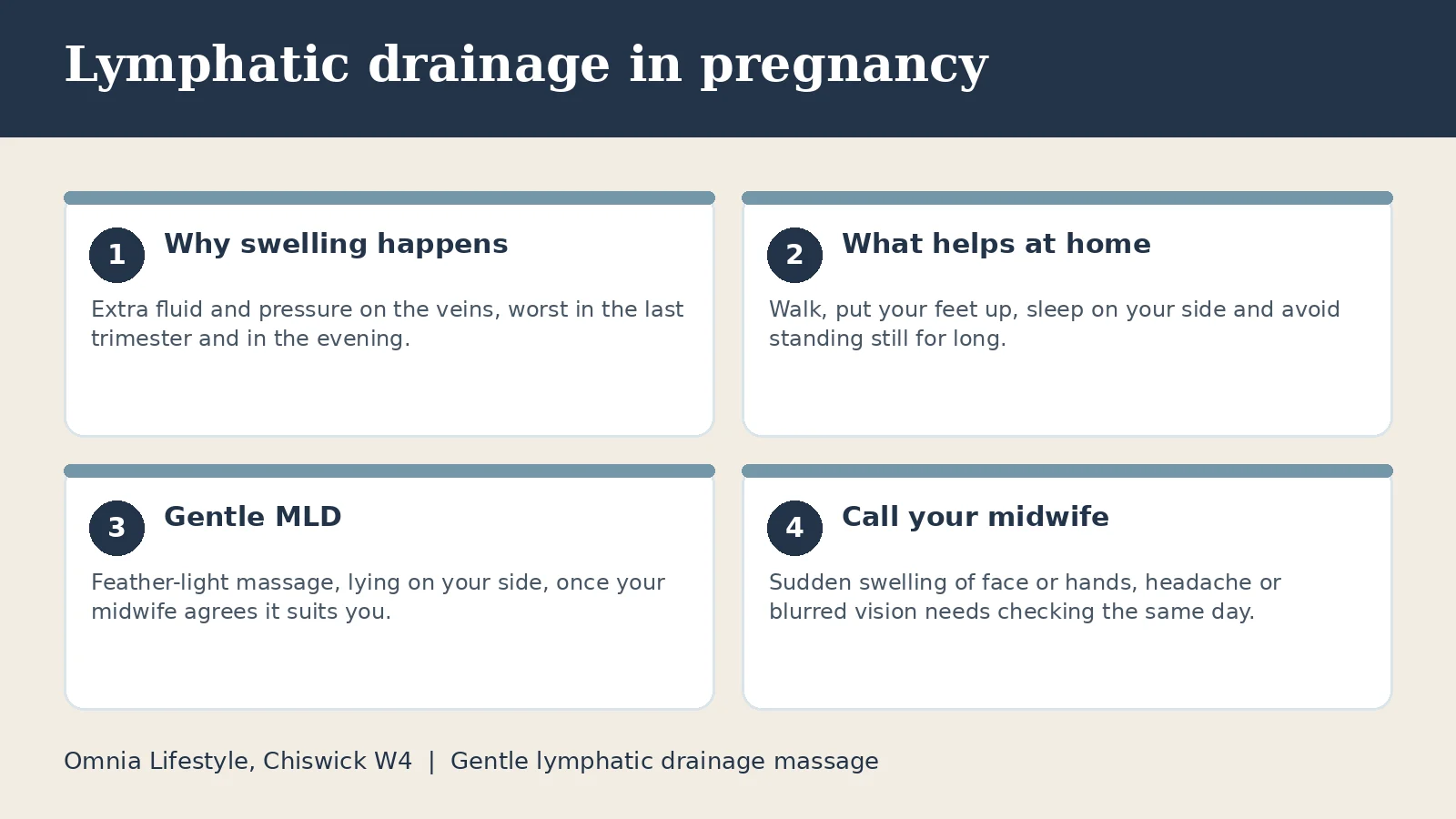
Lymphatic drainage in pregnancy is a very gentle, rhythmic massage that can ease the normal swelling of the feet, ankles and legs. Many therapists consider it suitable for healthy pregnancies, usually from the second trimester, provided your midwife or doctor agrees and sudden or unusual swelling has been checked first. It is done lying on your side, with light pressure only. Sudden swelling of the face or hands, or swelling with headache or blurred vision, needs urgent medical advice, not massage.
Why swelling happens in pregnancy
The NHS explains that during pregnancy your body holds more water than usual, and the growing womb can press on blood vessels in the legs. Fluid collects in the tissues, mainly in the feet and ankles, and gravity makes it worse as the day goes on. The NHS notes that swelling tends to be worse later in pregnancy, at the end of the day, in hot weather and after long periods of standing.
This kind of swelling, called oedema, usually builds slowly, affects both legs fairly evenly and improves overnight or with your feet up.
When swelling is not normal
The NHS advises calling your midwife, GP or labour ward immediately if you notice:
- A sudden increase in swelling in the face, hands or feet
- A very bad headache
- Blurred vision, flashing lights or other problems with your sight
- Severe pain just below the ribs
- Feeling very unwell, or nausea and vomiting
These can be signs of pre-eclampsia, which needs prompt assessment. Seek urgent help too if one leg is swollen, painful, warm or red, as this can be a sign of a blood clot (deep vein thrombosis), and call 999 for chest pain or sudden breathlessness, which the NHS lists as signs of a blood clot in the lung.
Is lymphatic drainage safe in pregnancy?
Manual lymphatic drainage uses very light pressure and does not work deeply into the muscles, which is why many therapists regard it as one of the gentlest massage options in pregnancy. Research specifically on lymphatic drainage in pregnancy is limited, so it should be seen as a comfort measure rather than a medical treatment.
Many therapists prefer to start after the first 12 weeks as a precaution. Before treatment we ask how many weeks you are, how your pregnancy is going and whether your midwife or consultant has any concerns. Lymphatic drainage is not suitable if you have pre-eclampsia, a history of blood clots or a clotting disorder, or a high-risk pregnancy where your care team has advised against it.
What it can help with
- Heavy, tight and puffy feet, ankles and lower legs
- Discomfort at the end of the day or after travelling
- General relaxation, which many women value as much as the reduction in swelling
It will not prevent swelling from returning, because the causes continue until after the birth. Many women find a session every week or two in the later months, together with the home measures below, keeps them more comfortable.
What a session is like
You lie on your side, supported by pillows, rather than flat on your back. Your therapist starts with very light, slow strokes around the neck and other lymph node areas, then works gently from the legs upwards. The pressure is feather-light and should never be uncomfortable. Sessions are usually 60 minutes, and many women feel lighter and need the toilet more often afterwards. If you prefer a more traditional massage, see our guide to pregnancy massage in Chiswick.
What you can do at home
- Keep moving. Short walks and gentle swimming help the calf muscles pump fluid back up the legs.
- Put your feet up whenever you can, ideally above the level of your hips.
- Avoid standing still for long periods, and do ankle pumps and circles while sitting.
- Sleep on your side in the later months. Countess of Chester Hospital's maternity service advises going to sleep on your left side in the third trimester, after 28 weeks, because it is safer for your baby.
- Wear comfortable shoes and avoid tight socks or waistbands.
- Drink plenty of water.
- Ask your midwife about compression stockings and whether they would help you.
The NHS recommends avoiding standing for long periods, wearing comfortable shoes and socks, resting with your feet raised as much as you can, and regular walks or foot exercises, such as moving each foot up and down 30 times and rotating it 8 times in each direction.
Gentle movements from our lymphatic drainage exercises guide, such as ankle pumps and deep breathing, are also suitable for most women in pregnancy. In later pregnancy, the NHS advises avoiding any activity that involves lying flat on your back for more than a few minutes.
After the birth
Swelling can take some time to settle after the birth as the body clears the extra fluid. Lymphatic drainage can be helpful postnatally too, including after a caesarean once your wound has healed and your doctor or midwife agrees.
Frequently asked questions
Can I have lymphatic drainage in the first trimester?
Many therapists prefer to wait until after 12 weeks as a precaution, and swelling is rarely a problem that early. Speak to your midwife if you have concerns.
How often can I have it?
Every one to two weeks suits most women in the later months. More frequent sessions are fine if they help and your midwife agrees.
Is it the same as a pregnancy massage?
No. Pregnancy massage usually works on muscle tension in the back, hips and shoulders. Lymphatic drainage uses much lighter pressure and focuses on moving fluid. Some sessions combine the two.
Does it help with carpal tunnel in pregnancy?
The NHS lists pregnancy as a risk factor for carpal tunnel syndrome, which causes tingling and numbness in the hand, and says it sometimes gets better by itself in a few months, particularly if it is caused by pregnancy. For hand symptoms, see our physiotherapy page, and mention new numbness to your midwife.
How much does it cost?
At Omnia, lymphatic drainage massage starts from £65. See how much lymphatic drainage massage costs.
Each pregnancy session at Omnia begins with a check of how your pregnancy is going, and manual lymphatic drainage starts from £65. You can book online, call 020 4515 0000 or visit us at 8 to 9 Bedford Corner, The Avenue, Chiswick W4 1LZ.
Sources
- NHS: Swollen ankles, feet and fingers in pregnancy
- NHS: Exercise in pregnancy
- NHS: Deep vein thrombosis (DVT)
- NHS: Pulmonary embolism
- Countess of Chester Hospital NHS Foundation Trust: Safe sleep during pregnancy
- NHS: Carpal tunnel syndrome
This article is general information, not medical advice. Always follow the advice of your midwife or doctor, and seek urgent help for any of the warning signs above.
Ready to book?
Manual Lymphatic Drainage