






Book at our Chiswick clinic
Blood Test
A lower interest in sex is common at some point in life, for both men and women. The NHS lists relationship problems, stress, anxiety and depression, pregnancy and having a baby, drinking too much alcohol, some medicines (including those for high blood pressure and antidepressants), hormonal contraception, and lower hormone levels with age, particularly around the menopause, as common causes. Long-term conditions such as diabetes, heart disease and an underactive thyroid can play a part too.
Blood tests cannot measure desire, but they can check for physical causes that are treatable, such as low testosterone, high prolactin, thyroid problems, raised blood sugar or iron overload. This guide explains which blood tests are most useful for low libido in men and women, which test to book first, what blood tests cannot tell you and when to seek urgent help.
Test it in Chiswick: our Hormone Health Check blood test costs £69, with your result explained in person by a practitioner. No GP referral needed. Book this test or call 020 4515 0000. Prefer to test at home? A home finger-prick kit is also available, ask us when you enquire.
Quick answer
For low libido, the most useful blood tests are testosterone with SHBG (sex hormone binding globulin), prolactin and thyroid function (TSH). Oestradiol, LH and FSH help explain an abnormal result and are useful around the menopause. HbA1c checks for diabetes, which is linked to low libido and erection problems, and ferritin can pick up iron overload. In men, testosterone should be measured on a morning sample before 11am, ideally fasting, and a low result repeated before any diagnosis is made.
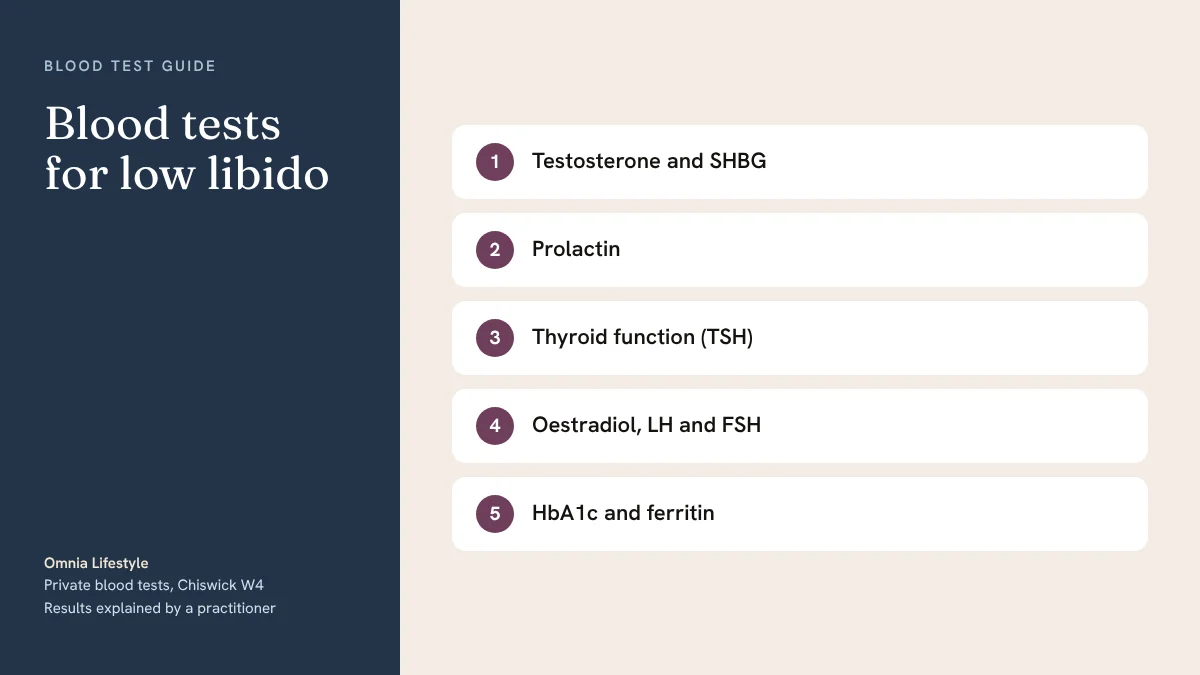
Blood tests that can help
Testosterone and SHBG
In men, low testosterone (hypogonadism) can cause reduced libido, fewer morning erections and erectile dysfunction. Testosterone is highest in the morning, so an NHS laboratory handbook advises measuring it before 11am on a fasting sample, and a level below the range on two occasions is needed to support a diagnosis. SHBG carries testosterone in the blood, and measuring it allows free testosterone to be calculated when the total level is borderline. Our Testosterone Check (£59) includes total testosterone, SHBG, free testosterone and the free androgen index, and the single Testosterone test (£49) is also available. See testosterone levels in men and SHBG levels explained.
In women, testosterone is much lower and a blood test cannot diagnose low desire. The British Menopause Society notes that many women with low testosterone levels do not have distressing low libido. Testosterone is measured mainly to rule out other conditions, and as a baseline before treatment is considered. Read testosterone levels in women.
Prolactin
Prolactin is a hormone made by the pituitary gland. High levels can cause poor libido in both sexes, erection problems in men and irregular or absent periods or breast milk production in women. Prolactin can be raised by some medicines, pregnancy, an underactive thyroid, stress (even the stress of the blood test) and, less often, a small pituitary growth called a prolactinoma. A mildly high result is usually repeated. Book the Prolactin test (£49) or read prolactin levels explained.
Thyroid function
The NHS lists an underactive thyroid among the conditions that can lower sex drive. A TSH test (£39) is a good screen, and our Thyroid panel (£59) adds free T3, free T4 and thyroid antibodies. See our guide to thyroid function test results.
Oestradiol, LH and FSH
In women, falling oestrogen around the perimenopause and menopause can reduce sex drive and cause vaginal dryness, which can make sex uncomfortable. NICE advises that perimenopause and menopause in women aged 45 or over are usually identified from symptoms rather than blood tests, but hormone tests can help in younger women or when the picture is unclear. In men, LH and FSH show whether low testosterone comes from the testes or the pituitary gland, and oestradiol is mainly checked when there is breast tissue swelling or during testosterone treatment. Our Oestradiol test (£49) can be booked on its own; see oestradiol levels explained.
HbA1c
Diabetes is one of the long-term conditions the NHS links with low libido, and it is also linked with erection problems. HbA1c shows your average blood sugar over the past 2 to 3 months. Book the HbA1c test (£59), or the Cholesterol and HbA1c Check (£59), which adds a cholesterol profile and CRP, as high cholesterol is another cause of erection problems. Read HbA1c levels explained.
Ferritin
Ferritin reflects your iron stores. A high level can be a sign of haemochromatosis, an inherited iron overload condition that the NHS says can cause erectile dysfunction, loss of sex drive and missed periods, alongside tiredness and joint pain. A low level points to iron deficiency, a common cause of tiredness that can also dampen interest in sex. The Ferritin test (£49) covers both. See ferritin levels explained.
Which test should I book?
- A focused start: Testosterone Check, £59. Total testosterone, SHBG, free testosterone and free androgen index, a focused first check for men.
- A broader picture: Hormone Health Check, £69. Testosterone, SHBG, free androgen index, prolactin, oestradiol, progesterone, LH and FSH, suitable for women and men.
- The fullest view: Testosterone Check Plus, £79. Everything in the Testosterone Check plus LH, FSH and oestradiol, to show why testosterone might be low.
None of these panels include thyroid function, HbA1c or ferritin, so you may wish to add a TSH test, HbA1c and ferritin. Our men's health and women's health pages list broader panels that include them.
What blood tests cannot tell you
Most low libido has no single hormonal cause. Stress, tiredness, relationship difficulties, low mood, alcohol, recreational drugs and medicines are among the most common reasons, and none show up on a blood test. Normal results are still useful because they help rule out treatable physical causes, and they can guide a conversation with your GP, a psychosexual therapist or a menopause specialist.
A result outside the range also needs interpreting carefully. A single low testosterone should be repeated on a morning sample, prolactin can be raised by stress, and hormone results in women vary through the menstrual cycle. Frequent erection problems in men can be linked to high blood pressure, high cholesterol or diabetes, so a GP may also want to check your blood pressure.
When to see a GP urgently
See a GP if you are worried about your sex drive, if you think a medicine or contraception may be affecting it, or if your sex drive has not returned to normal after pregnancy. Get urgent help if:
- you have chest pain that does not go away, pain that spreads to your arm, neck, jaw or back, or chest pain with sweating, feeling sick, light-headedness or breathlessness: call 999
- you have an erection that lasts more than 3 to 4 hours: call 999 or go to A&E, and do not drive yourself
- you feel you cannot keep yourself safe: call 999 or go to A&E. For urgent mental health support, call NHS 111 and select the mental health option, or call Samaritans on 116 123
Frequently asked questions
What blood test checks for low libido?
There is no single libido test. The most useful starting tests are testosterone with SHBG, prolactin and thyroid function, with HbA1c and ferritin added to look for other physical causes.
What time of day should I test testosterone?
For men, in the morning before 11am and ideally fasting, because testosterone is highest early in the day and can be lowered by food. Book an early appointment at the clinic if you can.
Can low testosterone cause low libido in women?
It can contribute, but many women with low testosterone levels do not have low desire, so a blood test cannot diagnose the cause. NICE advises considering testosterone for low sexual desire linked to the menopause if HRT alone has not helped.
Can thyroid problems affect sex drive?
Yes. The NHS lists an underactive thyroid among the long-term conditions that can lower sex drive. Treating the thyroid often helps energy and mood as well.
Can high prolactin cause erectile dysfunction?
Yes. High prolactin can cause erection problems and poor libido. Medicines, stress and an underactive thyroid can raise it, so a raised level is usually repeated and investigated further.
Low libido blood tests in Chiswick
Omnia Lifestyle is at 8 to 9 Bedford Corner, The Avenue, Chiswick, London W4 1LZ, a short walk from Turnham Green station (District line; Piccadilly line trains stop there early morning and late evening only) and served by buses 94, E3 and 272. Limited parking is available on request when you book. Every clinic test price includes your sample taken at the clinic, analysis at the Randox accredited laboratory, a practitioner review of your result with you, and a GP feedback report on request. You do not need a GP referral, and most results are back within a few working days.
Useful links: book the Hormone Health Check or the Testosterone Check, browse our men's health blood tests and women's health blood tests, or compare every blood test and price. Our guides to testosterone levels in men and testosterone levels in women explain the results in detail.
This article is general information, not medical advice. Discuss your results with your GP or practitioner.
Ready to book?
Blood Test




.jpg)
.jpg)
