






Book at our Chiswick clinic
Blood Test
Oestradiol, also written estradiol or E2, is the main form of oestrogen during the reproductive years. It is made mostly by the ovaries and drives the first half of the menstrual cycle, thickens the womb lining, and supports bone, skin and vaginal health. Men also make small amounts, mainly from testosterone.
Because oestradiol rises and falls through the cycle, a single number only makes sense alongside the day it was taken. This guide explains typical ranges by cycle phase and after the menopause, what low and high results can mean, and when the test is, and is not, useful.
Test it in Chiswick: our Oestradiol blood test costs £49, with your result explained in person by a practitioner. No GP referral needed. Book this test or call 020 4515 0000. Prefer to test at home? A home finger-prick kit is also available, ask us when you enquire.
Quick answer
Oestradiol is measured in pmol/L and depends on where you are in your cycle. One NHS laboratory uses these adult ranges: early (follicular) phase 80 to 420, mid-cycle 120 to 1,900, luteal phase 130 to 900, after the menopause below 110, and men below 120. Other laboratories use noticeably different ranges, so always read the range on your report. NICE advises against using oestradiol to diagnose the menopause in people aged 45 or over.
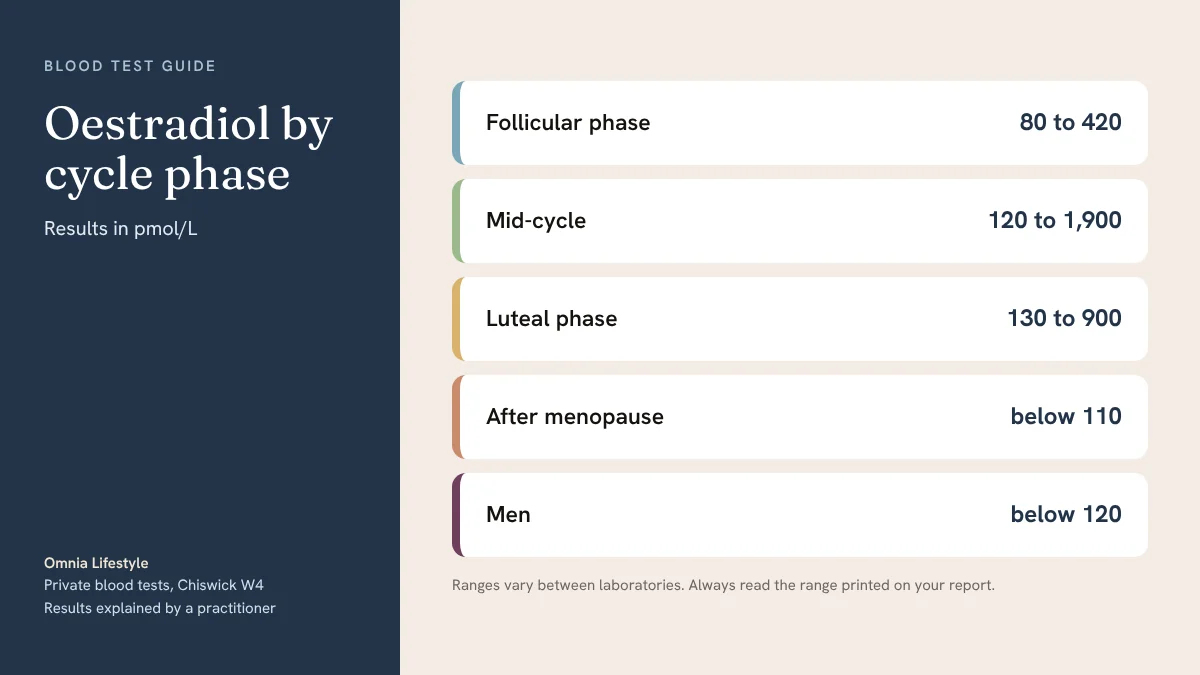
Oestradiol through the menstrual cycle
- Early or follicular phase (from your period to ovulation): levels start low and rise as an egg-containing follicle grows.
- Mid-cycle: oestradiol peaks just before ovulation, which triggers the surge of luteinising hormone (LH) that releases the egg. This is why the mid-cycle range is so wide.
- Luteal phase (after ovulation): levels dip, then rise again alongside progesterone before falling if pregnancy does not happen.
Hormonal contraception suppresses this natural pattern, so results taken on the pill, implant, injection or some coils need to be read differently.
What your oestradiol result means
The ranges below come from one NHS laboratory (North Bristol NHS Trust). Another NHS laboratory, for comparison, quotes 77 to 921 pmol/L for the follicular phase and less than 103 pmol/L after the menopause, which shows how much ranges differ.
- Follicular phase: 80 to 420 pmol/L
- Mid-cycle: 120 to 1,900 pmol/L
- Luteal phase: 130 to 900 pmol/L
- After the menopause: below 110 pmol/L
- Men: below 120 pmol/L (another NHS laboratory uses below 161 pmol/L for adult men)
Low oestradiol
A low result is expected after the menopause. Before the menopause, low oestradiol can occur with very low body weight, intense exercise or significant stress, early menopause (premature ovarian insufficiency), and conditions affecting the pituitary gland. A low reading early in the cycle can also be normal.
High oestradiol
A high result is normal around ovulation and in pregnancy, and during fertility treatment that stimulates the ovaries. Outside these situations, a high result may relate to ovarian cysts, HRT, or less commonly other hormone conditions. In men, raised oestradiol can be linked with excess weight, liver disease or testosterone treatment, and may contribute to breast tissue growth.
Oestradiol and the menopause
During perimenopause, oestradiol can swing from high to low from one week to the next, so a single result often looks normal. For this reason, NICE guideline NG23 says perimenopause and menopause should be identified from symptoms and periods, without blood tests, in otherwise healthy people aged 45 or over. NICE specifically lists oestradiol among the tests not to use for this purpose.
Blood tests have more of a role at younger ages:
- Aged 40 to 45: NICE advises considering an FSH test to help confirm the menopause in people with symptoms, including a change in their periods.
- Under 40: premature ovarian insufficiency is confirmed by raised FSH on two blood samples taken 4 to 6 weeks apart. Oestradiol is often measured alongside to show how low it is.
If you take HRT, oestradiol is not usually needed to guide treatment, which is based on how you feel. A menopause specialist may sometimes check a level if symptoms continue despite treatment. NICE also advises against using FSH to identify the menopause in people using combined hormonal contraception or high-dose progestogen.
Our Hormone Health Check (£69) measures oestradiol with FSH, LH, progesterone, prolactin, testosterone and SHBG, which gives a fuller picture than oestradiol alone. See our menopause blood tests.
Oestradiol in men
Men make oestradiol from testosterone, and a small amount is needed for bone health and sex drive. It is usually checked alongside testosterone when there is breast tissue growth, low libido, or during testosterone therapy. Our Testosterone Check Plus (£79) includes oestradiol with testosterone, SHBG, LH and FSH.
When to see your GP
Book a GP appointment if you have:
- Missed three periods in a row and are not pregnant
- Periods that have stopped or become irregular before the age of 40
- Any vaginal bleeding after the menopause, even a small amount or only once
- Not conceived after a year of trying, or sooner if you are 36 or over
- A new breast lump, in women or men
Get urgent help: if you might be pregnant and have a sharp, sudden and intense pain in your tummy, feel very dizzy or faint, feel sick or look very pale, call 999 or go to A&E, as these can be signs of an ectopic pregnancy.
Who should consider an oestradiol test
- Women under 45 with irregular or missed periods
- Women under 40 with menopause symptoms
- Anyone having fertility investigations
- Men with breast tissue growth or on testosterone therapy
Preparing for your test
- Know your cycle day: note the first day of your last period and tell us when you book. Baseline hormone profiles are usually taken in the first few days of the cycle, often between day 1 and day 5.
- Fasting: not needed for oestradiol.
- Medicines: tell us about hormonal contraception, HRT, fertility drugs and any breast cancer treatment, as some can affect results.
- Biotin: if you take high-dose biotin, NHS laboratories advise leaving at least 8 hours between your last dose and the sample.
How often to retest
Because oestradiol varies so much, a surprising result is best repeated at a known point in your cycle rather than acted on alone. If premature ovarian insufficiency is suspected, hormone tests are repeated 4 to 6 weeks apart. Otherwise, retest when symptoms change or as advised by your practitioner or GP.
Frequently asked questions
What is a normal oestradiol level?
It depends on your cycle day and the laboratory. As an example, one NHS laboratory uses 80 to 420 pmol/L in the follicular phase, 120 to 1,900 pmol/L at mid-cycle and 130 to 900 pmol/L in the luteal phase.
Is an oestradiol level of 100 pmol/L low?
Not necessarily. In the early days of the cycle it can sit within the follicular range of some laboratories, while after the menopause it is typical. It depends on your cycle day, age and the laboratory range.
Can an oestradiol test tell me if I am in the menopause?
Not reliably. Levels fluctuate during perimenopause, and NICE advises against using oestradiol to identify the menopause in people aged 45 or over. Symptoms and changes to your periods are more useful.
Do men need an oestradiol test?
Only in certain situations, such as breast tissue growth, low libido with abnormal testosterone, or monitoring during testosterone therapy.
Is oestradiol the same as oestrogen?
Oestradiol is one type of oestrogen and the most active during the reproductive years. When people talk about an oestrogen blood test, they usually mean oestradiol.
Oestradiol testing in Chiswick
You can have your blood taken at Omnia Lifestyle, 8 to 9 Bedford Corner, The Avenue, Chiswick, London W4 1LZ. We are a short walk from Turnham Green station on the District line (Piccadilly line trains stop there early in the morning and late in the evening only), and buses 94, E3 and 272 stop nearby. Limited parking is available on request when you book. Your sample is analysed at the Randox accredited laboratory, you do not need a GP referral, and a practitioner explains your result with you in person. Most results are ready within a few working days, and a GP feedback report is available on request.
Book our Oestradiol test, explore our women’s health blood tests, or compare every blood test and price. You may also find our guides to progesterone levels and FSH levels useful.
This article is general information, not medical advice. Discuss your results with your GP or practitioner.
Ready to book?
Blood Test




.jpg)
.jpg)
